
Forged Shafts Manufacturer in India: Step, Hollow and Flanged Shafts
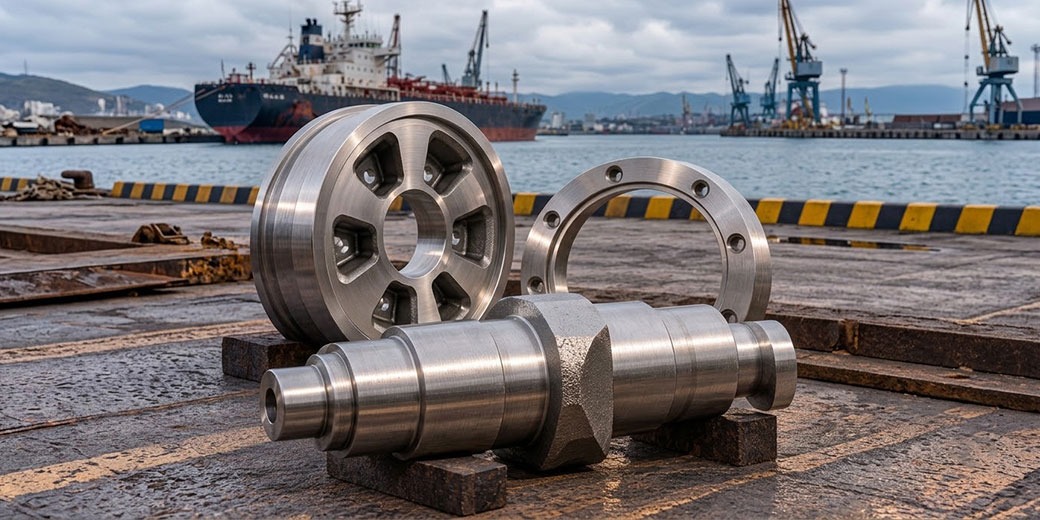
Forged shafts are rotating or load-carrying shafts made by forging rather than machining from bar, so the grain flow follows the shaft profile and fatigue resistance is higher. Indian manufacturers produce step shafts, flanged shafts, hollow shafts and long shafts for gearboxes, pumps, turbines, cranes, marine propulsion, rail and defence. The best route depends on length, diameter, steps and volume — open die forging, radial forging and closed die forging each suit different shaft types.
At a Glance: Forged Shaft Types and Processes
Shaft Type | Typical Process | Applications |
| Plain and step shafts | Open die or radial forging | Gearboxes, pumps, motors |
| Long shafts (high L/D) | Radial forging | Marine, rolls, oil & gas tools |
| Hollow shafts and tubes | Radial forging on mandrel | Aerospace, defence, oil & gas |
| Flanged shafts | Open die or upset forging | Turbines, couplings, hydro |
| Large rotor shafts | Open die forging | Power generation, heavy industry |
Why Forge a Shaft Instead of Machining from Bar
Radial forging vs Machining from bar
A shaft machined from bar cuts through the bar’s grain flow at every step and shoulder — exactly where stress concentrates. A forged shaft has grain flow following its profile, which improves fatigue strength at shoulders and fillets. Forging also uses less material for step shafts with large diameter differences, because the forging starts closer to the final shape.
Radial Forging for Long and Hollow Shafts
Radial forging uses multiple hammers striking the workpiece simultaneously as it rotates and feeds through, producing long shafts with excellent straightness, concentricity and tight diameters. With a mandrel, it produces hollow shafts and tubes with controlled wall thickness, saving material and machining.
Open Die Forging for Large Shafts
For large-diameter and heavy shafts, open die forging on a press provides the deformation needed to close internal porosity and refine the core. A sufficient reduction ratio is critical for internal soundness and UT acceptance.
Materials for Forged Shafts
- EN19, EN24, 4140, 4340, 34CrNiMo6 for high-strength shafts
- Carbon steels for general-purpose shafts
- Stainless and duplex for pump and marine shafts
- Inconel and titanium for aerospace and high-temperature shafts
Quality Controls for Shafts
- UT of the full body to detect internal defects
- MT of fillets, keyways and shoulders
- Straightness and runout checks
- Hardness and mechanical testing from prolongations
- Dimensional inspection after finish machining
Why Buyers Choose Vinir Engineering for Forged Shafts
- Radial forging for long, step and hollow shafts with tight tolerances
- Open die forgings up to 15,000 kg for large shafts and rotors
- In-house heat treatment, straightening, CNC turning and grinding
- UT, MT and mechanical testing in an NABL-accredited lab
- AS9100D across all four units, with ABS approval for marine shafts