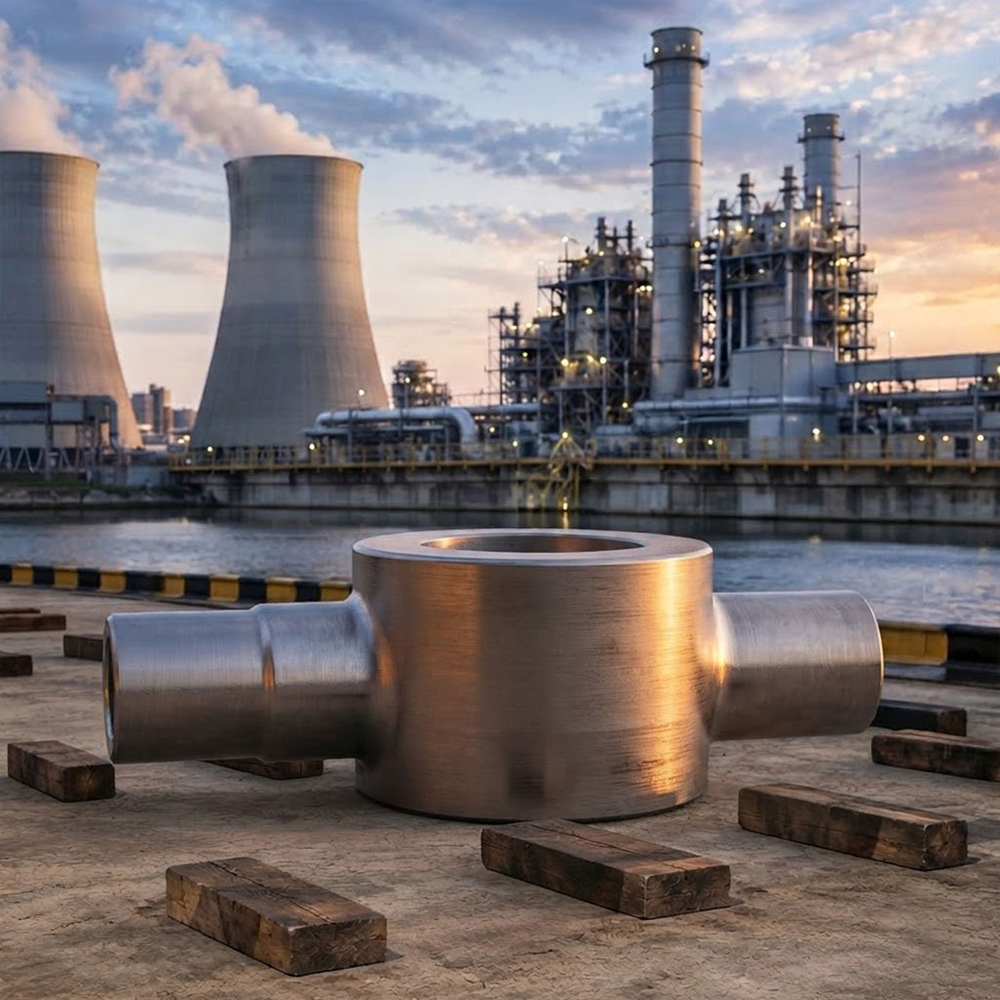
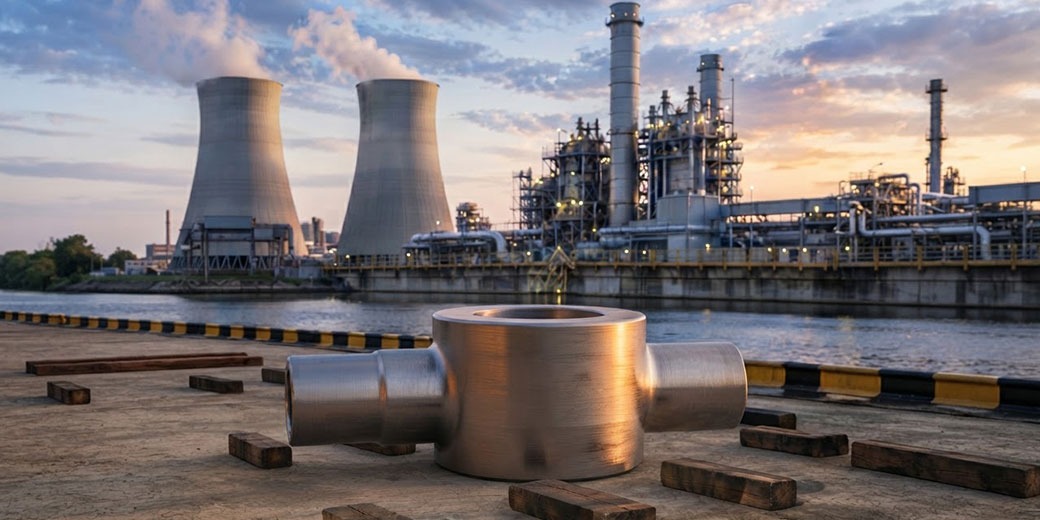
Power generation gas turbines and steam turbines — produced by Siemens Energy (Munich), GE Vernova (Schenectady), Mitsubishi Power (Yokohama), and Baker Hughes (Houston) are among the largest consumers of CrMoV alloy steel shaft forgings, Inconel 718 compressor disc forgings globally. Each heavy-duty gas turbine (50–600 MW class) contains multiple compressor disc and shaft forgings requiring EN 10269, ASTM A470, or equivalent specifications at the highest quality levels. Indian forging manufacturers with AMS 2750-calibrated heat treatment, immersion UT capability, and NABL mechanical testing are positioned to supply power generation turbine OEM supply chains.
OEM
Key Turbine Platform
Key Forging
Specification
Siemens Energy (Munich)
SGT-800 (50 MW), SGT5-8000H (530 MW)
CrMoV compressor disc, shaft, ring
EN 10269 Grade 30CrMoV9, AMS 2750
GE Vernova (Schenectady)
LM2500 (marine), 7HA.02 (367 MW)
Inconel 718 compressor disc, CrMoV shaft
AMS 5663, AMS 2750
Mitsubishi Power (Yokohama)
M701F4 (333 MW), M501JAC (470 MW)
CrMoV rotor disc, Inconel 718 compressor disc
JIS G4107 (CrMoV), AMS 5663 (718)
Baker Hughes (Houston)
MS7001EA, LM6000 aero-derivative
Inconel 718 disc, compressor structural ring
AMS 5663, AMS 2750 Class 2
Ansaldo Energia (Genoa)
GT36 (570 MW), AE94.3A (350 MW)
CrMoV rotor disc and shaft, Inconel 718 HP disc
EN 10269 Grade 30CrMoV9
The global power generation turbine forging market is segmented between two material categories: CrMoV (chromium-molybdenum-vanadium) alloy steel for the lower-temperature compressor and structural shaft sections (operating below 550°C), and nickel superalloys (primarily Inconel 718 in the 400–650°C range) for the higher-temperature compressor and turbine disc sections. The material selection cutoff where CrMoV gives way to Inconel 718 as temperature increases is approximately 550°C for the disc materials.
Siemens Energy’s industrial gas turbine programme the SGT series from the 18 MW SGT-400 to the 530 MW SGT5-8000H uses EN 10269 Grade 30CrMoV9 (9% Cr, 1% Mo, 0.2% V) for compressor shaft and disc forgings the same standard specified by Doosan Škoda Power and MHI Thermal Power for their steam turbine products. This common specification across multiple turbine OEMs means that a forging manufacturer who develops the 30CrMoV9 capability can access multiple OEM supply chains with the same forging process.
GE Vernova’s heavy-duty gas turbines the 7HA.02 (367 MW) and 9HA.02 (571 MW) use Inconel 718 for the high-pressure compressor disc forgings. GE’s supply chain for HA series compressor discs includes both GE Aviation-heritage aeroengine disc manufacturers and industrial forging suppliers qualified through GE’s GESR (General Electric Supplier Requirements) process.
The combined cycle power plant boom driven by natural gas plants providing flexible backup power for intermittent renewables is sustaining high turbine OEM production volumes globally. GE Vernova, Siemens Energy, and Mitsubishi Power all operate backlogs of 3–5+ years for their largest turbine models. This sustained production backlog drives turbine OEM procurement teams to actively develop alternative forging sources reducing dependence on any single supplier and improving supply chain resilience.
CrMoV alloy steel (30CrMoV9 equivalent to EN 10269 and ASTM A470 Class 8) compressor disc and shaft forgings — normalise + temper heat treatment with AMS 2750-calibrated furnaces.
Dual certification EN 10269 and ASTM A470 documentation available for export turbine OEM supply.
Inconel 718 double ageing at 718°C ± 8°C and 621°C ± 8°C for gas turbine compressor disc forgings.
NABL Charpy at -20°C and at elevated temperature (450°C, 550°C) for CrMoV creep characterisation.
Open die CrMoV shaft forgings to 15,000 kg on 3,000T press.
1.What is the EN 10269 Grade 30CrMoV9 specification and how does it relate to ASTM A470 for power generation rotor forgings?+–
EN 10269 Grade 30CrMoV9 (European) and ASTM A470 Class 8 (American) are the two parallel standards for CrMoV alloy steel rotor forgings used in steam and gas turbine power generation. Both specify minimum tensile strength of 750–900 MPa, minimum yield strength of 580–750 MPa, minimum elongation of 14%, and elevated temperature Charpy impact requirements. The chemical compositions are similar: both are 9% chromium, 0.7–1% molybdenum, 0.15–0.3% vanadium alloy steels. For Indian manufacturers supplying both European (Siemens Energy) and US-heritage (GE Vernova) turbine OEM programmes, dual certification documentation reduces procurement complexity.
2.What is the GE GESR (General Electric Supplier Requirements) process for power generation forging qualification?+–
GE’s GESR is GE’s supplier quality management standard it applies to all suppliers of critical components to GE Vernova’s power generation turbine programmes. GESR qualification for power generation forging supply involves: pre-qualification assessment (capability questionnaire, quality system certification, laboratory accreditation review); manufacturing process review (detailed review of forging sequence, heat treatment procedures, NDT procedures); qualification lot production (typically 1–3 disc or shaft forgings with GE or GE-approved third-party inspection witness); and qualification test report review by GE’s Materials and Metallurgy group. GESR is the power generation equivalent of the aerospace NADCAP qualification.
3.What elevated temperature mechanical testing is required for CrMoV power generation disc forgings?+–
CrMoV (30CrMoV9, A470 Class 8) disc forgings for gas and steam turbine service require mechanical testing at elevated temperature to characterise creep and elevated-temperature strength. Typical requirements: tensile at 450°C and 550°C (reporting 0.2% proof stress and tensile strength at temperature); Charpy impact at ambient temperature; creep and stress-rupture testing (1% creep strain stress at 450°C/550°C for 100 hours). These elevated temperature tests are typically performed on witness test pieces produced from the same heat and heat treatment batch as the production forgings the witness pieces travel through the same heat treatment cycle as the production forgings, ensuring the reported properties represent the actual condition of the forgings.
4.What is a combined cycle power plant and why is it increasing global turbine forging demand?+–
A combined cycle power plant (CCPP) uses a gas turbine (Brayton cycle) and a steam turbine (Rankine cycle) in combination the gas turbine exhaust (at approximately 600°C) is directed to a heat recovery steam generator that produces steam to drive a steam turbine. This combination achieves thermal efficiencies of 60–65% versus 35–40% for simple-cycle gas turbines alone. Combined cycle plants are being built globally as the preferred electricity source for countries reducing coal while maintaining dispatchable power alongside intermittent renewables. Each CCPP contains one or two gas turbines plus one steam turbine creating demand for both gas turbine disc forgings (Inconel 718, CrMoV) and steam turbine rotor forgings (CrMoV, P91).
5.What is the Siemens Energy SGT5-8000H gas turbine and what compressor disc forging specifications does it apply?+–
The Siemens Energy SGT5-8000H is the world’s most powerful single-shaft gas turbine at 530 MW in simple cycle. The H-class turbine’s compressor section contains 13 compressor stages each stage using an annular disc forging in CrMoV alloy steel (30CrMoV9 per EN 10269) for the lower-temperature stages and Inconel 718 (AMS 5663-equivalent) for the higher-temperature compressor stages above approximately 450°C. The CrMoV compressor disc forgings range from 100 kg (small early-stage discs) to 3,000+ kg (large rear-stage discs). The Inconel 718 compressor disc forgings are in the 50–500 kg range within the closed die capability of Indian forging manufacturers with Inconel 718 process qualification.