
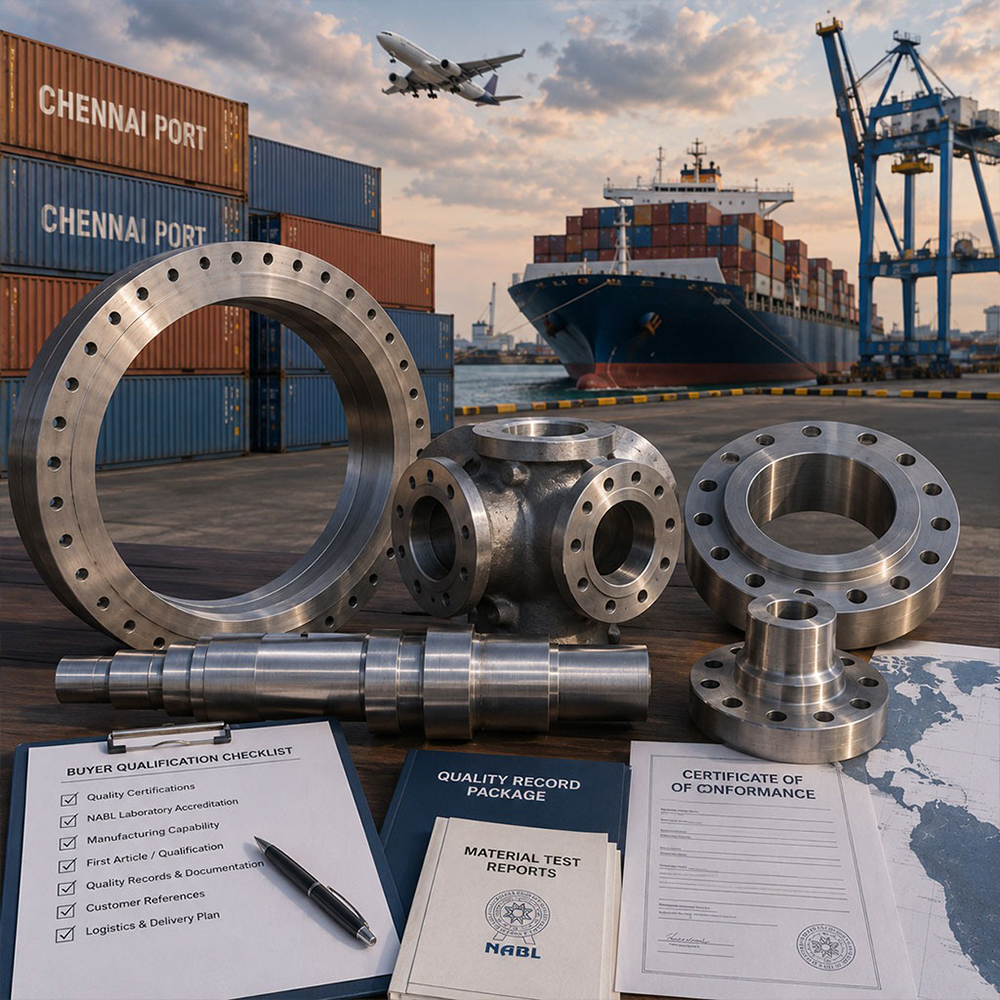
How to Source Critical Forgings from India: A Buyer’s Complete Guide
Sourcing critical forgings from India for aerospace, oil and gas, defence, nuclear, marine, and power generation applications requires navigating a qualification process, documentation requirements, and logistics considerations that differ from domestic procurement in Europe or North America.
This buyer’s guide covers the complete process: how to evaluate Indian forging manufacturers, what quality credentials to verify, how to structure the RFQ, what documentation to expect with delivery, and how to manage the logistics and import process. It is intended for procurement engineers and supply chain managers who are evaluating Indian forging sources for the first time.
| Qualification Step | What to Verify | How to Verify | Typical Timeline |
| Quality system certification | AS9100D, API 20B, ISO 9001 – scope and expiry | OASIS database (AS9100D); API.org (API 20B); TÜV/BV certificate portal | 1 day |
| Laboratory accreditation | NABL scope covering relevant test methods | NABL.in online directory – search by lab name | 1 day |
| Manufacturing capability | Press capacity, ring rolling OD, materials processed | Request capability statement – verify against requirement | 1–2 weeks |
| First article / qualification lot | Material, dimensions, NDT – first production conformance | AS9102 FAIR for aerospace; API 20B PSL 3 qualification forging | 8–16 weeks |
| Quality record package | MTR, NABL reports, heat treatment, NDT, CoC | Sample quality package from a previous similar order | 1 week |
| Reference check | Customer references for equivalent critical forgings | Direct contact with reference customers | 2–4 weeks |
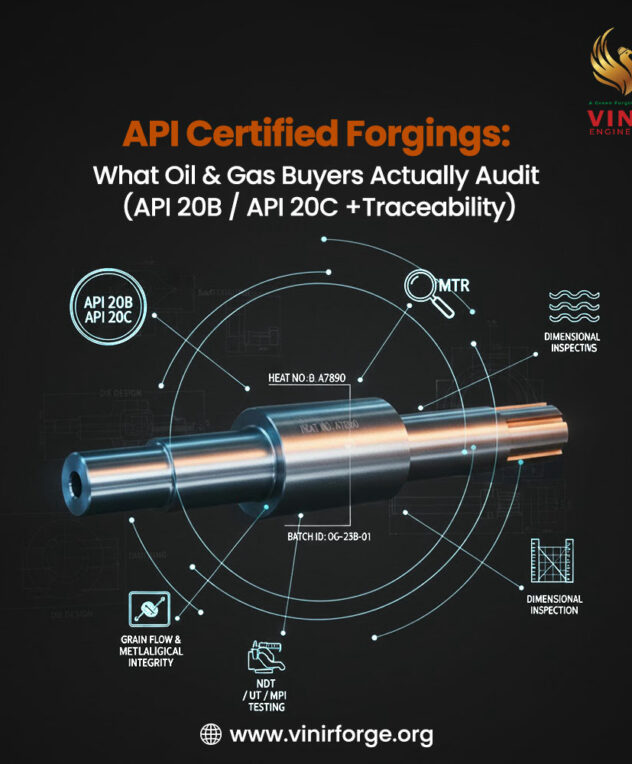
The first step in evaluating an Indian forging manufacturer for critical industry supply is credential verification not site visits, not RFQ responses, but verifiable third-party credentials. For aerospace supply, OASIS (oasis.sae.org) is the definitive AS9100D certification database a supplier claiming AS9100D but not verifiable in OASIS is not a legitimate aerospace supplier. For oil and gas supply, api.org/certification provides the API monogram licence directory a supplier claiming API 20B certification but absent from this directory should be treated with caution. For marine supply, ABS’s approved manufacturer directory, Lloyd’s Register’s approved manufacturers list, and Bureau Veritas’s approved firms list are the reference databases.
The NABL (National Accreditation Board for Testing and Calibration Laboratories) accreditation is India’s equivalent of ISO/IEC 17025 laboratory accreditation recognised by ILAC (International Laboratory Accreditation Cooperation) and therefore internationally accepted by aerospace, oil and gas, and nuclear customers globally. Indian forging manufacturers may claim to have an “in-house laboratory” buyers must verify that the laboratory is NABL-accredited (not merely ISO 9001 certified or “calibrated”) by checking the NABL.in online directory. A NABL accreditation certificate shows the specific test methods accredited verifying that the method relevant to the buyer’s specification (e.g., Charpy impact at -46°C per ASTM E23) is within the accredited scope.
The RFQ for critical forgings should include: the material specification (ASTM/ASME grade or AMS specification with full designator), the applicable quality standard (API 20B PSL, AS9100D with AS9102 FAIR, ASME VIII Division requirements), the NDT requirements (UT method and acceptance standard, MT or PT requirements), the documentation requirements (MTR format, NABL report format, CoC content), the applicable TPI requirement (Bureau Veritas, DNV, Intertek specify the applicable inspection agency), and the delivery port. Incomplete RFQs result in non-comparable quotations quality and documentation cost are significant variables in critical forging pricing.
Logistics and lead time management for Indian forging procurement: ocean freight from Chennai to European ports (Rotterdam, Hamburg, Antwerp) takes 18–22 days; to US Gulf Coast takes 22–26 days; to US East Coast takes 24–28 days. Total lead time (purchase order to delivery at customer site) for standard alloy steel forgings is typically 10–16 weeks; for stainless steel and duplex, 12–18 weeks; for titanium and nickel alloys, 16–24 weeks. Indian critical forging procurement should be initiated at least 3–4 months before the required delivery date.
Vinir Capability
- Vinir’s complete buyer support package: capability statement (press capacity, materials, certifications, NABL scope) within 1 business day of request.
- Sample quality record package from a recent comparable order within 5 business days.
- RFQ response with unit pricing, lead time, and documentation schedule within 10 business days.
- Reference contacts from existing customers (oil and gas, aerospace, defence, marine, railway) available on request.
- Pre-qualification audit support (documentation preparation, site visit coordination) within 4 weeks.
- First article production timeline commitment at order placement.
- INCOTERMS: ex-works Bommasandra, FOB Chennai, CIF (any port).
- Packaging per ASTM A700 for corrosion protection during ocean freight.