

Defence Forging Certifications Compared: AS9100D, DGQA, IBR, and ABS
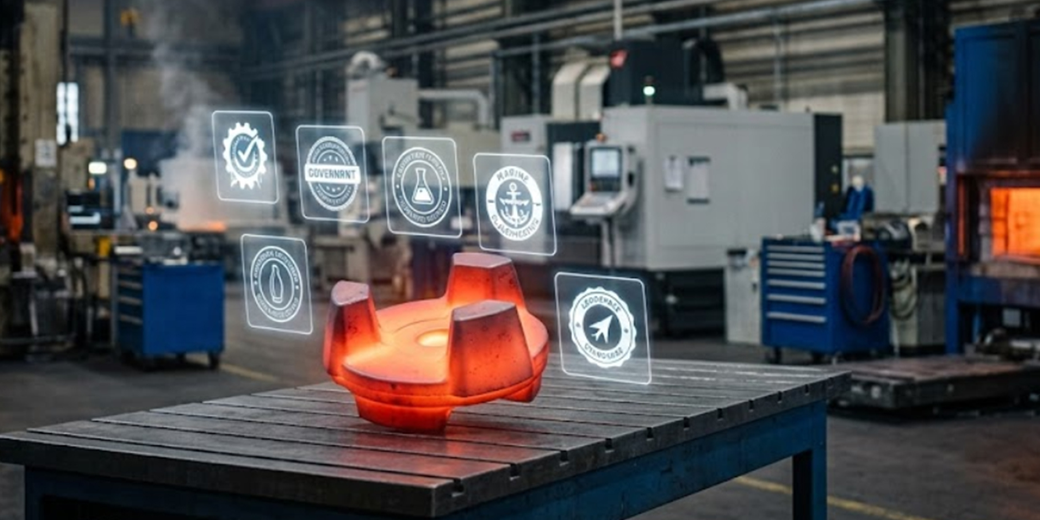
Defence forging certification in India involves multiple overlapping approval requirements that confuse buyers and suppliers alike. AS9100D, DGQA, IBR, ABS, NABL — each covers a different scope, is issued by a different authority, and applies to different programme types. Understanding what each one covers, who issues it, what it verifies, and when it is required is essential for defence procurement teams evaluating Indian forging suppliers and for forging manufacturers planning their certification roadmap.
Certification Overview: What Each One Covers
| Certification | Issued By | Covers | Required For |
| AS9100D | Accredited third party (BV, TÜV, DNV) | Quality management system — all processes in scope | All defence and aerospace programmes |
| DGQA | Govt of India — DGQA Directorate | Supplier approval for Indian armed forces procurement | Indian Army, Navy, Air Force programmes |
| IBR | Govt of India — Chief Inspector of Boilers | Pressure-retaining forged components | Steam systems, pressure vessels, nuclear, certain naval |
| ABS | American Bureau of Shipping | Naval and marine structural and propulsion components | Naval shipbuilding at MDL, GSL, GRSE |
| ISO 9001 | Accredited third party | Generic quality management system | Commercial — insufficient alone for defence |
| NABL | Govt of India — Quality Council of India | Test and calibration laboratory competence | Mechanical and chemical testing for DGQA acceptance |
| NADCAP | Performance Review Institute (PRI) | Special processes — heat treatment, NDT, welding | Some international defence programmes |
AS9100D: The Foundation Certification
AS9100D is the quality management system standard for aviation, space, and defence — the single most important certification for any Indian forging manufacturer seeking to serve defence programmes. It is issued by an IAQG-recognised accreditation body, of which there are several operating in India: Bureau Veritas, TÜV SÜD, DNV, Lloyd’s Register Quality Assurance, and Intertek among others.
What AS9100D Actually Verifies
AS9100D verifies that the quality management system meets the requirements of the standard — not that specific products meet specific requirements. The distinction matters. An AS9100D certificate means the process controls, documentation systems, non-conformance management, corrective action processes, and special process qualification records are in place and functioning. It does not guarantee that every forging leaving the facility meets its drawing requirements.
Why the Scope Statement Is More Important Than the Certificate Header
The scope statement on an AS9100D certificate defines exactly which processes and facilities are covered. Common scope statements that buyers should scrutinise:
“Design and manufacture of closed die forgings” — covers only closed die forging. Open die, ring rolling, heat treatment, NDT, and machining are not covered even if performed at the same facility.
“Manufacture of forgings including heat treatment and NDT at Facility A” — covers forging, heat treatment, and NDT at one named facility only. A second facility under the same company name is not covered.
“Design and manufacture of forgings, heat treatment, CNC machining, NDT testing, and sub-assembly at Facilities A, B, C, and D” — the full forge-to-finish scope across multiple facilities. This is the scope that enables a single AS9100D certificate to cover an entire programme without gaps.
Buyers who read only the certificate header — “Vinir Engineering Limited — AS9100D Certified” — without reading the scope statement cannot assess whether the certification actually covers the operations performed for their programme.
The Three-Year Certification Cycle
AS9100D follows a three-year certification cycle. Surveillance audits in years one and two review a rotating subset of the standard’s requirements. Full recertification in year three covers the complete standard. Certification lapses if surveillance audits are not completed on schedule or if major findings from an audit are not closed within the required timeframe.
A supplier presenting an AS9100D certificate that expired six months ago, or one with an open major finding from the last surveillance, is not currently certified. Defence buyers should request not just the certificate but the last surveillance audit completion record.
DGQA: India’s Military Quality Overlay
The Directorate General of Quality Assurance operates under the Ministry of Defence and is responsible for ensuring quality in procurement for the Indian armed forces. DGQA is not a certification body in the international sense — it is a government quality authority that approves suppliers and conducts quality oversight throughout the procurement lifecycle.
DGQA vs AS9100D: Fundamentally Different Mechanisms
AS9100D is granted by a commercial third-party certification body based on a documented audit. DGQA approval is a government regulatory function — DGQA conducts its own assessment independent of any commercial certification body’s findings. Holding AS9100D does not automatically confer DGQA approval. They are parallel requirements.
DGQA approval covers:
- The specific product category — forgings of a defined type and material
- The specific facility
- The specific end-user application — Army, Navy, or Air Force procurement
A supplier DGQA-approved for alloy steel structural forgings for Army programmes is not automatically approved for titanium forgings for Air Force programmes. Each category and application may require separate assessment.
DGQA Source Inspection
Beyond initial approval, DGQA conducts ongoing source inspection — physical presence at the supplier’s facility before each delivery to a DGQA-covered programme. For new suppliers and first article runs, DGQA inspectors are present at forging, heat treatment, and NDT stages. For established suppliers with good quality records, source inspection may be compressed to documentation review and final inspection witness.
DGQA source inspection is not optional and is not substituted by the supplier’s own quality records, regardless of how complete they are. It is an independent government quality control function written into the procurement contract.
How DGQA Approval Is Obtained
DGQA maintains its own vendor registration system.
The registration process requires:
- Submission of a capability statement and AS9100D certificate
- On-site assessment by DGQA technical officers
- Demonstration of relevant production capability — equipment, procedures, test lab
- Successful production of test pieces or sample components to DGQA-specified requirements
The DGQA assessment is detailed and technical — DGQA officers are qualified engineers who understand forging processes, heat treatment metallurgy, and NDT. A supplier who has not invested in genuine process capability and documentation will not pass DGQA assessment regardless of what the AS9100D certificate says.
IBR: Pressure-Retaining Components
The Indian Boiler Regulations (IBR) govern the manufacture, inspection, and certification of boilers and pressure vessels operating in India. IBR certification for a forging manufacturer means the manufacturer is approved to produce pressure-retaining forged components — flanges, pressure vessel heads, boiler drums, valve bodies — that will be used in systems where failure could cause a pressure explosion.
Where IBR Applies in Defence Forging
IBR applies across several defence forging categories:
Naval steam propulsion — Indian Navy vessels with steam propulsion systems require IBR-certified forged components in the steam system — main steam flanges, stop valve bodies, turbine casing flanges. ABS covers the structural classification but IBR covers the pressure system compliance.
Nuclear power applications — forged components for India’s civil and naval nuclear power programmes require IBR certification for pressure-retaining applications. This overlaps with the broader nuclear certification requirements (AERB oversight) for safety-critical nuclear components.
Defence industrial facilities — power generation equipment at defence production facilities and ordnance factories requires IBR-certified components for steam systems.
The IBR Certification Process
IBR certification for a forging manufacturer involves:
- Assessment by the Chief Inspector of Boilers (or authorised deputy) of the manufacturer’s quality system, equipment, and process capability
- Review of material sourcing practices and test lab capability
- Witnessed production of approval test pieces with mechanical testing
- Ongoing survey — IBR-authorised inspectors witness heat treatment and testing for each production lot of IBR-certified forgings
IBR-certified forgings are accompanied by an IBR Form III B — the material certificate signed by the IBR inspector confirming that the forging was manufactured and tested in compliance with IBR requirements.
IBR and ABS: When Both Are Required
For naval vessels with steam propulsion — steam-powered frigates, certain submarine auxiliary systems — forged components at the intersection of the structural classification (ABS) and the pressure system (IBR) require both certificates. A main steam flange on a destroyer must be ABS-certified because it is a structural component of the vessel and IBR-certified because it is a pressure-retaining component of the steam system. Only a manufacturer holding both approvals can supply these dual-certified components without involving a second supplier.
ABS: Naval and Marine Classification
The American Bureau of Shipping is one of the world’s principal ship classification societies. For Indian naval shipbuilding at MDL, GSL, and GRSE — all of which build to ABS class — forging manufacturers supplying structural and propulsion components must hold ABS approval.
What ABS Approval Covers
ABS approval for a forging manufacturer confirms that the facility can produce forgings meeting ABS material specifications and quality requirements, under ongoing ABS surveyor oversight. The approval covers specific material grade families and forging process types — a manufacturer approved for alloy steel open die forgings is not automatically approved for duplex stainless steel closed die forgings without demonstrating that specific capability to ABS.
The ABS Survey Process
Unlike AS9100D which is audited annually and then every three years in full, ABS survey operates on a lot-by-lot basis for certified deliveries.
An ABS surveyor must:
- Be notified before each production lot of ABS-certified forgings
- Attend heat treatment and witness the cycle for critical components
- Witness mechanical testing (tensile, Charpy, hardness) for each cast or heat
- Review and stamp the ABS material certificate (Form C1 or equivalent) for each lot
This ongoing involvement means ABS approval has an operational overhead that AS9100D does not — every delivery requires coordinating ABS surveyor attendance. Suppliers who underestimate this when first pursuing ABS approval find their first delivery schedules disrupted by surveyor availability.
Lloyd’s Register and Bureau Veritas as Alternatives
ABS is not the only acceptable classification society for Indian naval programmes. Lloyd’s Register (LR) and Bureau Veritas (BV) hold equivalent recognition for Indian naval shipbuilding. Some programmes specify ABS or LR or BV — any of the three being acceptable. Indian Register of Shipping (IRS) is accepted for some auxiliary and patrol vessel programmes but is not always recognised as equivalent to the three international societies for principal combat vessel programmes.
NABL: Laboratory Accreditation
NABL is not a product or quality management system certification — it is a laboratory accreditation covering the competence of a specific test lab to perform specific tests. For defence forging in India, NABL accreditation matters at two points:
DGQA acceptance — DGQA requires NABL-accredited mechanical test results (tensile, impact, hardness, chemical analysis) for acceptance of most defence programme components. Results from a non-NABL lab are typically not accepted without retesting at an accredited facility.
AS9100D compliance — AS9100D requires that testing is performed by competent laboratories with calibrated equipment. NABL accreditation is the recognised evidence of this competence in India.
A forging manufacturer who outsources mechanical testing to a non-NABL lab faces two problems: test results may not be accepted by DGQA, and the outsourcing itself introduces a traceability and scheduling risk. An in-house NABL-accredited lab eliminates both problems.
NADCAP: International Special Process Accreditation
NADCAP (National Aerospace and Defence Contractors Accreditation Program) is a special process accreditation covering heat treatment, NDT, welding, chemical processing, and other defined operations to a level of rigour that exceeds AS9100D requirements for special processes. NADCAP is administered by the Performance Review Institute (PRI) and is primarily required in US aerospace and defence supply chains — programmes managed by Lockheed Martin, Boeing Defence, Raytheon, General Dynamics, and similar US primes.
NADCAP is not currently a routine requirement for Indian DPSU programmes. However, for Indian forging manufacturers targeting international defence programmes — supplying to US or European primes as part of Indian offset obligations or direct international supply — NADCAP accreditation for heat treatment and NDT becomes relevant.
NADCAP assessment is significantly more detailed than AS9100D audit — the checklist for heat treatment (AC7102) covers furnace calibration, process control, records, and operator qualification at a level of specificity that often reveals gaps in facilities that have comfortably passed AS9100D audits. Achieving NADCAP accreditation is a one-to-two year project for most manufacturing facilities.
The Certification Roadmap for a Defence Forging Manufacturer
For an Indian forging manufacturer building the certification profile to serve the full range of defence programmes, the logical sequence is:
Phase 1 — Foundation (months 1–18) AS9100D certification covering all in-house processes. This is the entry gate for all other defence certifications and programmes.
Phase 2 — Indian military programmes (months 12–30) DGQA registration and approval in relevant product categories. Concurrent with AS9100D surveillance. Requires demonstrated production history.
Phase 3 — Pressure and naval programmes (months 18–36) IBR certification for pressure-retaining applications. ABS approval for naval shipbuilding supply. Both require existing AS9100D and demonstrated capability.
Phase 4 — International programmes (months 36+) NADCAP accreditation for heat treatment and NDT, where international programme requirements demand it.
NABL accreditation for the in-house test lab should ideally be obtained concurrently with Phase 1 — it is the foundation for all subsequent certification activities and DGQA interactions.
Vinir Engineering holds AS9100D (all four units, full forge-to-finish scope), IBR, ABS, and NABL accreditation — covering Phases 1 through 3 completely. The certification profile enables supply across the full range of Indian defence forging programmes without certification gaps.
Frequently Asked Questions — Defence Forging Certifications
Is AS9100D sufficient on its own for Indian defence forging programmes?
AS9100D is necessary but not sufficient for most Indian defence programmes. DGQA approval is additionally required for programmes procured by the Indian Army, Navy, and Air Force. IBR is required for pressure-retaining components in steam and nuclear systems. ABS is required for naval shipbuilding classification. International defence programmes typically require only AS9100D, though US programmes increasingly require NADCAP for heat treatment and NDT special processes in addition.
How does a buyer verify that an AS9100D certificate is genuine and current?
The IAQG operates an online database — OASIS (Online Aerospace Supplier Information System) — where all AS9100D certified organisations are listed with their current certification status, scope, and expiry date. Buyers can search the OASIS database by company name to verify that the AS9100D certificate presented is current, issued by an IAQG-recognised body, and has the scope claimed. This verification takes approximately two minutes and eliminates any possibility of accepting a fraudulent or expired certificate.
What is the difference between DGQA and BIS certification for defence forgings?
DGQA and BIS serve entirely different functions. DGQA is a defence-specific quality authority that oversees military procurement — it approves defence suppliers and inspects military procurement components. BIS (Bureau of Indian Standards) manages Indian national standards (IS standards) and certifies products against those standards. BIS certification for a forging confirms compliance with a specific Indian standard. DGQA oversight confirms compliance with military procurement requirements. Both may apply to the same product but they are separate, parallel requirements with different scopes.
Can a forging manufacturer hold ABS approval without AS9100D?
Theoretically yes — ABS has its own facility assessment process and does not formally require AS9100D as a prerequisite. In practice, most Indian naval shipbuilding programme quality plans require both ABS and AS9100D from forging suppliers. A manufacturer with ABS but without AS9100D will pass the classification society requirement but fail the OEM quality system requirement and cannot supply the programme. Obtaining AS9100D first and then pursuing ABS is the logical sequence because the AS9100D quality management infrastructure provides the documentation and process control foundation that makes the ABS facility assessment straightforward.
How long does it take to obtain all four certifications — AS9100D, DGQA, IBR, and ABS?
Assuming a manufacturer starts with no certifications and needs to build from scratch: AS9100D typically takes 12–18 months from quality system implementation to certification. DGQA registration and approval, running in parallel after AS9100D is in place, adds 12–24 months. IBR and ABS can be pursued concurrently with DGQA and typically take 12–18 months each from application to approval. The total elapsed time from starting point to holding all four certifications is typically 3–5 years. Manufacturers with an existing ISO 9001 quality management system and a history of quality manufacturing compress this timeline somewhat, but the DGQA and classification society processes have minimum timelines that cannot be significantly accelerated.