
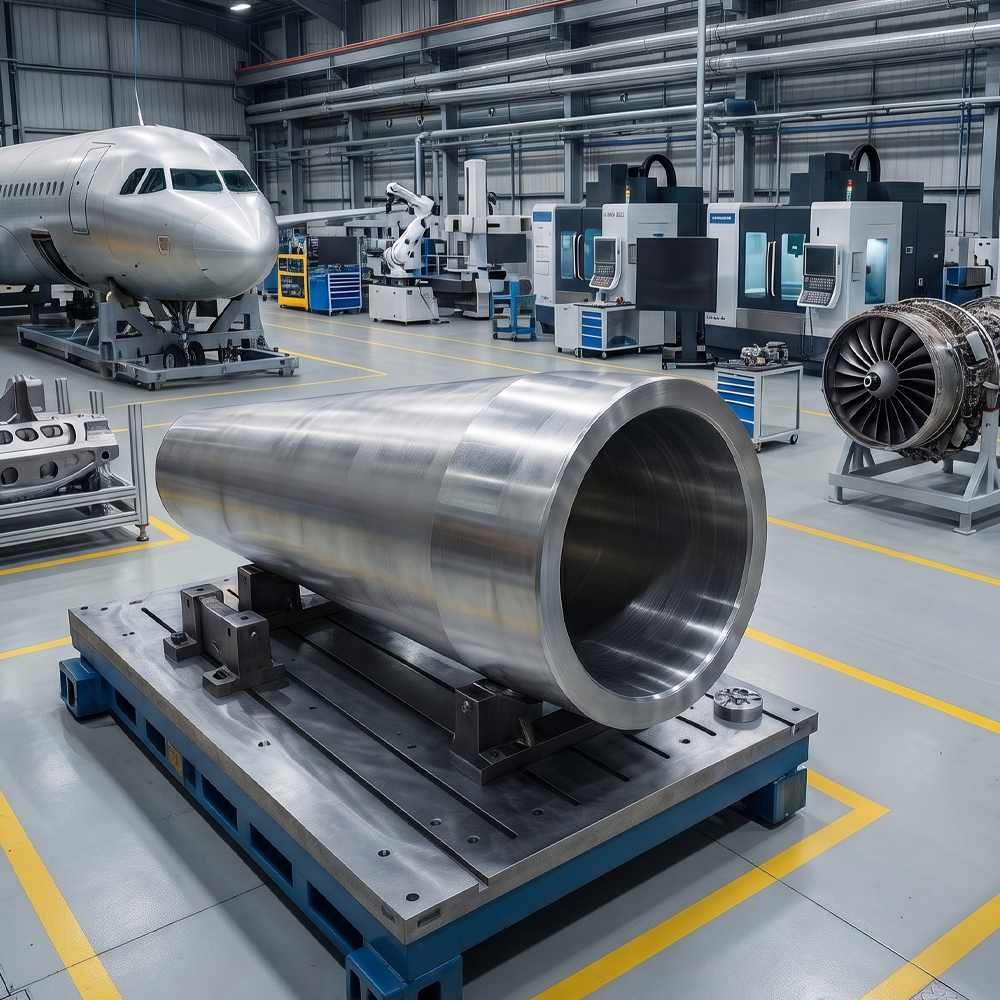
Aerospace Forging Manufacturers in India: AS9100D Certified Guide 2025
Aerospace forging manufacturers in India produce structurally critical forged metallic components for aircraft, helicopters, aeroengines, spacecraft, and defence aviation platforms. Unlike general industrial forging, aerospace forging operates under AS9100D quality management, airworthiness-linked material traceability, mandatory first article inspection for every new part number, and documentation requirements that must satisfy both the original equipment manufacturer and the regulatory authority under whose oversight the platform operates. Vinir Engineering has manufactured aerospace grade forgings in Bangalore and Hosur since 1984, holding AS9100D, IBR, and ABS certifications across four manufacturing units.
At a Glance: Aerospace Forging Requirements in India
| Parameter | Requirement |
| Quality standard | AS9100D mandatory |
| Material traceability | Heat number to finished component — airworthiness-linked |
| First article inspection | Mandatory for every new part number |
| NDT | 100% UT for structural, FPI for titanium |
| Documentation | MTR, traveller, heat treatment record, NDT report, FAIR, CoC |
| Special processes | Heat treatment and NDT must be formally qualified |
| Weight range (Vinir) | 5 kg – 15,000 kg |
| Batch size (Vinir) | 1 unit first article to 250 units production |
Why Aerospace Forging Is a Distinct Manufacturing Category
Most forging manufacturers in India developed their primary capabilities around automotive or general industrial production — characterised by high volumes, standardised geometries, and quality systems built for throughput rather than traceability. Aerospace forging operates on a fundamentally different model.
In automotive forging a batch rejection is a commercial inconvenience. In aerospace forging a material traceability gap — a heat number that cannot be traced back to a mill certificate — is a grounding event for every aircraft carrying components from the affected heat. The consequences of quality failure are regulatory and safety-critical, not merely commercial.
This is why aerospace OEMs — HAL, DRDO, Safran, GE Aviation, Rolls-Royce, Pratt & Whitney, Boeing — maintain rigidly controlled approved vendor lists and do not simply accept the lowest price. Every forging supplier on an aerospace approved vendor list has invested years of qualification effort and sustained it through demonstrated performance.
For Indian aerospace forging manufacturers, the entry requirements are high but the competitive moat, once established, is very deep. A supplier qualified for titanium airframe forgings at HAL has a supply relationship that is extremely difficult to replace — and that HAL has very strong incentive to maintain.
India’s Aerospace Forging Demand: Domestic and International
HAL Programmes
Hindustan Aeronautics Limited is the largest domestic customer for aerospace forged components in India. Current active HAL programmes requiring forged components include:
Tejas Light Combat Aircraft — titanium alloy airframe structural forgings, aluminium alloy structural members, alloy steel landing gear analogues, Inconel engine component forgings. Tejas Mk1A production rate targets of 24 aircraft per year create sustained forging demand.
ALH Dhruv and LCH Prachand — rotor head structural forgings in titanium, gearbox housing forgings in aluminium, structural frame forgings in alloy steel.
HTT-40 and IJT — training aircraft programmes with alloy steel and aluminium forging requirements at moderate volumes.
Su-30 MKI overhaul — HAL manages Su-30 MKI maintenance at Nasik. Russian-origin forged components being indigenised for overhaul supply.
HLFT-42 and AMCA — future programmes in development that will require qualified Indian aerospace forging sources before production begins.
DRDO and Research Establishments
DRDO’s Gas Turbine Research Establishment (GTRE) in Bangalore develops the Kaveri aeroengine — requiring Inconel, titanium, and high-strength steel forgings for compressor and turbine components. DRDO’s various aeronautics establishments generate forging requirements for demonstrator aircraft, UAV platforms, and propulsion system development.
BrahMos and Missile Programmes
BrahMos Aerospace’s indigenisation obligations create forging demand for titanium and high-temperature alloy components. DRDO missile programmes (Astra, Akash, Agni upper stages) require aerospace-grade forging capability.
International Offset and Direct Supply
India’s defence procurement offset policy requires international OEMs winning Indian defence contracts to invest a percentage of the contract value in Indian industry. Aerospace forgings are a preferred offset category — they have high value, require genuine manufacturing capability to produce, and create technology transfer of process knowledge. International OEMs including Airbus, Boeing Defence, Lockheed Martin, and Safran have used offset obligations to qualify Indian aerospace forging suppliers.
AS9100D: The Non-Negotiable Entry Requirement
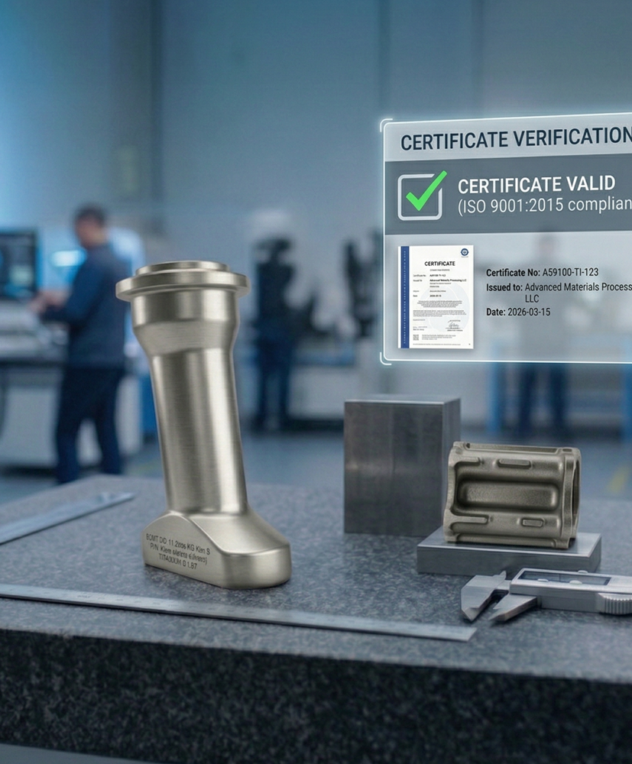
AS9100D certification is the threshold requirement for aerospace forging supply in India. Without a current AS9100D certificate covering the relevant processes and facilities, no credible aerospace OEM will proceed with supplier evaluation.
What AS9100D Requires of Aerospace Forging Manufacturers
Beyond the ISO 9001 baseline, AS9100D adds requirements that are directly relevant to aerospace forging:
First Article Inspection — mandatory for every new part number. Every dimension on the drawing is measured and recorded. Every mechanical property is tested. Every NDT method specified is applied and documented. The complete First Article Inspection Report (FAIR) is submitted to and approved by the OEM before production begins.
Key Characteristics — dimensions and properties designated safety-critical in the design are identified as key characteristics. Key characteristics are 100% inspected on every component — no sampling permitted for these features.
Configuration control — the drawing revision used in production must match the current approved revision. Obsolete revisions must be removed from the production environment. A forging produced to a superseded drawing is a non-conformance regardless of whether the changed dimension was actually relevant.
Special process qualification — heat treatment and NDT are special processes. The furnace must be calibrated to AMS 2750. The NDT procedures must be written and approved. Operators must be formally trained and qualified. These qualifications are maintained in records reviewable by the OEM and the certification body auditor.
Materials Used in Indian Aerospace Forgings
Titanium Alloys — Ti-6Al-4V (Grade 5)
The dominant aerospace titanium grade. Density 4.43 g/cm³ versus 7.85 g/cm³ for steel — 44% weight saving per unit volume at comparable structural performance. Used in:
- Airframe structural frames and bulkhead forgings on Tejas and Dhruv
- Rotor head and blade retention forgings on HAL helicopters
- Compressor disc and fan disc forgings in aeroengines
- Landing gear structural members on weight-critical platforms
Titanium forging requires controlled atmosphere protection during heating to prevent alpha case formation — a brittle oxygen-enriched surface layer that reduces fatigue life. Fluorescent penetrant inspection after final machining is mandatory for aerospace titanium forgings.
Inconel 718 and 625
For hot section aeroengine components where operating temperatures exceed steel capability :
- Turbine disc forgings — the highest-stress rotating component in an aeroengine
- Compressor disc forgings for rearward compressor stages operating at elevated temperature
- Combustion chamber structural forgings
Inconel 718 requires solution annealing and double ageing heat treatment to develop its full strength. The ageing procedure is narrow — temperature and time deviations measurably affect creep and fatigue properties at elevated temperature.
Aluminium Alloys — 2024, 7075, 7050
For weight-sensitive structural applications where operating temperatures are below 120°C :
- Wing rib and spar forgings on lighter aircraft
- Helicopter transmission housing forgings
- Secondary structural members and brackets
7075-T6 is the highest-strength commercial aluminium alloy — tensile strength 500–570 MPa at density 2.81 g/cm³. 7050 has better damage tolerance than 7075 for applications where fatigue crack growth resistance is the design driver.
High-Strength Alloy Steels
For landing gear structures, actuator housings, and engine mount forgings where titanium cannot be justified economically :
- 4340 for moderate-strength structural applications
- 300M for highest-strength landing gear analogues
- 15-5PH and 17-4PH precipitation-hardening stainless steels for corrosion-resistant structural applications
Aerospace Forging Processes: What Is Used and Why
Closed Die Forging for Aerospace Components
Closed die forging produces near-net-shape components with controlled grain flow through the cross-section. For aerospace structural forgings — brackets, fitting forgings, rib-section forgings — closed die provides dimensional consistency and grain flow orientation that alternative processes cannot match at equivalent production rates.
Critical aerospace closed die requirements beyond standard industrial forging :
- Die design must orient grain flow to the primary stress direction in the finished component
- Forging temperature must be controlled and documented — particularly for titanium and Inconel where the temperature window is narrow
- Flash removal and trim must not introduce stress concentrations at the parting line
- Die condition must be verified at defined intervals — worn dies produce forging laps and dimensional drift that are not always visible before machining removes the evidence
Open Die Forging for Aerospace Shafts and Heavy Structural Components
Open die forging handles the larger aerospace forgings — engine shaft forgings, large structural transition sections, heavy frame forgings.
The process provides :
- Maximum reduction ratio flexibility — can achieve high reduction in any direction to maximise grain refinement
- No tooling cost for simple geometry — economic for very low volume, very large components
- Access for ultrasonic testing before machining — the forging is tested in the as-forged condition before significant machining investment is made
Ring Rolling for Aerospace Rings and Discs
Ring rolling produces seamless rings for aerospace compressor and turbine disc blanks, bearing race blanks, structural frame rings, and actuator cylinder blanks.
The advantages for aerospace are significant :
- Seamless construction eliminates weld stress concentrations — critical for rotating disc applications where hoop stress is the primary loading
- Circumferential grain flow aligns with the direction of highest stress in a rotating disc
- Near-net-shape profile — reduces machining stock and the associated risk of removing surface material with favourable grain flow
Radial Forging for Aerospace Shafts and Cylinders
For hollow shafts, compressor shaft forgings, and thick-walled cylindrical aerospace components, radial forging provides uniform grain structure across the full cross-section that open die forging on a press cannot achieve for hollow geometries.
How Vinir Engineers Aerospace Forging Programmes
Vinir Engineering’s aerospace forging capability covers the full weight range of Indian aerospace programme requirements — 5 kg for small structural fittings through to 15,000 kg for large open die structural forgings. Titanium forging capability covers Ti-6Al-4V for airframe and rotor system applications. Inconel capability covers 625 and 718 for engine hot section components.
In-house heat treatment includes AMS 2750 calibrated furnaces for quench and temper of alloy steels, solution anneal and age hardening for Inconel 718, and controlled atmosphere capability for titanium stress relieving. NABL-accredited in-house testing covers tensile, Charpy impact, hardness, and chemical analysis with test methods traceable to international standards (ASTM, AMS).
AS9100D certification covers the complete forge-to-finish workflow across all four manufacturing units — die design, forging, heat treatment, CNC machining, NDT, and assembly under one quality management system.
Frequently Asked Questions — Aerospace Forging Manufacturers India
What certifications are required for aerospace forging manufacturers in India?
AS9100D is the mandatory baseline for all aerospace forging in India. For programmes with HAL involvement, HAL-specific vendor qualification overlays AS9100D. For international aerospace programmes (Airbus, Boeing, Safran offsets), AS9100D is typically the primary requirement with NADCAP for heat treatment and NDT on higher-criticality programmes. IBR applies where pressure-retaining components are involved. NABL accreditation for the test lab is required for DGQA acceptance on defence aerospace programmes.
How does aerospace forging differ from defence structural forging?
Aerospace forging is characterised by the airworthiness dimension — forged components on type-certified aircraft are subject to regulatory oversight (DGCA in India, FAA or EASA for internationally certified platforms) that extends beyond the OEM’s own quality system. Material traceability must be maintained to the airworthiness standard, not just the commercial quality standard. First article inspection is mandatory for every new part number regardless of similarity to previously qualified components. Special process qualification for heat treatment and NDT is more rigorous than in most non-aviation defence programmes.
Which forging process is most commonly used for aerospace structural components?
Closed die forging is the most common process for small-to-medium aerospace structural components (5–1,400 kg) where near-net-shape geometry and consistent grain flow are required. Ring rolling is preferred for disc and ring components. Open die forging handles the largest aerospace forgings and shaft components where size exceeds closed die press capacity. Radial forging is used for hollow shaft and cylindrical components. The majority of aerospace forgings by part number count are produced by closed die forging, but the highest-value individual components are often ring-rolled discs or large open die structural forgings.
Can Indian aerospace forging manufacturers supply to international OEMs?
Yes. Indian AS9100D certified aerospace forging manufacturers can supply to international OEMs subject to OEM-specific qualification, applicable export control regulations (ITAR, EAR for US-origin technology), and any additional airworthiness authority approvals required for the specific platform. India’s offset policy creates a structured pathway for international OEMs to qualify Indian forging suppliers — the offset obligation provides commercial incentive for the OEM to invest in qualification rather than defaulting to established international sources.
What is the typical qualification timeline for a new aerospace forging supplier?
Qualification for an aerospace forging programme typically takes 18–30 months from initial submission to first production order. The timeline covers Stage 1 document review (2–3 months), Stage 2 shop floor audit (2–3 months), Stage 3 first article production and inspection (4–8 months), Stage 4 process validation (6–12 months), and AVL approval (1–3 months). Suppliers with existing AS9100D certification and demonstrated production history in the relevant material compress the Stage 1 and 2 timeline. Suppliers attempting a new material family for the first time extend the Stage 3 timeline due to process development requirements.