
Seamless Rolled Ring Forging Supplier for USA from India: Aerospace, Energy & Industrial Applications
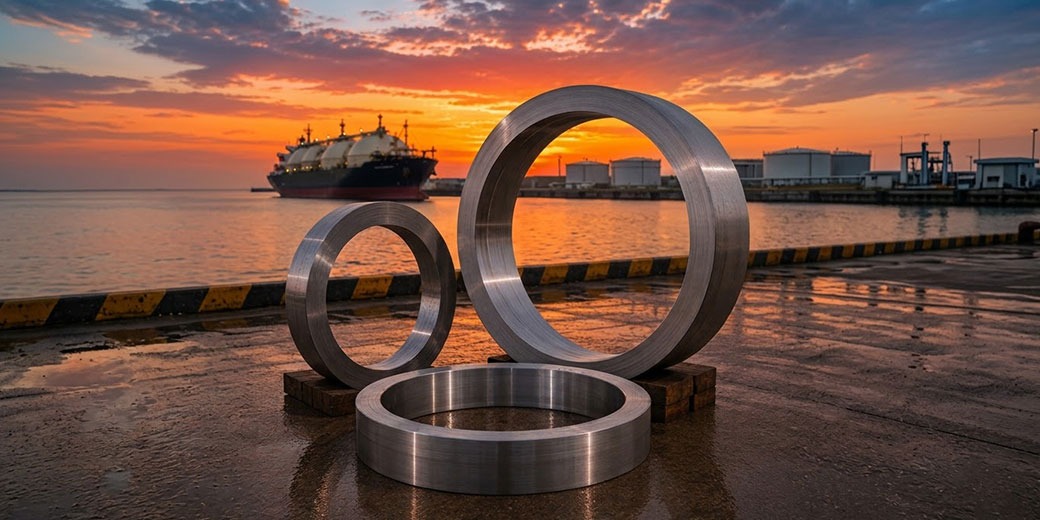
Seamless rolled rings are used wherever a circular component must carry high radial, axial or pressure loads without the discontinuity of a welded joint. US demand spans bearing races, flanges, gear rings, turbine rings, pressure-vessel components, aerospace rings and large industrial rotating equipment.
For procurement teams, the key advantage of ring rolling is material efficiency combined with circumferential grain flow. A properly designed ring blank can approach the finished geometry more closely than a ring machined from plate or a large solid disc, reducing both material waste and machining time. The process is particularly attractive in high-value alloys and large diameters.
India can serve as a competitive source for seamless rolled rings when the supplier controls the entire route from starting material and ring preform through rolling, heat treatment, NDT and machining. Vinir states ring-rolling capability across an approximate diameter range of 200 to 4,500 mm, positioning it for both medium and large custom rings for US industrial programs.
How Seamless Ring Rolling Works
The process begins with a billet or cut stock that is upset and pierced to create a donut-shaped preform. The preform is then rolled between driven and idler rolls so wall thickness decreases while diameter increases. Axial rolls can control ring height, while radial rolling controls the diameter and wall section.
Because the ring is formed continuously rather than welded from plate, the material develops circumferential flow around the component. That can be advantageous for rotating, pressure and fatigue-loaded applications. The final benefit, however, depends on process control: temperature, reduction per pass, mandrel position, growth rate and final sizing all influence geometry and microstructure.
Where US Buyers Use Rolled Rings
- Wind turbine bearing and flange rings
- Gas and steam turbine rings
- Aerospace engine and structural rings
- Oil & gas flanges, connectors and pressure rings
- Marine propulsion and deck-equipment rings
- Large gear blanks and bearing races
- Industrial kiln, compressor and rotating-equipment rings
Different sectors impose very different standards. A wind-turbine tower or bearing ring is not qualified like an aerospace engine ring, and a pressure-retaining oil & gas ring may require different material specifications and NDT. The supplier should therefore qualify against the application, not simply advertise a diameter range.
Material Selection for Rolled Rings
Rolled rings can be produced in carbon and alloy steels, stainless steels, duplex and super duplex, nickel alloys, titanium and other forgeable materials. The correct material is dictated by load, temperature, corrosion environment and downstream heat treatment.
For general industrial gear rings, ASTM A290/A290M is one specification covering carbon and alloy steel forged or rolled rings for reduction gears. Other ring applications may reference ASTM, ASME, AMS, API or customer-specific material and process specifications. The purchase order should identify the exact material condition and any supplementary requirements rather than relying on a generic alloy name.
Ring Geometry: Diameter Is Only One Capability Metric
A supplier may advertise a large outside diameter but be unable to produce the buyer’s required wall thickness, height or finished weight at that diameter. Ring capability is a three-dimensional envelope involving outside diameter, inside diameter, axial height, radial wall, weight and alloy flow stress.
US buyers should submit the finished cross-section and ask for the proposed forged envelope. This allows the supplier to confirm whether the ring can be rolled directly to shape, requires a rectangular preform with heavier machining, or should be produced by another method.
Heat Treatment and Distortion Control
Large rings can distort during heat treatment because their thin annular geometry responds differently from a compact block. Quenching can produce ovality, warpage or local variation if support, loading and cooling are not controlled. High-alloy rings may also have narrow temperature windows and strict solution-treatment or ageing requirements.
The manufacturing plan should define when dimensional checks occur relative to heat treatment and whether straightening or sizing is permitted. Machining stock should accommodate realistic heat-treatment movement without becoming unnecessarily heavy.
NDT, Mechanical Testing and Ring Traceability
UT is often used for volumetric inspection of steel and alloy rings, while MT or PT may be applied to surfaces depending on material. Aerospace and high-criticality rings can require highly specific calibration standards and inspection techniques. Mechanical tests may be taken tangentially, radially or axially depending on the governing specification.
Traceability should remain continuous through piercing, rolling, heat treatment and machining. If one parent heat produces multiple rings, each ring should maintain a clear link to the parent material, manufacturing lot, heat-treatment batch and test results.
Machined Rolled Rings vs Rough Rings
US buyers can source rings as forged, rough machined, proof machined or finish machined. Rough machining is often useful because it removes scale and creates surfaces for more reliable UT and dimensional inspection. Finish machining in India can materially reduce delivered weight and downstream cycle time when the supplier has adequate turning, boring, drilling and metrology capacity.
The choice should be made based on tolerance, inspection sequence and logistics. Very tight final interfaces may still be finish-machined near the assembly location, while stable dimensions and large material-removal volumes can often be completed more economically at source.
Why India Is Relevant to US Rolled-Ring Sourcing
Large seamless rings are capital-intensive products. Buyers need a supplier with rolling equipment, forge heating, manipulation, heat-treatment furnaces, NDT and large-diameter machining. India’s established heavy-engineering base can be attractive when these processes are available within one manufacturing group and the order profile is high mix rather than mass production.
For US procurement teams diversifying supply chains, an India source is particularly relevant for second-source qualification, long-lead replacement rings and programs where machining content is significant enough to influence total landed cost.
What US Buyers Should Verify Before Approving a Supplier
| Buyer Question | What to Verify | Why It Matters |
Does the ring fit the true equipment envelope? | OD, ID, height, wall, weight and alloy at the required size. | A headline maximum diameter can hide section limitations. |
How is the preform produced? | Starting stock, upset, piercing and rolling sequence. | Preform quality controls grain flow and defect risk. |
| What happens after rolling? | Heat treatment, sizing/straightening, rough machining and inspection order. | Post-roll operations strongly affect final geometry. |
How is each ring tested? | UT/MT/PT method, mechanical coupon orientation and acceptance criteria. | Ring properties are direction-sensitive and application-specific. |
Can the ring ship machined? | Large turning/boring capacity, metrology, preservation and packaging. | Machining at source can reduce weight and US lead time. |
Frequently Asked Questions
1.What is a seamless rolled ring forging?
2.What sizes of rolled rings can Vinir manufacture?
3.Why use a rolled ring instead of machining a ring from plate?
4.Which standards apply to rolled rings in the USA?
5.Do rolled rings require ultrasonic testing?
6.Can seamless rolled rings be supplied finish machined from India?
7.What should be included in a rolled ring RFQ?
Why Vinir Engineering Fits This Requirement
Vinir’s stated 200-4,500 mm ring-rolling range, combined with heat treatment, machining and testing, supports the kind of high-mix ring supply that US energy, industrial, offshore and critical-equipment buyers often need. The strongest RFQs will include the finished cross-section and complete inspection requirements so the rolling and machining route can be engineered together.