
Reactor Pressure Vessel Forging for US Nuclear Programmes from India
Reactor pressure vessel forgings are the most safety-critical and highest-value forged components in any nuclear power plant. The RPV contains the reactor core, primary coolant, and the control rod mechanisms its structural integrity is the primary barrier preventing radioactive release. A single RPV programme for a US AP1000 or SMR design may contain 20–40 distinct forged components nozzle forgings, shell ring forgings, head dome forgings, and flange forgings with individual values ranging from $50,000 for smaller nozzle forgings to $5 million for large shell ring forgings. Indian forging manufacturers with IBR certification, ASME Section III awareness, NQA-1-compatible quality systems, and SA-508 Grade 3 processing capability are positioned to supply the nozzle and structural forging categories of US RPV programmes.
At a Glance: RPV Forging Categories and Requirements
| Forging Category | Weight Range | Material | Class | Critical Requirement |
| Shell ring forgings | 50,000–300,000 kg | SA-508 Grade 3 | Class 1 | VAR, tightest chemistry, 10CFR50 App B |
| Head dome forgings | 20,000–100,000 kg | SA-508 Grade 3 | Class 1 | Same |
| Nozzle forgings | 500–5,000 kg | SA-508 Grade 3 / SA-182 F316L | Class 1 | Full NQA-1, immersion UT |
| Flange forgings | 5,000–20,000 kg | SA-508 Grade 3 | Class 1 | Same |
| Closure head flange | 10,000–30,000 kg | SA-508 Grade 3 | Class 1 | Same |
| Instrumentation nozzles | 10–200 kg | SA-182 F316L, Inconel 600 | Class 1 | Traceability, immersion UT |
| Support skirt | 5,000–15,000 kg | SA-508 Grade 3 | Class 2 | NQA-1, slightly relaxed |
The RPV in a US Pressurised Water Reactor
The AP1000 reactor pressure vessel the standard for new US PWR construction is a large pressure vessel approximately 12 metres tall and 4 metres in internal diameter, operating at 155 bar (2,250 psi) coolant pressure and 325°C coolant temperature. It must maintain these conditions for 60 years of operation potentially extended to 80 years under subsequent licence renewal.
The vessel is assembled from individually forged rings and components that are welded together during fabrication. Each weld between forging sections is subject to ASME Section III Class 1 NDE requirements 100% radiography and 100% UT of every weld and each forging must be produced and certified to the same Class 1 quality standard.
RPV Forging Weight Categories and Indian Capability
Shell ring forgings (50,000–300,000 kg): These are the cylindrical sections of the RPV body each ring section is ring-rolled from a large-diameter ingot, heat treated, and machined. Shell ring forgings for a standard PWR RPV weigh 100,000–300,000 kg per ring beyond the capability of all but the largest forging operations globally (JSW Steel in Japan, DOOSAN in Korea, Sheffield Forgemasters in UK). This category is beyond current Indian forging manufacturer capability.
Head dome forgings (20,000–100,000 kg): The hemispherical upper and lower head closures are formed by press forging of large ingots. Same weight range issue as shell rings beyond practical Indian forge shop capacity for a full PWR RPV programme.
Nozzle forgings (500–5,000 kg): The inlet and outlet nozzles for primary coolant, the emergency core cooling system nozzles, the control rod drive mechanism (CRDM) housings, and the instrumentation penetrations these are produced by closed die or open die forging in the 500–5,000 kg range. This is the RPV forging category accessible to Indian forging manufacturers with 3,000+ tonne press capacity.
Instrumentation nozzles (10–200 kg): Small-diameter nozzle forgings for temperature, pressure, and neutron flux instrumentation penetrations. Produced in SA-182 F316L stainless or Inconel 600. Closed die forging range – well within Indian forging capability.
The practical opportunity: Indian forging manufacturers enter the US RPV supply chain at the nozzle forging level not the shell ring or head dome level. Nozzle forgings represent 30–40% of the total RPV forging count by piece number, and their individual value ($50,000–$500,000 per nozzle depending on size and complexity) makes them commercially significant despite being smaller than the shell ring forgings.
SA-508 Grade 3 Processing for RPV Nozzle Forgings
Material Procurement
SA-508 Grade 3 billet for RPV nozzle forgings must come from mills with established nuclear supply credentials. The tighter chemistry limits copper maximum 0.10%, phosphorus maximum 0.008%, sulphur maximum 0.008% require vacuum induction melting (VIM) plus vacuum arc remelting (VAR) or electroslag remelting (ESR) at a minimum. Mills capable of consistently producing SA-508 Grade 3 to nuclear embrittlement-sensitive element targets include:
- Creusot Forge (France) — a primary global source for nuclear RPV forgings. Part of the Framatome group
- JSW Steel (Japan) — major supplier to Asian and international nuclear programmes
- DOOSAN Heavy Industries (Korea) — supplier to AP1000 Vogtle and international nuclear programmes
- Schoeller-Bleckmann (Austria) — European nuclear material supplier
For Indian forging manufacturers producing RPV nozzle forgings, raw material must be procured from one of these internationally recognised nuclear steel suppliers with full MTR documentation showing every specified element including copper, phosphorus, and sulphur at the nuclear embrittlement-sensitive targets.
Heat Treatment of SA-508 Grade 3 RPV Nozzle Forgings
Quench and temper procedure: SA-508 Grade 3 is quenched from 860–900°C and tempered at minimum 650°C (the ASME Section III Appendix requirement for adequate impact toughness). The minimum tempering temperature is higher than for commercial alloy steel ensuring adequate grain boundary toughness against temper embrittlement during long-term elevated temperature service in the reactor.
Stress relief after welding: After welding of nozzle forgings into the RPV shell, a post-weld heat treatment (PWHT) is performed at 600–650°C. The nozzle forging must maintain its mechanical properties through this PWHT cycle which means the original tempering temperature must be above the PWHT temperature to prevent any change in the tempered microstructure during PWHT.
AMS 2750 / NQA-1 furnace requirements: The heat treatment furnace used for SA-508 Grade 3 nuclear forgings must comply with AMS 2750 pyrometry requirements AND the NQA-1 requirement for independent inspection of the heat treatment process. The furnace chart must be retained as a permanent quality record for the RPV’s operating life potentially 80+ years.
NDE Requirements for RPV Nozzle Forgings
Immersion UT – Mandatory for All Class 1 Forgings
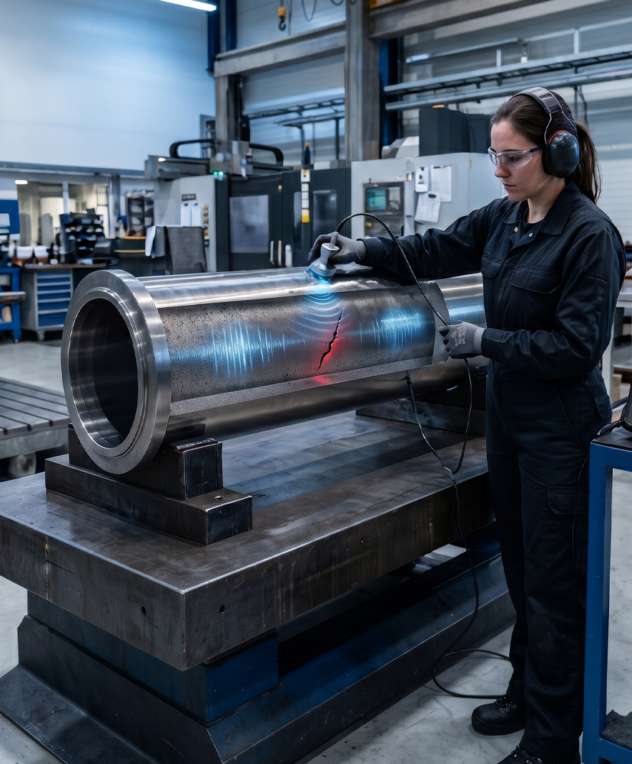
All ASME Section III Class 1 forgings above a minimum size require 100% volumetric inspection by immersion UT. The ASME Section III acceptance criteria for Class 1 RPV nozzle forgings are the most stringent applied to any commercial pressure vessel:
Reference standard: Flat-bottom holes (FBH) machined in an SA-508 Grade 3 reference block. The reference block must be from the same material heat and heat treatment condition as the production forging not a generic steel reference. This requirement is more stringent than commercial industrial UT where generic carbon steel reference blocks are acceptable.
Scanning coverage: 100% volume coverage every cubic centimetre of the nozzle forging must be interrogated by the UT beam. For complex nozzle geometries, this requires multiple probe setups and scanning directions, documented by a scanning plan that demonstrates coverage completeness.
Acceptance criteria: ASME Section III NB-2532 defines the specific FBH equivalent size limits for Class 1 forgings significantly more conservative than ASME VIII commercial pressure vessel acceptance criteria.
NQA-1 independent verification: The UT inspection must be performed by personnel independent of the manufacturing organisation not by the production team. This requires either a separate inspection department within the Indian facility with organisational independence, or a third-party NDT company conducting the inspection under the NQA-1 programme.
MT and PT for RPV Nozzle Forgings
Magnetic particle testing (MT): All SA-508 Grade 3 nozzle forgings require MT of all forged surfaces after heat treatment and after any machining that removes more than the minimum specified amount of surface material. Wet fluorescent MT is specified for Class 1 the highest sensitivity MT method.
Liquid penetrant testing (PT): For austenitic stainless (SA-182 F316L) instrumentation nozzle forgings, PT replaces MT stainless is non-ferromagnetic. AMS 2647 equivalent sensitivity level is required by ASME Section III.
The AP1000 RPV: Nozzle Forging Opportunities
AP1000 Primary Coolant Inlet and Outlet Nozzles
Each AP1000 RPV has four primary coolant nozzles two inlet nozzles (where cool water enters the reactor core) and two outlet nozzles (where hot water exits). These are the largest and most highly stressed nozzle forgings on the RPV.
Geometry: The primary coolant nozzles are complex forgings a large circular bore (matching the primary circuit piping diameter, approximately 600–800mm) with the nozzle body transitioning to the RPV shell attachment geometry. The nozzle inner radius the transition from the nozzle bore to the RPV shell is a high-stress concentration that is a key inspection focus.
Weight: 1,000–3,000 kg per primary coolant nozzle, depending on specific AP1000 design revision.
Material: SA-508 Grade 3 same as the RPV shell. The nozzle weld to the shell is a Class 1 weld requiring full-penetration geometry and 100% NDE.
NQA-1 documentation: For each primary coolant nozzle, the complete documentation package VIM/VAR MTR with copper/phosphorus/sulphur data, forging process record, heat treatment record with AMS 2750 furnace calibration reference, immersion UT report, MT report, dimensional inspection, and CoC must be assembled and retained for the RPV’s operating life. No document can be missing. A single missing document prevents the nozzle from being incorporated in the RPV.
AP1000 CRDM Housing Nozzles
The AP1000 closure head contains 69 control rod drive mechanism (CRDM) housing penetrations each a precision stainless steel nozzle forging that penetrates the RPV closure head and provides the pressure boundary for the control rod drive mechanism.
Material: SA-182 F316L austenitic stainless or Alloy 690 (nickel alloy) depending on the specific AP1000 design revision. Alloy 690 (Inconel 690) was adopted as a replacement for Alloy 600 (Inconel 600) following primary water stress corrosion cracking (PWSCC) experience with Alloy 600 CRDM nozzles in operating PWRs.
Geometry: Small-diameter tube forgings (50–100mm OD, 30–60mm bore) with a precision-machined attachment weld geometry. Each nozzle must be straight within very tight tolerances eccentricity in the CRDM housing causes binding of the control rod drive mechanism.
Opportunity for Indian manufacturers: 69 CRDM nozzles per AP1000 unit in Alloy 690 or F316L small-diameter precision forgings in the 10–50 kg range is a volume category well-suited to Indian closed die forging capability with the appropriate nuclear quality infrastructure.
SMR RPV Forging Opportunities – The Near-Term Frontier
NuScale VOYGR RPV
The NuScale Power Module – the first SMR to receive NRC design certification has an integral RPV that is significantly smaller than a conventional PWR RPV.
The NuScale module RPV :
- Height: approximately 20 metres (including steam generators)
- Diameter: approximately 2.7 metres
- Operating pressure: 96 bar (lower than conventional PWR at 155 bar)
- Weight: approximately 650 tonnes complete
RPV nozzle forging requirements per module: Smaller than conventional PWR but same ASME Section III Class 1 quality requirements. A 12-module VOYGR site (assembled power 924 MWe) requires 12 complete module RPVs creating sustained forging demand across a multi-year construction programme.
The opportunity size: NuScale has announced plans for VOYGR deployment across multiple US utilities. Each plant requires 12 modules 12 RPVs with their complete complement of nozzle forgings. If NuScale achieves even 10 plant deployments, the total nozzle forging demand exceeds 1,000 individual nozzle forgings a significant sustained supply opportunity.
TerraPower Natrium RPV
TerraPower’s Natrium sodium-cooled fast reactor (SFR) being constructed at Kemmerer, Wyoming uses a different reactor vessel design from a conventional PWR. The primary system is sodium-cooled rather than water-cooled which changes some material requirements:
Sodium compatibility: Components in contact with liquid sodium must be compatible with sodium chemistry austenitic stainless steel (316L or 304L) is the standard material for sodium system components. The Natrium reactor vessel is stainless steel rather than SA-508 Grade 3 carbon steel.
Operating temperature: Sodium-cooled fast reactors operate at higher coolant temperatures (500–550°C) than water-cooled reactors (325°C for AP1000). At these temperatures, creep resistance becomes important alongside tensile strength the forging must maintain adequate strength across 60 years of operation at elevated temperature.
Indian stainless forging opportunity: SA-182 F316L or F304L stainless steel nozzle and structural forgings for sodium system components within Indian forge shop capability with appropriate NQA-1 quality controls.
Qualification Pathway for Indian RPV Nozzle Forging Supply
The Three-Phase Approach
Phase 1 — Foundation building (12–18 months): Develop NQA-1-compatible quality system procedures clause-by-clause mapping of existing AS9100D procedures to 10CFR50 Appendix B criteria. Establish formal hold point management. Implement 50-year record retention capability. Procure SA-508 Grade 3 material from a nuclear-approved mill for process qualification purposes. Produce and fully document process qualification forgings under the NQA-1-compatible system.
Phase 2 — N-Certificate holder engagement (6–12 months): Identify the specific US N-Certificate holder (Westinghouse, BWX Technologies, Holtec) to engage as the first customer. Submit the NQA-1 programme documentation for review. Complete the N-Certificate holder’s supplier qualification assessment quality system review, site visit, qualification forgings.
Phase 3 — First production order: Under the N-Certificate holder’s oversight, produce first production nozzle forgings with all hold points witnessed and all documentation assembled to NQA-1 requirements. First lot subject to enhanced inspection 100% mechanical testing rather than sampling.
Why Phase 1 Is the Critical Investment
The most common failure mode for Indian manufacturers approaching US nuclear supply is attempting to shortcut Phase 1 presenting AS9100D as equivalent to NQA-1 without the specific programme development required. US N-Certificate holders who have attempted to qualify Indian forging manufacturers report that the quality system gap between AS9100D and NQA-1 is real and requires dedicated effort to close.
The specific gaps that require explicit procedure development:
- Independent inspection procedure: AS9100D does not require organisational independence of inspection from manufacturing. NQA-1 does explicitly.
- Hold point notification procedure: AS9100D does not require external notification before proceeding past inspection points. NQA-1 does with specific notification lead times.
- Significance determination for NCRs: AS9100D requires corrective action. NQA-1 requires significance evaluation is this NCR a significant condition adverse to quality requiring root cause analysis and management review? The determination process must be documented.
- Record lifetime management: AS9100D does not address 50+ year record retention. NQA-1 requires a specific records management plan for lifetime records.
Vinir Engineering’s RPV Forging Supply Readiness
Vinir Engineering’s position for US RPV nozzle forging supply:
IBR certification: The most directly relevant existing certification IBR requires witness inspection of heat treatment and mechanical testing by an independent IBR-authorised surveyor, equivalent in spirit to NQA-1 hold point requirements. IBR-experienced quality teams understand the discipline of external witness inspection that NQA-1 requires.
Open die forging to 15,000 kg: Covers the RPV primary coolant nozzle weight range (1,000–3,000 kg) comfortably. The 3,000T hydraulic press with dango manipulators produces nozzle forgings in SA-508 Grade 3 at the required reduction ratios for grain refinement.
Closed die forging 10–1,400 kg: Covers the CRDM housing nozzle and instrumentation nozzle weight range entirely.
NABL-accredited testing: OES chemical analysis capable of verifying copper, phosphorus, and sulphur to SA-508 Grade 3 nuclear embrittlement-sensitive targets. Tensile and Charpy impact testing to ASME Section III required methods.
Immersion UT: Available for SA-508 Grade 3 nozzle forgings. SA-508 Grade 3 calibration reference standard procurement planned as part of nuclear qualification programme.
NQA-1 development: AS9100D quality system provides the foundation. NQA-1 gap analysis completed specific procedure developments identified and in progress for US nuclear programme engagement.