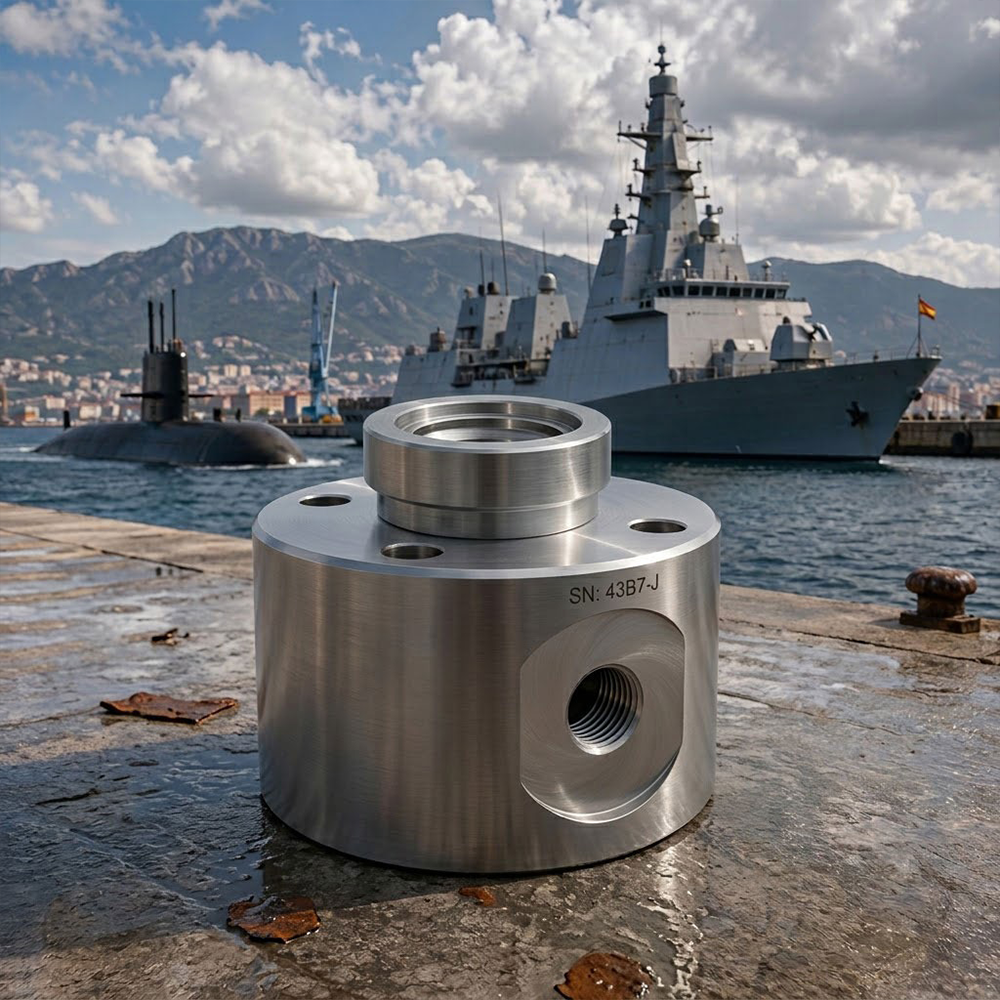
Navantia — Spain’s state-owned shipbuilder headquartered in Madrid with shipyards at Ferrol, Cádiz, and Cartagena is one of Europe’s most capable naval shipbuilding companies. Navantia produces the F-110 frigate for the Spanish Navy, the S-80 submarine (now S-81 Isaac Peral), and has won international orders for F-100 frigates (Australia’s Hunter class in partnership with BAE Systems) and LHD amphibious assault ships (Australia HMAS Canberra class). Each naval vessel programme consumes propulsion shaft forgings, rudder stock forgings, and structural hull fitting forgings requiring ABS or Bureau Veritas marine classification certification.
Programme
Vessel Type
Key Forging
Classification
F-110 Frigate (Spanish Navy)
Multi-mission frigate
Propulsion shaft, rudder stock, hull fittings
BV Naval / Lloyd’s Register
S-81 Isaac Peral submarine
AIP submarine
Pressure hull fittings, propulsion shaft
Spanish Navy spec / DNV
LHD (Australia — HMAS Canberra)
Amphibious assault ship
Propulsion shaft, steering gear
BV Marine / Lloyd’s
MINEHUNTER programme
Mine countermeasures vessel
Structural hull fittings
BV Marine
Auxiliary vessels (A-15 class)
Navy support ships
Shaft and structural forgings
BV Marine
Navantia’s F-110 frigate programme — five ships ordered for the Spanish Navy at a contract value of €4.3 billion is the largest Spanish naval procurement programme in a generation. The F-110 uses a combined diesel and gas (CODAG) propulsion system with GE LM2500 gas turbine and MTU diesel engines. Propulsion shaft forgings for the F-110 are in alloy steel (4340 or equivalent), 2,000–5,000 kg, requiring Bureau Veritas naval classification with full heat treatment and mechanical testing witness by BV naval surveyor. The F-110 programme’s sustained production schedule (deliveries through 2033) creates multi-year forging demand for qualified shaft forging suppliers.
The S-81 Isaac Peral submarine — Spain’s first domestically designed and built submarine, using air-independent propulsion (AIP) technology requires pressure hull fitting forgings in high-strength alloy steel equivalent to HY-80 (yield strength minimum 551 MPa in saltwater environments). The S-81 programme was subject to significant engineering challenges during development the submarine was initially overweight but has now completed sea trials and entered service. Three further S-class submarines (S-82, S-83, S-84) are on order, creating ongoing demand for pressure hull structural forgings.
Navantia’s international programmes — including the F-100 Álvaro de Bazán class design exported to Australia and Norway create export forging demand that extends beyond Spanish domestic shipbuilding. The Australian Hunter-class frigates (being built by ASC Shipbuilding in Adelaide under the Navantia/BAE Systems design partnership) use propulsion and structural forgings sourced through the programme supply chain. Navantia’s role as design authority for Hunter class means its qualified forging suppliers may access Australian shipbuilding programme content.
The Spanish Navy’s wider fleet — including older Descubierta class corvettes, Buque de Acción Marítima (BAM) patrol vessels, and the Juan Carlos I LHD requires ongoing maintenance and replacement of propulsion shaft forgings and structural hull components. This fleet maintenance market provides sustained lower-volume forging demand beyond new build programmes and is typically less demanding in terms of supplier qualification than new build programme supply.
Open die alloy steel propulsion shaft forgings to 15,000 kg on 3,000T hydraulic press.
4340 and CrMoV alloy steel.
BV Naval and BV Marine survey coordination for heat treatment witness and mechanical testing.
100% UT before and after heat treatment per ASTM A388 equivalent.
Wet fluorescent MT two perpendicular directions.
HY-80 equivalent alloy steel for pressure hull structural forgings.
AS9100D full scope.
Ocean freight Chennai to Ferrol, Cadiz, or Cartagena: 24–32 days.
Frequently Asked Questions
1.What propulsion system does the Navantia F-110 frigate use and what does that mean for shaft forging requirements?+–
The F-110 uses a CODAG (Combined Diesel and Gas) propulsion arrangement MTU 20V 8000 M71L diesels for cruise speed and GE LM2500+ gas turbines for high-speed sprint capability. The two propulsion shafts are each driven by a combined gearbox that accepts input from both diesel and gas turbine. Propulsion shaft forgings for the F-110 are in 4340 or equivalent alloy steel, quenched and tempered to approximately 700–800 MPa tensile, with the shaft geometry determined by the gearbox output coupling dimensions. Bureau Veritas naval classification requires witnessed heat treatment and mechanical testing for all propulsion shafts on BV-classed naval vessels. The F-110 shafts are approximately 3,000–5,000 kg each within Vinir’s open die forging capability.
2.What is air-independent propulsion (AIP) and does it affect submarine forging requirements?+–
AIP (Air-Independent Propulsion) is a submarine propulsion technology that allows a conventionally powered (non-nuclear) submarine to operate its propulsion system without access to atmospheric oxygen enabling longer submerged endurance than conventional battery-only submarines. Spain’s S-81 uses a hydrogen fuel cell AIP system (Sterling Motor Ibérica). The AIP system’s pressure vessels and fuel system components require pressure-containing forgings that must meet submarine structural design codes. The AIP fuel storage components (hydrogen storage system) use austenitic stainless steel or titanium for hydrogen compatibility — different from the alloy steel pressure hull fittings. For Indian forging manufacturers, the AIP-specific forging categories are smaller and more specialised than the primary propulsion shaft and pressure hull fittings.
3.How does Navantia’s Hunter-class frigate partnership with BAE Systems create Australian forging opportunities for Indian suppliers?+–
The Hunter-class frigate (9 ships for the Royal Australian Navy) uses the Navantia F-100/F-110 design as its basis, with BAE Systems as the prime contractor in Australia and ASC Shipbuilding as the Australian shipbuilder. Component supply for Hunter class is managed through the programme supply chain jointly overseen by BAE Systems and Navantia. Forging manufacturers qualified for Navantia F-110 supply through the Spanish supply chain may access Hunter-class forging content either through Navantia’s involvement in the supply chain or through the programme’s qualified supplier list that Navantia contributes to. This dual-programme access (Spanish F-110 and Australian Hunter class) multiplies the commercial value of a single Navantia qualification.
4.What Spanish Navy standards supplement Bureau Veritas classification for naval forging supply?+–
The Spanish Navy’s Armada Española applies its own technical standards (NM -Normas Militares) for naval vessel components procured under Spanish defence contracts. NM standards supplement BV classification requirements with Spanish Navy-specific material grades, inspection procedures, and documentation formats. For propulsion shaft forgings, the applicable NM standard specifies material grade requirements and acceptance criteria that may be more restrictive than BV Rules alone. Navantia flows these NM requirements to its forging suppliers through the purchase order specification Indian manufacturers must ensure their quality systems can accommodate NM-specific documentation requirements alongside BV classification certification.
5.What is the commercial opportunity for Indian marine forging manufacturers in the Spanish naval fleet maintenance market?+–
Spain’s naval fleet includes 5 Álvaro de Bazán class F-100 frigates, 4 Santa María class (FFG-7 derivative) frigates, 3 Agosta class submarines (being replaced by S-80 class), the Juan Carlos I LHD, and various support vessels. Fleet maintenance generates ongoing demand for replacement propulsion shaft forgings, rudder stock forgings, and structural hull fittings as original components reach end of service life (typically 25–35 years). Replacement forgings must match the original specification (BV-classified alloy steel) but do not necessarily require the same extended qualification process as new-build programme supply. For Indian forging manufacturers with BV survey approval, fleet maintenance replacement forging supply is accessible through Navantia’s MRO supply chain with a qualification timeline of 8–14 months.