
Radial Forging vs Machining from Bar: Material Utilisation, Grain Flow, Machining Time and Total Cost
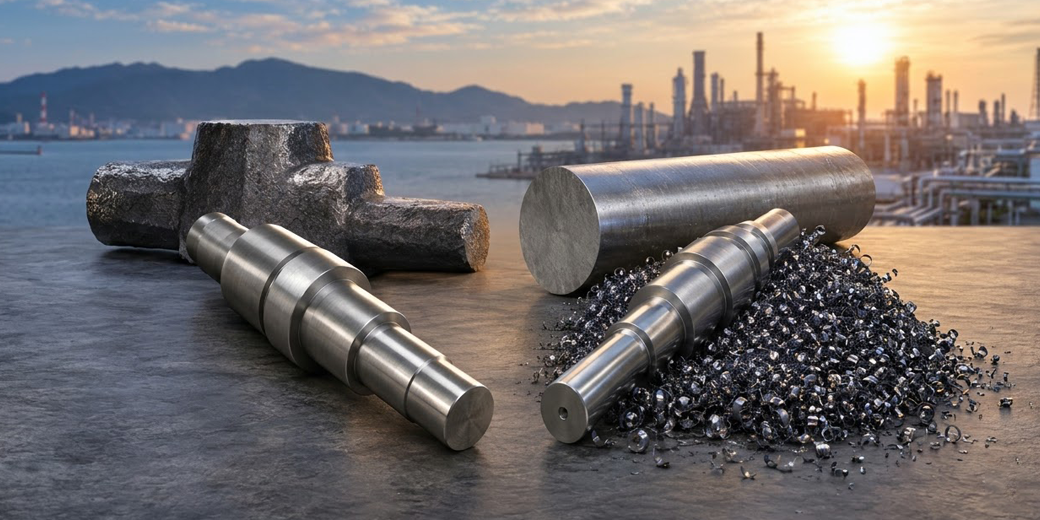
When an OEM needs a long shaft or stepped component, one of the most important manufacturing decisions is whether to machine the component directly from bar stock or first create a near-net forged preform.
Machining from bar appears straightforward: purchase material at the largest required diameter and remove everything that is not part of the final component.
For small and simple components, that approach can be economical.
For large stepped shafts manufactured from high-value materials, however, it can become extremely wasteful.
This is where radial forging vs machining from bar becomes an important total-cost comparison.
Understanding the Buy-to-Finish Ratio
Suppose a finished shaft weighs 200 kg but requires 500 kg of starting bar because one short section of the component has a much larger diameter.
The buy-to-finish ratio is:
500 kg ÷ 200 kg = 2.5:1
That means 300 kg of purchased material does not remain in the final component.
Much of it becomes machining chips.
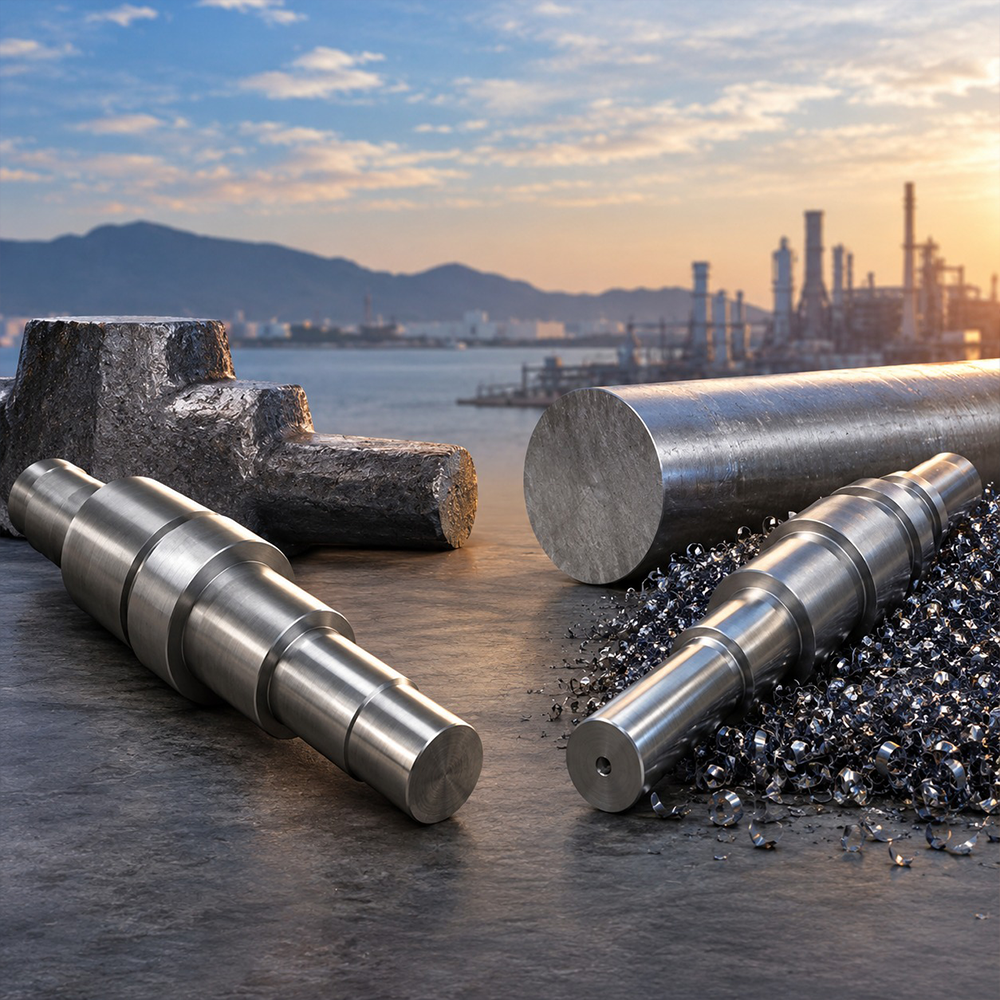
A stepped radial-forged preform can place more material where the final component actually needs it, potentially reducing both starting weight and machining time.
Why Material Cost Changes the Economics
Material waste becomes increasingly important as alloy value rises.
Removing 200 kg of general-purpose carbon steel and removing 200 kg of certified titanium alloy represent very different economic situations.
Premium materials can carry cost associated not only with alloying elements but also with melting route, testing, certification and traceability.
Near-net radial forging therefore becomes particularly attractive for expensive materials and large diameter transitions.
Radial Forging Can Reduce Machining Time
Less excess stock generally means less metal needs to be cut away.
This can reduce:
- Machine hours: Heavy rough turning can consume substantial spindle time.
- Cutting-tool consumption: High-strength steels, titanium and nickel alloys can create significant tool wear.
- Chip generation: Less removed material means less handling and recycling of machining waste.
- Coolant and energy use: Reduced machining volume can decrease downstream process consumption.
- Capacity pressure: Large CNC machines are expensive assets, so reducing rough-machining hours can release valuable production capacity.
This is why the cheapest rough material does not necessarily produce the cheapest finished component.
Machining from Bar vs Radial-Forged Preform
| Cost/Engineering Factor | Machining from Bar | Radial-Forged Preform |
| Initial manufacturing simplicity | High | Moderate |
| Starting material requirement | Potentially high | Can be substantially lower |
| Rough-machining volume | High for stepped parts | Lower |
| Forging setup | Minimal/none | Required |
| Ability to create stepped stock | Limited | Strong |
| Material-flow engineering | Determined by starting stock | Additional controlled deformation |
| Small one-off component | Often attractive | Case dependent |
| Large expensive-alloy shaft | Can become costly | Strong candidate |
Grain Flow: A Fundamental Manufacturing Difference
Machining removes material but does not introduce the same thermomechanical deformation as forging.
A radial-forged shaft undergoes additional plastic working before final machining.
For elongated components, this can create directional material flow along the shaft axis and through forged diameter transitions.
The engineering significance depends on material, loading and component design, but it remains a fundamental difference between machining a shape from stock and forging a preform closer to that shape.
When Machining from Bar Makes Sense
Radial forging should not be forced onto every shaft.
Machining directly from bar can remain the better option when:
- The quantity is extremely low and forging setup cannot be economically justified.
- The component is relatively small, so material waste remains limited.
- The geometry is close to constant diameter, leaving little benefit from a stepped preform.
- Standard certified bar is readily available, reducing procurement complexity.
- The material is inexpensive, making machining waste less significant.
When Radial Forging Becomes More Attractive
The commercial case for a radial-forged preform generally becomes stronger as component size, diameter variation, alloy cost and repeat volume increase.
It can also become more compelling when machining capacity is constrained or when the component’s metallurgical requirements favour a forged starting condition.