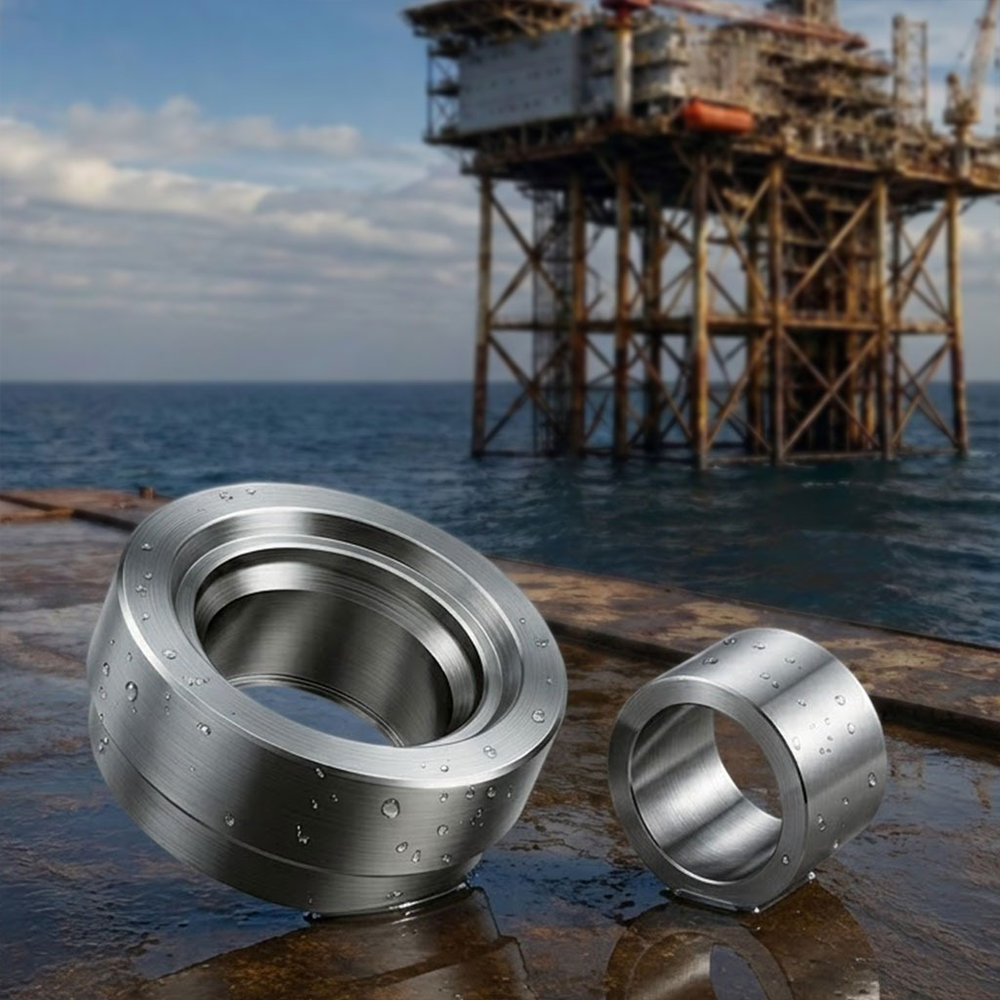
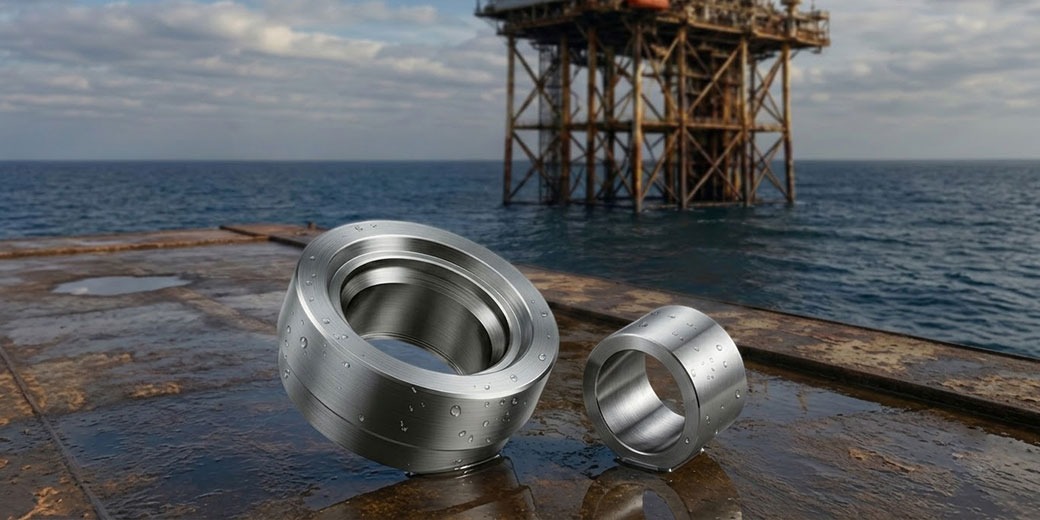
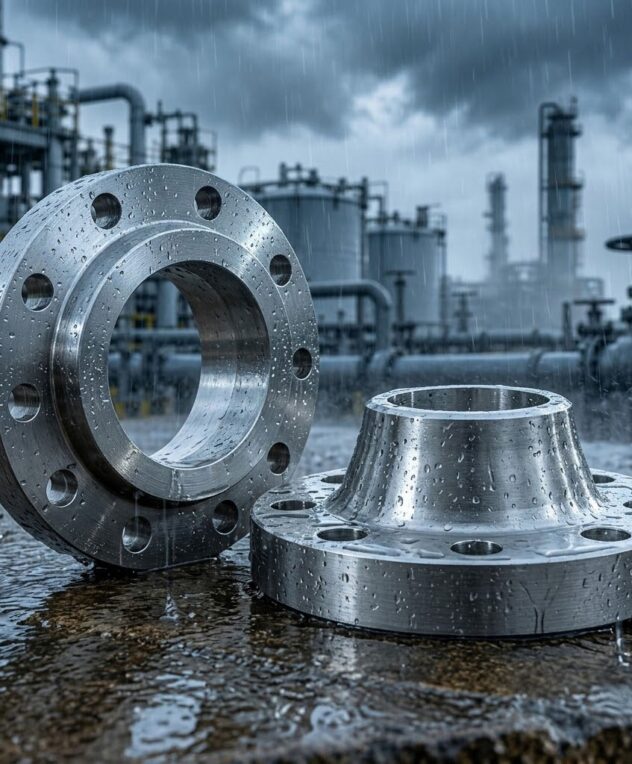
Fixed offshore platform jackets — the tubular steel lattice structures that support oil and gas production topsides above the sea surface use large structural node forgings, conductor guide frame forgings, and pile sleeve forgings at every tubular intersection. Jacket structural forgings in ASTM A694 F65, ASTM A106 Grade B, and API 5L structural grades are required at all high-stress weld connections in offshore jacket structures. Indian API 20B certified forging manufacturers produce these structural forgings for offshore installation contractors (McDermott, Saipem, Heerema, Subsea 7) and jacket fabricators globally.
Application
Material
Standard
Weight Range
Jacket node forging (tubular joint)
ASTM A694 F65
API 2B, NACE where H₂S present
500–5,000 kg
Conductor guide frame structural
A36 / A694 F52
AWS D1.1 structural welding
100–1,000 kg
Pile sleeve insert forging
A694 F65
API 2A-WSD jacket design
500–3,000 kg
Mooring padeye forging
A694 F65, A537 CL2
API 2FP, DNV OS-E301
50–500 kg
Riser base forging
A694 F65 / F70
API 17B, DNV OS-F201
200–2,000 kg
Offshore platform jacket structures — whether fixed steel jackets in water depths of 30–300 metres (North Sea, Gulf of Mexico, offshore Southeast Asia) or compliant towers in deeper water concentrate structural forces at tubular joint nodes. Each node is a complex welded connection between multiple bracing members and the main leg; the stress concentration at the node weld toe is the primary fatigue crack initiation site over the jacket’s 25–40 year design life. Node forging replacing the fabricated (cut-and-welded) node with a seamless forged equivalent at the highest-stress connections eliminates the weld toes at these critical locations and significantly improves fatigue performance.
The global offshore jacket installation market is served by a small number of large marine contractors: McDermott International (Houston), Saipem (Milan), Heerema Fabrication Group (Vlissingen), Sembcorp Marine (Singapore), and Keppel Offshore & Marine (Singapore). These contractors fabricate jackets for oil and gas operators worldwide at their fabrication yards and then install them at the offshore location using their own heavy-lift vessels. Forging procurement for jacket nodes and structural fittings flows through the contractor’s procurement team at the fabrication yard.
North Sea jacket replacements — as life extension programmes drive the need to assess structural integrity of ageing 1970s and 1980s vintage platforms create demand for replacement node forgings where original non-forged nodes have developed fatigue cracking. UK North Sea operators (BP, Harbour Energy, Repsol Sinopec) engaged in structural remediation of ageing platforms replace non-forged nodes with forged equivalents at the highest-loaded structural positions. This remediation market is separate from the new jacket installation market and is accessible to Indian forging manufacturers through UK structural engineering firms (Aker Solutions UK, COWI, Ramboll).
Offshore Southeast Asia — Malaysia (Petronas and its operating companies), Indonesia (Pertamina, Medco), Vietnam (PVN, Vietgas), and Thailand (PTT) represents a growing jacket installation market as these countries develop their offshore gas resources. Southeast Asian operators apply API standards and engage US and European contractors for engineering oversight creating API 20B forging demand accessible from India with the geographic advantage of short ocean transit times.
A694 F65 and F70 structural forgings, 50–5,000 kg.
NABL Charpy at -29°C for GoM and North Sea low-temperature requirements.
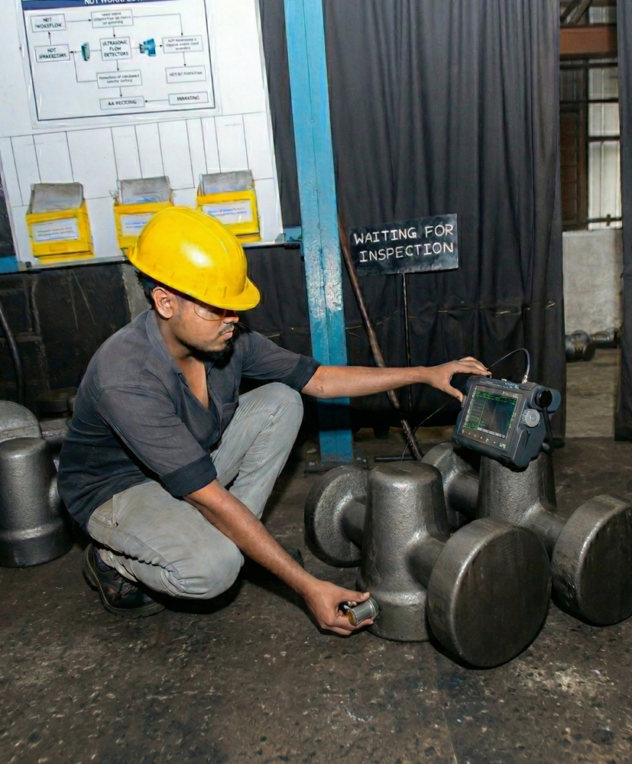
100% UT per ASTM A388.
PWHT simulation capability for large node forgings subject to post-weld heat treatment during fabrication.
NACE MR0175 sour service for jacket structures in H₂S-containing environments.
Ring rolling to Ø4,500mm for large-diameter riser base and pile sleeve ring forgings.
TPI by Bureau Veritas, DNV, and SGS.
Ocean freight Chennai to Rotterdam, Houston, or Singapore: 22–30 days depending on destination.
Frequently Asked Questions
1.What is a jacket node forging and why is it preferable to a fabricated node for offshore structures?+–
A jacket node is the intersection point in an offshore platform jacket structure where multiple tubular steel brace members connect to the main leg chord. A fabricated node is made by welding individual brace stub connections to the main chord — creating weld toes at the highest-stress location. A forged node is produced as a single seamless steel piece with the brace connection geometries formed during forging — eliminating all weld toes at the connection interface. Offshore fatigue analysis (per API RP 2A or DNV OS-C101) shows that node weld toes have stress concentration factors (SCF) of 2–5× the nominal brace stress — replacing a fabricated node with a forged node at critical structural positions reduces SCF by 50–70%, directly improving fatigue life at that joint.
2.What ASTM A694 grade is specified for offshore jacket structural forgings and what does the grade number mean?+–
ASTM A694 covers forged steel flanges and fittings for high-pressure gas transmission piping — but its F65 and F70 grades are also widely specified for offshore structural forgings at high-stress connections. The designation F65 means minimum yield strength 65,000 psi (448 MPa); F70 means 70,000 psi (483 MPa). Both require Charpy impact testing at -20°F (-29°C) per ASTM A694, making them suitable for North Sea and GoM ambient temperature conditions. A694 F65 and F70 are essentially weldable structural steel forgings — similar to EN 10025-3 S355NL and S460NL in European practice — with the addition of the -29°C Charpy requirement that normal structural steel standards do not mandate.
Large offshore installation contractors procure jacket structural forgings through their own qualified supplier lists, managed by their procurement teams at the primary fabrication yard locations — McDermott at Batam (Indonesia) and Altamira (Mexico), Saipem at Arbatax (Italy) and Karimun (Indonesia), Heerema at Vlissingen (Netherlands). The contractor receives a Bill of Materials from the operator’s engineering contractor identifying which jacket nodes require forgings (versus fabricated nodes), then issues RFQs to their qualified forging suppliers. Indian forging manufacturers should be registered on these contractor-managed approved supplier lists — qualification typically requires API 20B certification, site audit, and test forging demonstration.
4.What is the offshore Southeast Asia jacket market and how accessible is it to Indian forging manufacturers?+–
Southeast Asia’s offshore gas development — primarily in Malaysia (Petronas), Indonesia (Pertamina), and Vietnam (PVN) — installs 30–60 new offshore jackets per year across the region. Each jacket requires 10–30 structural forgings at key nodes and pile sleeves. The contractor supply chain for Southeast Asian jackets typically involves Singapore or Indonesian fabrication yards (Sembcorp, Keppel, Sapura) procuring from qualified API 20B suppliers. Indian forging manufacturers have a geographic advantage — ocean transit from Chennai to Singapore is 10–14 days versus 28–35 days from European suppliers. API 20B certification is the primary gateway qualification; site audits by Sembcorp or Keppel procurement teams add 6–12 months to the qualification timeline.
5.What post-weld heat treatment (PWHT) requirements apply to jacket node forgings and how do they affect forging design?+–
Jacket structural fabrication often requires PWHT of node welds — heating the welded assembly to 600–650°C and holding for sufficient time to relieve residual weld stresses. The forging must maintain its specified mechanical properties through this PWHT cycle. For A694 F65 forgings (typically normalized or quenched and tempered), the initial tempering temperature must be above the PWHT temperature to prevent any microstructural change during PWHT. Forging manufacturers must verify that the tempering temperature used during production exceeds 650°C by an adequate margin — and must conduct simulated PWHT testing on material from qualification lots to verify that the required yield and Charpy properties are maintained after PWHT. This PWHT simulation requirement is equivalent to the SPWHT requirement discussed in the nuclear forging blogs.