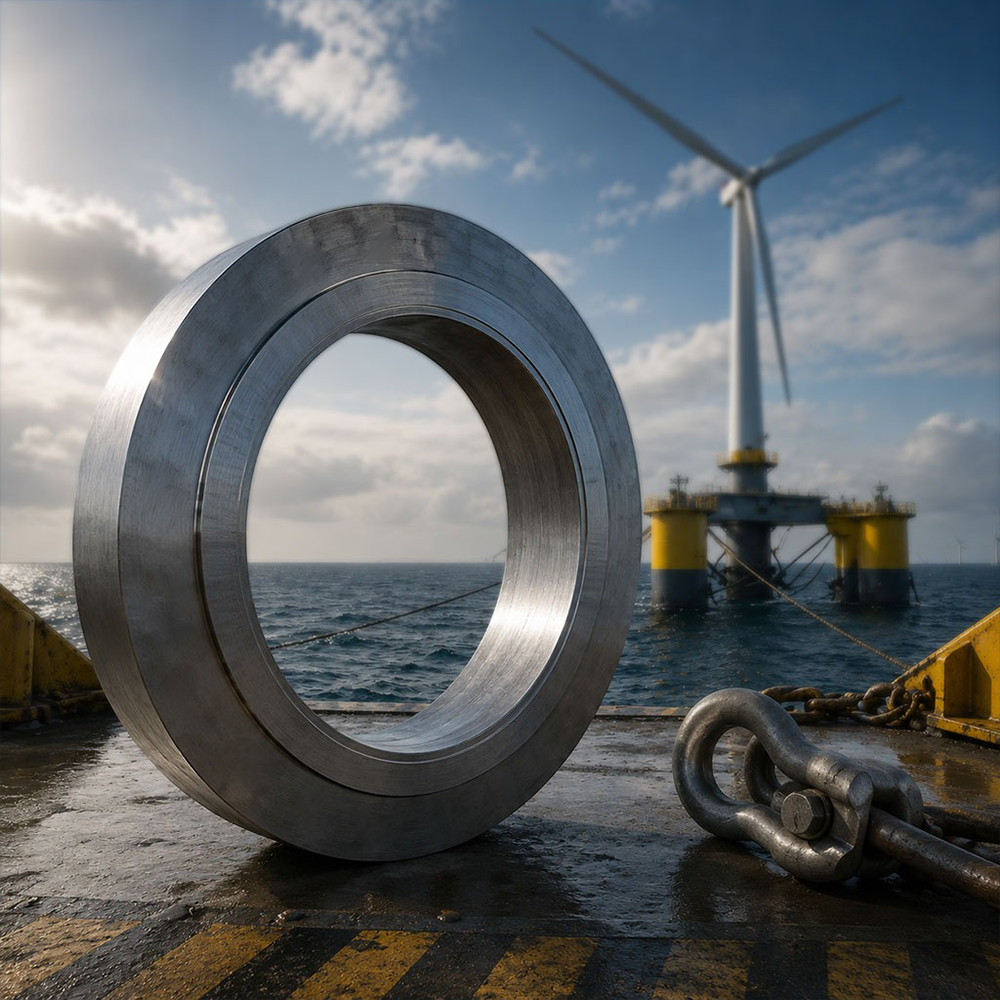
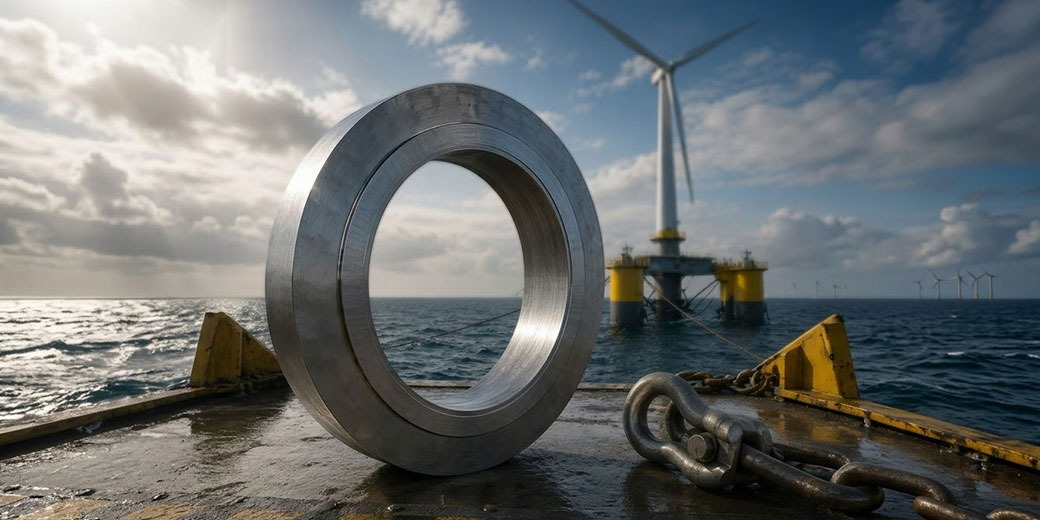
Floating offshore wind — enabling turbine installation in water depths of 60–1,000+ metres where fixed foundations are impractical is one of the fastest-growing segments of the global energy transition. The three primary floating platform types (spar, semi-submersible, and tension leg platform) all use large structural steel forgings for mooring system hardware, hull structural connection fittings, tower base interface flanges, and riser guide structural components. The global floating offshore wind pipeline exceeds 300 GW in development creating substantial future demand for structural and mooring forgings. Indian forging manufacturers with API 20B certification and DNV-approved materials capability are positioned to supply this emerging market.
Platform Type
Developer / Project
Key Forging
Standard
Spar (concrete/steel)
Equinor Hywind Scotland
Mooring chain hardware, tower interface flange
DNV OS-E301, API 2FP
Semi-submersible
WindFloat Atlantic (EDP/Repsol)
Column-to-pontoon node, mooring padeye
DNV OS-C101, BV Naval
Tension Leg Platform (TLP)
Various US (California, Gulf)
Tendon anchor plate, hull structural node
API RP 2T, ABS MODU
Barge type
Ideol, BlueFloat
Barge structural fittings, mooring hardware
BV/DNV MODU rules
Equinor’s Hywind Scotland — the world’s first commercial floating wind farm (30 MW, 5 × 6 MW Siemens Gamesa turbines on Equinor spar platforms) demonstrated the technical viability of floating offshore wind at commercial scale since 2017. Hywind Tampen (Norway, 88 MW) followed in 2023 the world’s largest floating wind farm. Each Hywind spar platform uses three catenary mooring chains anchored to suction anchors on the seabed. The mooring chain hardware shackles, connecting links, and mooring line tensioners are forged in Grade R4 or R4S mooring chain steel per DNV OS-E301, the international standard for offshore mooring chain and hardware.
Semi-submersible floating wind platforms — exemplified by WindFloat Atlantic (Portugal, using Principle Power technology) and the proposed US West Coast floating wind developments (California, Oregon) use pontoon-and-column hull structures held in position by mooring lines or dynamic positioning. The primary structural forgings for semi-submersible floating wind are at the intersection nodes between hull columns and pontoons high-stress locations in wave-induced fatigue loading. DNV OS-C101 (Design of Offshore Steel Structures) defines the structural analysis requirements for these nodes.
The US floating offshore wind market — driven by state mandates in California (10 GW by 2045), Oregon, and Hawaii is in the pre-commercial development phase, with commercial installations expected after 2030. Multiple developers (Equinor, RWE, Ørsted) hold US floating wind leases off California and Oregon. The California floating wind market is particularly significant water depths of 500–1,000 metres off the California coast preclude fixed foundations, making floating platforms mandatory. This creates a uniquely concentrated floating wind forging demand that will emerge in the late 2020s.
Tower base interface flanges — the connection between the floating platform’s tower support structure and the wind turbine tower are large-diameter ring-rolled forgings similar to conventional fixed-bottom offshore tower flanges. For floating platforms, the tower base flange must accommodate the platform’s pitch and roll motion, adding fatigue requirements to the standard static load design. S355NL or S420NL (higher strength) may be specified for floating platform tower interface flanges where the higher fatigue loading warrants the strength upgrade.
DNV OS-E301 Grade R4/R4S mooring hardware forgings shackles and connecting links in 2205 duplex or alloy steel.
A694 F65 and F70 structural node forgings with -29°C Charpy for floating platform structural connections.
Ring rolling to Ø4,500mm for tower interface flanges in S355NL or S420NL.
NABL Charpy at -40°C for high-latitude floating wind applications (Norwegian Sea, Scottish West Coast).
BV Naval and DNV MODU rules compliance documentation.
TPI by Bureau Veritas and DNV.
Ocean freight Chennai to Norwegian, Spanish, or US West Coast ports: 20–35 days depending on destination.
Frequently Asked Questions
1.What are the three main floating offshore wind platform types and which uses the most structural forgings?+–
Spar platforms (cylindrical steel or concrete columns ballasted below the wave action zone) use the fewest structural forgings — their geometry is simple and their mooring system uses catenary chain hardware. Semi-submersibles (multiple buoyant columns connected by submerged pontoons) use the most structural forgings — the column-to-pontoon intersection nodes are complex high-stress structural connections benefiting from forged node construction. Tension leg platforms (buoyant hull held vertically by taut vertical tethers/tendons to the seabed) use substantial structural forgings for the tendon anchor plates and hull-to-tendon interface structural connections. Semi-submersibles currently dominate floating wind development (WindFloat, Principle Power, BW Ideol designs) — making semi-sub structural node forgings the highest-priority floating wind forging category.
2.What is DNV OS-E301 and what does it require for floating offshore wind mooring hardware?+–
DNV OS-E301 (Position Mooring) is DNV’s standard for the design, manufacture, and testing of mooring systems for offshore floating structures — including floating wind platforms. For mooring chain hardware (shackles, connecting links, tensioners), OS-E301 defines: material grade requirements (Grade R3, R4, or R4S based on breaking load requirements), proof load testing (each piece tested to 50% of minimum breaking load), NDT (MT or PT of all surfaces after proof load test), and dimensional requirements. Floating wind mooring hardware typically uses Grade R4 (minimum breaking strength higher than R3) to reduce hardware size and weight. Indian forging manufacturers producing OS-E301 Grade R4 mooring hardware forgings must arrange proof load testing either in-house or at a certified testing facility — the proof load test requirement is additional to standard mechanical testing.
3.Why is floating offshore wind development in California significant for Indian forging supply?+–
California’s floating wind mandate (10 GW by 2045, with commercial leases auctioned in 2022) represents one of the largest single-market floating wind developments globally. California’s water depths (500–1,000 metres off the coast) require spar or semi-submersible platforms — both requiring structural and mooring forgings. California’s distance from established European floating wind supply chains (Equinor’s Norwegian spar facilities, Principle Power’s Portuguese manufacturing) creates supply chain pressure that favours geographically diverse sources including India. Indian forging manufacturers have ocean transit access to California via the Pacific route (Chennai to Los Angeles: 18–22 days) — faster than European suppliers reaching California via the Panama Canal (28–35 days from Rotterdam).
Floating wind platforms experience wave-induced fatigue loading as the platform pitches and rolls in sea states continuously over its 25–30 year design life. DNV OS-C101 requires fatigue analysis of all structural nodes using S-N curves (stress-life fatigue curves) appropriate for the weld class or material category. For forged nodes (eliminating weld toes at the node junction), the applicable S-N curve is the highest class — B or C — giving 3–5× better fatigue performance than welded nodes (D or E class). The fatigue loading in floating wind is more severe than for fixed-bottom offshore wind because the platform’s motion amplifies the wave-induced loads on the structural joints. This more demanding fatigue environment further strengthens the case for forged nodes versus fabricated nodes in floating wind platform structures.
5.What is the qualification timeline for an Indian forging manufacturer seeking DNV OS-E301 mooring hardware qualification?+–
DNV qualification for mooring hardware forgings involves: obtaining DNV type approval for the forging manufacturing process (quality system assessment, test programme of representative hardware sizes), demonstrating compliance with OS-E301 material grade requirements through a qualification test programme, and establishing DNV surveyor witnessing arrangements for production lot testing. The type approval process takes 6–12 months from initial application. Once type approval is held, each production lot requires proof load testing witnessed by a DNV surveyor — this can be arranged through DNV’s global surveyor network without requiring an India-based DNV office. Total qualification timeline from first engagement to first production DNV-certified hardware: 12–18 months.