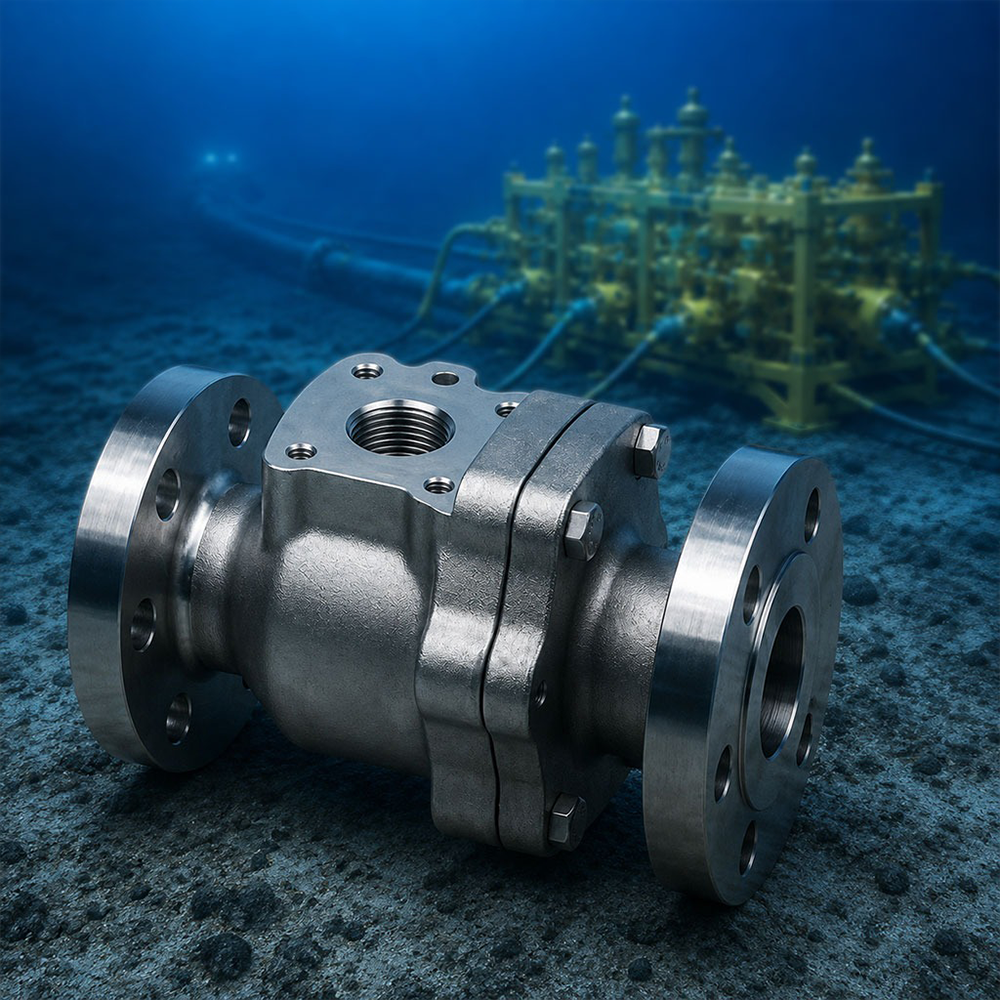
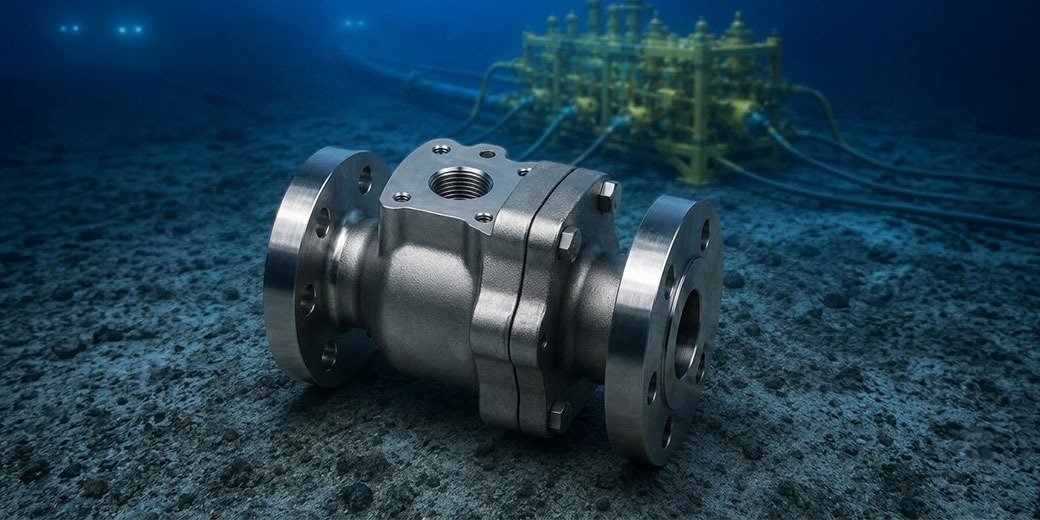
Subsea manifolds — the subsea structures that receive production from multiple satellite wells and route it to the export pipeline are among the most technically demanding and highest-value subsea forging applications. Each subsea manifold contains 20–50 individual forged valve bodies, nozzle forgings, hub forgings, and structural fitting forgings in super duplex 2507, Inconel 625, and 4130M alloy steel. TechnipFMC (Houston/Paris), Aker Solutions (Oslo), OneSubsea (Baker Hughes), and Schlumberger (now SLB) produce subsea manifolds for global deepwater developments. Indian API 20B certified forging manufacturers with super duplex and Inconel 625 capability are positioned to supply this technically demanding global market.
OEM
System
Key Forging
Material / Standard
TechnipFMC
Subsea tree, manifold, PLET
Valve body, choke body, connector hub
Super duplex 2507, API 20B PSL 4
Aker Solutions
Subsea production system
Valve body, riser connector
Super duplex 2507, NORSOK M-630
OneSubsea (Baker Hughes)
Subsea processing, tree
High-pressure valve body, pump housing
Inconel 625, super duplex
SLB (Schlumberger)
Subsea wellhead, tree
Wellhead housing, connector hub
4130M NACE, Inconel 625
Dril-Quip
Wellhead connector system
Wellhead casing head, tieback connector
4130M NACE, 17-4PH SS
TechnipFMC — headquartered in Houston (US) and Paris (France) following the 2017 merger of Technip and FMC Technologies is the world’s largest subsea equipment company by revenue. TechnipFMC’s subsea trees, manifolds, and pipeline-end terminations (PLETs) are installed at deepwater fields globally (GoM, Brazil, West Africa, North Sea, Southeast Asia). Each TechnipFMC subsea manifold contains 30–60 individual forgings valve bodies, connector hubs, structural flanges, and nozzle forgings sourced from TechnipFMC’s approved forging supplier list. The valve bodies and choke bodies are in super duplex 2507 or Inconel 625; structural flanges and nozzle forgings in A694 F65 or 4130M depending on the system design.
API 20B PSL 4 — the highest qualification level in the API 20B standard applies to the most safety-critical subsea pressure-containing components. PSL 4 requires: 100% volumetric UT of every piece, full chemical analysis including trace elements, heat treatment with independent inspection witness, hydrostatic proof test of each piece, and materials review board approval for any non-conformance. For TechnipFMC’s deepwater subsea trees operating at pressures up to 15,000 psi (1,035 bar) and temperatures to 350°F (177°C), PSL 4 is the standard quality level applied to the primary pressure-containing valve bodies.
Aker Solutions — headquartered in Fornebu, Norway, with global engineering centres designs subsea production systems for Norwegian North Sea and international deepwater projects. Aker Solutions’ subsea tree and manifold forging procurement follows NORSOK M-630 for CRA components alongside API 20B. The super duplex 2507 valve bodies for Aker Solutions’ subsea trees require G48 corrosion testing at 40°C the same requirement as Norwegian NCS subsea supply discussed in the Norway oil and gas blogs.
The global subsea manifold market is growing as more deepwater fields are developed without surface platforms the subsea tieback model (connecting satellite wells to an existing host platform via subsea manifold and pipeline) is increasingly preferred over standalone platform development for smaller fields. This trend drives manifold installation demand across all deepwater provinces GoM, pre-salt Brazil (Petrobras), West Africa (Nigeria LNG, Angola LNG), and Southeast Asia.
Super duplex 2507 (A182 F53) valve body forgings with G48 at 40°C, Charpy at -46°C, ferrite content 35–65%.
Inconel 625 forgings solution annealed with rapid water quench.
4130M NACE MR0175 sour service.
17-4PH stainless for wellhead connector systems.
NABL-accredited testing for all specified mechanical and corrosion tests.
TPI by Bureau Veritas, DNV, and Intertek — all on TechnipFMC and Aker Solutions approved TPI lists.
PMI (positive material identification) on all CRA components.
Documentation package format for API 20B PSL 4 complete including material review board traceability.
Frequently Asked Questions
1.What is API 20B PSL 4 and what does it add beyond PSL 3 for subsea manifold forging supply?+–
API 20B PSL 4 is the highest quality level for oilfield forgings, applying to the most safety-critical subsea pressure-containing components. PSL 4 adds to PSL 3: 100% UT of every production piece (PSL 3 requires sampling), full trace element chemistry (including copper, aluminium, tin, arsenic, antimony, phosphorus to tighter limits), materials review board (MRB) formal disposition of every non-conformance (no informal resolution), and in some cases hydrostatic proof test of each piece at 1.5× design pressure. The documentation package for PSL 4 is significantly more comprehensive than PSL 3 the engineering review and traceability requirements are those of a safety-critical component whose failure would result in an uncontrolled subsea blowout. Indian manufacturers seeking TechnipFMC and Aker Solutions deepwater supply must demonstrate PSL 4 documentation capability, not just PSL 3.
2.What is Inconel 625 and why is it used for subsea choke body forgings?+–
Inconel 625 (UNS N06625) is a nickel-chromium-molybdenum-niobium alloy providing excellent corrosion resistance across a very wide range of corrosive environments acidic, alkaline, chloride, and sour gas. For subsea choke bodies the flow control components that regulate wellbore production flow rate the combination of high-velocity erosion from the produced fluid stream and aggressive chemistry (H₂S, CO₂, chlorides, sand) creates service conditions that exceed the corrosion resistance of even super duplex stainless steel. Inconel 625 provides the corrosion and erosion resistance required in these most aggressive service conditions. The choke body forging in Inconel 625 is solution annealed at 1,093–1,204°C with rapid quench, providing the fully solid-solution-strengthened microstructure with maximum corrosion resistance and yield strength of 415 MPa minimum.
3.How do Indian API 20B manufacturers access TechnipFMC’s approved forging supplier list?+–
TechnipFMC’s approved forging supplier list (ASL) is managed by TechnipFMC’s global supply chain quality organisation, with regional procurement centres in Houston, Paris, and Kuala Lumpur. The qualification process involves: API 20B license verification in the API directory, on-site quality system assessment by TechnipFMC’s supply chain quality team (requiring travel to the Indian facility), qualification test forgings (typically 3–5 pieces in each material grade and size range), independent laboratory testing at a TechnipFMC-approved laboratory, and engineering review and approval by TechnipFMC’s materials and welding engineering group. Timeline: 18–30 months from initial engagement to ASL approval. The most efficient approach is to engage TechnipFMC’s Kuala Lumpur regional centre (which covers Asia-Pacific and sometimes India) alongside the Houston centre.
4.What is a PLET (Pipeline End Termination) and what forging content does it contain?+–
A PLET is the subsea structure at the end of a pipeline that provides the mechanical and flow connection to a subsea tree, manifold, or riser base. PLETs contain: the pipeline end connector (a forged hub that mates with the pipeline flange), isolation valves (with forged valve bodies in super duplex or alloy steel), and structural frame fittings (alloy steel structural flanges and connection nodes). PLETs are relatively small subsea structures (1–5 tonnes total weight) but contain 5–15 individual forgings per unit. For a deepwater field development with 10–20 satellite wells, the PLET forging content is 50–300 individual forgings per project a meaningful procurement volume for Indian forging manufacturers serving subsea equipment OEMs.
5.What positive material identification (PMI) testing is required for subsea CRA forging supply?+–
PMI (Positive Material Identification) is the in-field or in-workshop verification that a component’s material is what is specified on the documentation using portable XRF (X-ray fluorescence) spectrometry or OES to verify chemical composition directly on the component. For subsea CRA forgings (super duplex 2507, Inconel 625, 17-4PH), PMI is required by TechnipFMC, Aker Solutions, and most major subsea OEMs on 100% of CRA components before installation. PMI verifies that the correct CRA material was used not a less corrosion-resistant look-alike carbon steel or lower-grade stainless. Indian forging manufacturers must either perform PMI in-house (using NABL-accredited XRF equipment) or arrange for third-party PMI by the witnessing TPI company before components leave the facility