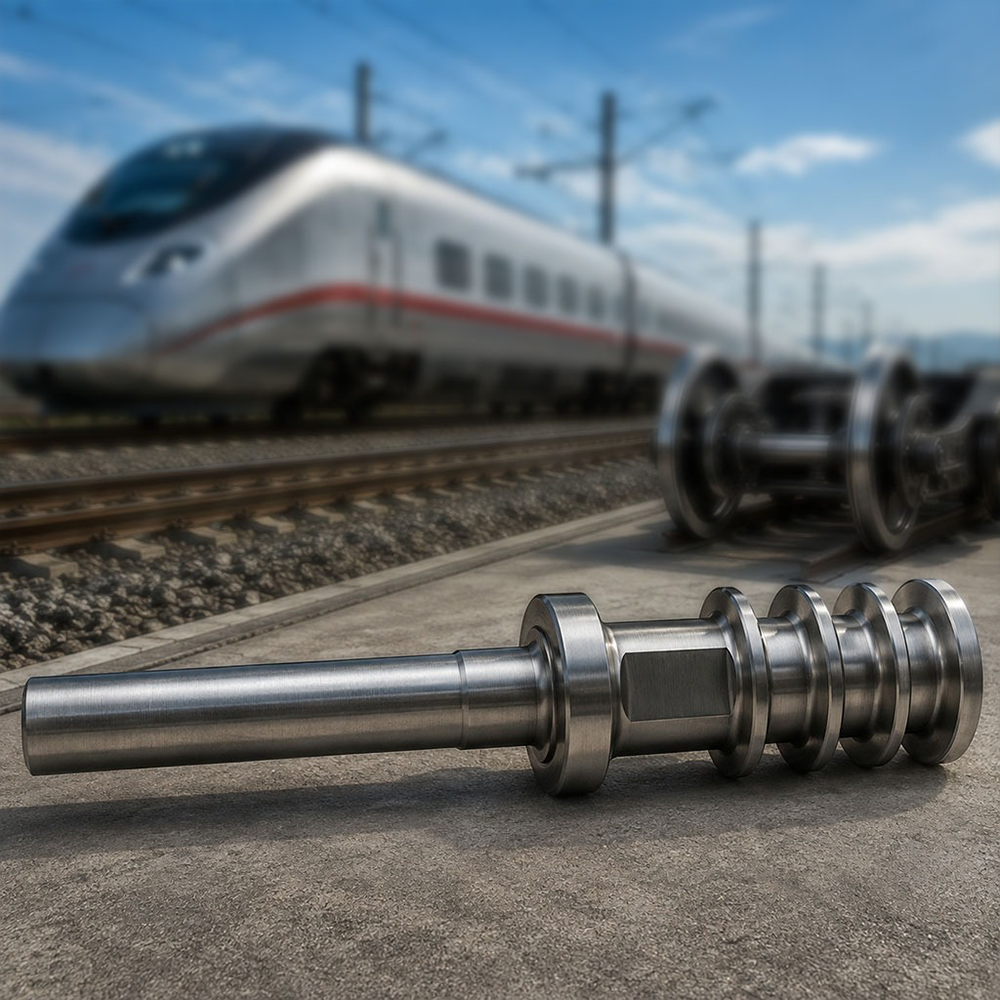
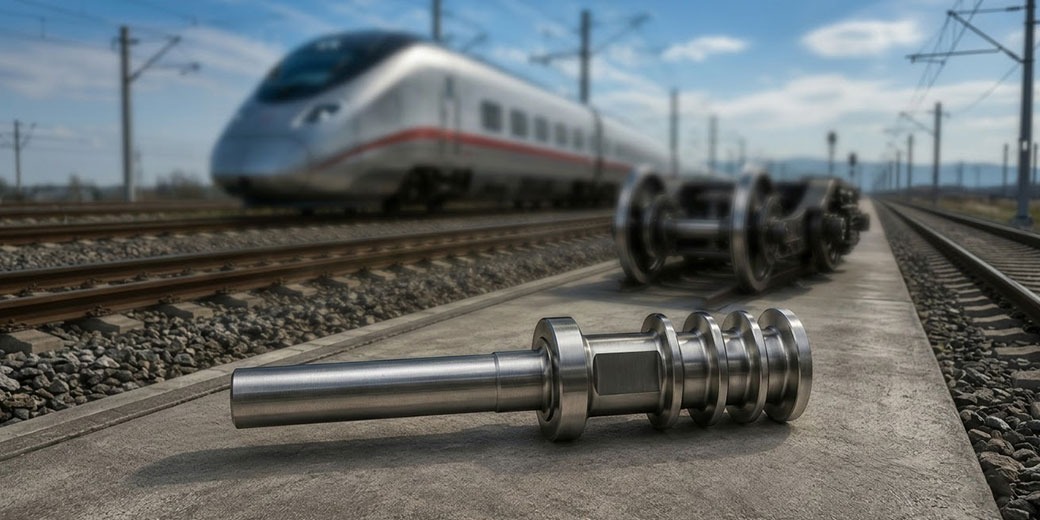
High-speed rail is experiencing its most significant global expansion in history — new HSR lines under construction or planned in the United States (Texas Central, Brightline West), Saudi Arabia (Haramain extension), India (Mumbai-Ahmedabad), Australia (Sydney-Melbourne), and across Southeast Asia and Africa. Every high-speed rail vehicle whether Siemens Velaro, Alstom Avelia, CAF Oaris, or CRRC Fuxing uses EA4T alloy steel axle forgings per EN 13261 as the universal standard. IRIS certified Indian forging manufacturers with open die EA4T capability are positioned to supply global HSR axle demand through the rolling stock OEM supply chains serving these emerging markets.
Market
Project / Programme
OEM
Axle Standard
USA
Brightline West (Las Vegas), Texas Central
Siemens Mobility, Talgo
EN 13261 EA4T or APTA equivalent
Saudi Arabia
Haramain HSR extension, NEOM
Siemens / Alstom (consortium)
EN 13261 EA4T
India
Mumbai-Ahmedabad Bullet Train
Kawasaki / Hitachi (Shinkansen)
JIS E 4502 equivalent, EN 13261
Australia
Sydney-Melbourne HSR (planning)
TBD — Siemens/Alstom likely
EN 13261 EA4T
Southeast Asia
Jakarta-Bandung (Indonesia)
CRRC / Siemens
EN 13261 EA4T or GB standard
The United States’ emerging high-speed rail market — driven by state and federal investment following the Infrastructure Investment and Jobs Act represents the most significant new HSR forging procurement opportunity outside China. Brightline West (Las Vegas to Rancho Cucamonga, California) is under active construction with Siemens Mobility’s Venture trainsets selected for operation. The Venture trainsets use EA4T axle forgings per EN 13261 establishing EN 13261 as the axle standard for US HSR operations. Texas Central (Dallas to Houston) has selected Hitachi/Shinkansen N700 Series technology, which uses JIS E 4502 axle standards closely related to EN 13261 EA4T requirements.
Saudi Arabia’s HSR expansion the Haramain HSR (Mecca-Medina) is already operational at 300 km/h using Talgo 350 and Renfe trains is planning extensions and the NEOM development includes new HSR connections within the futuristic urban development. The Haramain HSR uses EA4T axle forgings supplied through the Talgo-Renfe supply chain. Future Saudi HSR extensions will use the same rolling stock technology and therefore the same EA4T axle specification.
India’s Mumbai-Ahmedabad High Speed Rail (MAHSR) — the “bullet train” project using Japanese Shinkansen E5 Series technology is under active construction with the first phase between Surat and Bilimora planned for partial opening by 2026. The Japanese Shinkansen axle specification (JIS E 4502) is comparable to EN 13261 EA4T in material grade and inspection requirements. Indian forging manufacturers have a unique opportunity: As Make in India content requirements increase for the MAHSR programme, domestic EA4T axle forging supply from Indian IRIS-certified manufacturers becomes not just cost-competitive but policy-mandated.
Australia’s Sydney-Melbourne HSR feasibility study — commissioned by the Australian government in 2022 with results published in 2023 identified a technically viable corridor. The study recommended technology similar to European HSR (Siemens or Alstom platforms) that would use EN 13261 EA4T axle forgings. While commercial HSR development in Australia is 10–15 years from completion, early qualification of Indian axle forging suppliers with the likely OEMs (Siemens Mobility, Alstom) positions Indian manufacturers for this significant future procurement.
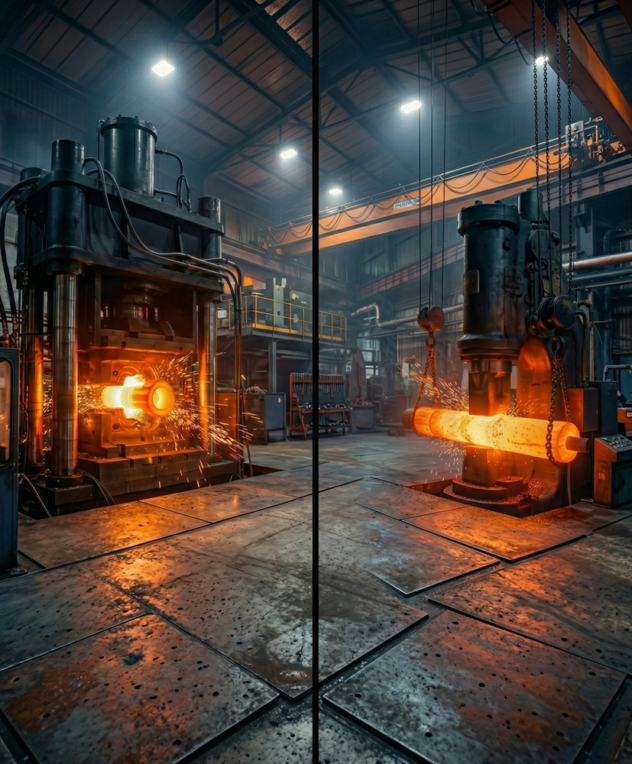
EA4T alloy steel axle forgings, 150–400 kg, open die on 3,000T hydraulic press.
100% UT with EA4T-specific calibration standard per EN 13261 Appendix A.
Full magnetic particle inspection of finished axle surface per EN 15313.
Complete EN 13261 documentation package: MTR, independent chemistry, heat treatment record, 100% UT report, MT report, dimensional report, certificate of conformance.
JIS E 4502 equivalency documentation for Japanese Shinkansen technology programmes (MAHSR).
NABL Charpy at -20°C. Make in India content certification capability for MAHSR programme axle supply.
Ocean freight Chennai to various ports: 14 days (Australia) to 28 days (USA).
Frequently Asked Questions
1.What is the Brightline West project and what EA4T axle forging demand does it create?+–
Brightline West is a privately funded high-speed rail project connecting Las Vegas to the Los Angeles suburban area (Rancho Cucamonga), with trains completing the 218-mile journey in approximately 2 hours 10 minutes at speeds up to 200 mph (320 km/h). Siemens Mobility’s Venture HSR trainsets have been selected. Each Venture trainset (8 cars) uses approximately 32 axle forgings. Brightline West’s initial fleet of 10 trainsets requires 320 axle forgings plus spares with additional trains ordered as ridership grows. The Brightline West opening (planned 2028 for the LA28 Olympics) establishes EN 13261 EA4T as the US HSR axle standard and creates the first significant US high-speed rail axle forging procurement accessible to IRIS-certified Indian manufacturers.
2.How does India’s Make in India policy affect MAHSR (Mumbai-Ahmedabad HSR) axle forging procurement?+–
The MAHSR project agreement between India and Japan specifies progressive Make in India content starting with Japanese-supplied trains and components for the first sets, then increasing Indian content for subsequent train sets. For axle forgings specifically, the MAHSR project has identified axle manufacturing as a priority for Indian industrial development. Japan International Cooperation Agency (JICA), which finances the MAHSR project, and the National High Speed Rail Corporation (NHSRC) are actively seeking qualified Indian manufacturers for EA4T equivalent axle forging supply as train set procurement progresses. An IRIS-certified Indian forging manufacturer with EA4T production capability and JIS E 4502 equivalency documentation is precisely the profile NHSRC seeks for MAHSR axle supply in the Make in India framework.
3. What is the difference between EN 13261 EA4T and Japanese JIS E 4502 for axle forgings?+–
EN 13261 EA4T (European standard) and JIS E 4502 (Japanese Industrial Standard for railway axles) specify very similar materials and requirements both target high-alloy steel with minimum tensile strength 700 MPa, guaranteed low-temperature Charpy impact, and 100% UT. The primary differences are: terminology (EN 13261 uses EA4T grade designation, JIS uses different classification identifiers), specific mechanical property numbers that differ marginally, and the ultrasonic testing procedure references (EN 15313 in European practice versus JIS Z 2344 in Japanese practice). An Indian forging manufacturer producing to EN 13261 EA4T can document JIS E 4502 equivalency through a comparative technical assessment demonstrating that the material and inspection requirements are met simultaneously by the EN 13261 production process.
4.What market certification is required for HSR axle supply in the United States and how does EN 13261 relate to it?+–
The United States does not have a national standard equivalent to EN 13261 specifically for high-speed rail axles the FRA (Federal Railroad Administration) and APTA (American Public Transportation Association) standards cover conventional passenger rail but not speeds above 200 mph. For Brightline West (selecting Siemens Venture trainsets), the applicable axle standard will follow the Siemens Venture’s existing EN 13261 EA4T specification from European operations. The FRA’s oversight of HSR safety in the US is evolving the FRA is developing safety standards for operations above 200 mph through its High Speed Ground Transportation research programme. In the interim, operators importing certified European HSR technology use the European standards (EN 13261) as the axle material specification.
5.What competitive advantage does an IRIS-certified Indian forging manufacturer have in global HSR axle supply versus Chinese competitors?+–
Chinese axle forging manufacturers (CRRC subsidiaries, CSR Qishuyan) are highly competitive for HSR programmes using Chinese technology (Jakarta-Bandung in Indonesia, Africa HSR) but face significant market access barriers in Europe, the US, Japan, and Australia due to geopolitical concerns about Chinese technology in critical infrastructure. European and US HSR programmes specifically exclude or restrict CRRC and associated suppliers. IRIS-certified Indian manufacturers face none of these geopolitical restrictions India is viewed as a neutral, trusted manufacturing source by European, US, Japanese, Australian, and Saudi Arabian procurement organisations. This geopolitical neutrality, combined with competitive pricing (20–30% below European axle forging supply) and IRIS certification, gives Indian manufacturers a distinctive competitive advantage in non-Chinese global HSR programmes.