
Inconel 718 Forging for Indian Aerospace: GTRE Kaveri, HAL Engine Division, and ISRO
India’s aerospace and space sector — HAL’s Aero Engine Division (Bengaluru), ISRO, and DRDO’s aeronautical laboratories consumes Inconel 718 forged compressor disc, turbine disc, and structural ring components for military aeroengines, launch vehicle propulsion systems, and missile propulsion. The GTRE (Gas Turbine Research Establishment, Bengaluru) developing the Kaveri engine, ISRO’s Vikas liquid propulsion engine (for GSLV/PSLV), and DRDO’s missile propulsion programmes all require Inconel 718 forging capability that has historically been imported or produced at government facilities. Make in India aerospace manufacturing creates the strategic imperative for domestic Inconel 718 forging supply from AS9100D-certified private sector Indian manufacturers.
| Organisation / Programme | Inconel 718 Application | Specification | Make in India Status |
| GTRE — Kaveri engine (GTX-35VS) | HP compressor disc, combustor casing ring | AMS 5663 equivalent, CEMILAC | Strategic priority — domestic supply critical |
| HAL Engine Division (Bengaluru) | Adour, Shakti, PTAE-7 engine components | AMS 5663, AS9100D | HAL vendor qualification required |
| ISRO — Vikas engine (GSLV/PSLV) | Turbopump structural ring, combustion chamber | ISRO internal spec, AS9100D | ISRO qualified domestic vendor needed |
| DRDO — DRDL (Hyderabad) | Missile propulsion structural rings | DRDO classified, AS9100D baseline | Atmanirbhar Bharat — domestic priority |
| BDL — Akash missile propulsion | Solid rocket motor casing structural fittings | DRDO specs, DGQA | PIL listed — domestic mandatory |
GTRE (Gas Turbine Research Establishment) — DRDO’s gas turbine R&D laboratory in Bengaluru — has been developing the Kaveri engine (GTX-35VS) for the Tejas LCA since the 1980s. While the Kaveri has faced development challenges, GTRE continues R&D on the engine core and is developing the Kaveri Derivative (KD) engine for unmanned combat aerial vehicle (UCAV) applications. The Kaveri’s high-pressure compressor uses Inconel 718 disc forgings processed to AMS 5663-equivalent specifications currently the most critical domestic Inconel 718 forging requirement in the Indian defence aerospace sector.
ISRO’s Vikas engine a liquid-fuelled rocket engine producing 790 kN thrust, used in the second stage of PSLV and the core stages of GSLV uses Inconel 718 for turbopump structural rings and injector plate structural components. The Vikas engine’s turbopump operates at very high rotational speeds (approximately 10,000 rpm) with liquid propellant Inconel 718’s combination of high strength, cryogenic toughness, and resistance to both reducing and oxidising environments makes it the design choice. ISRO has established its own material qualification process for domestic Inconel 718 forging suppliers.
HAL’s Engine Division (HAED, Bengaluru) produces the Shakti engine (a licensed Turbomeca Ardiden derivative for the Dhruv ALH helicopter) and the PTAE-7 (a Pratt & Whitney Canada JT15D derivative for the HJT-36 Sitara trainer). Both engines use Inconel 718 compressor and turbine structural rings. Private sector AS9100D manufacturers who receive HAED vendor approval can supply Inconel 718 structural rings for these programmes reducing HAED’s dependence on imported components and licensed OEM-controlled supply chains.
ISRO’s Gaganyaan human spaceflight programme — India’s first crewed orbital mission requires the highest levels of reliability and traceability for all structural components. The service module and crew module structural fittings and propulsion system hardware use Inconel 718 and Ti-6Al-4V forgings with the most stringent quality documentation requirements in Indian aerospace. ISRO’s vendor qualification for Gaganyaan-critical components includes witness testing, document audits, and independent third-party laboratory verification of material properties.
Vinir Capability
- AS9100D full scope — the quality management baseline for CEMILAC, ISRO, and GTRE vendor qualification.
- Inconel 718 double ageing at 718°C ± 8°C and 621°C ± 8°C in AMS 2750-calibrated furnaces with full TUS records.
- AMS 5663-equivalent heat treatment with complete furnace documentation.
- VAR or triple-melt billet from Special Metals or Carpenter Technology for aerospace rotating component applications.
- AMS 2154 Class A immersion UT.
- FPI to AMS 2647.
- AS9102 FAIR capability for GTRE and HAED first article qualification.
- NABL chemistry (OES including trace elements) and mechanical testing.
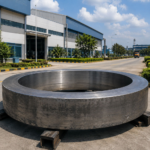
- Ring rolling to Ø4,500mm for ISRO turbopump and DRDO missile structural ring applications.