
AS9100D Aerospace Forging Qualification in India: What the Certification Process Really Involves
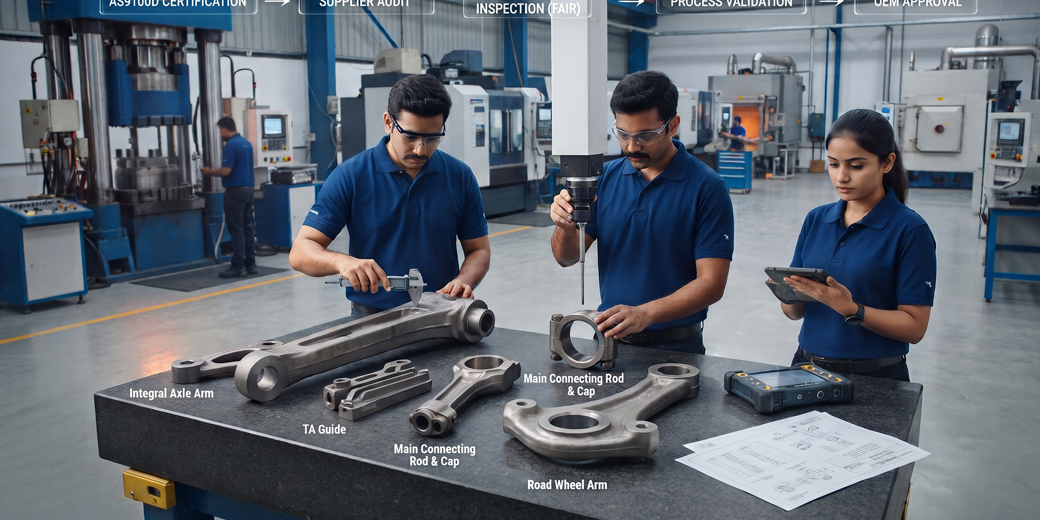
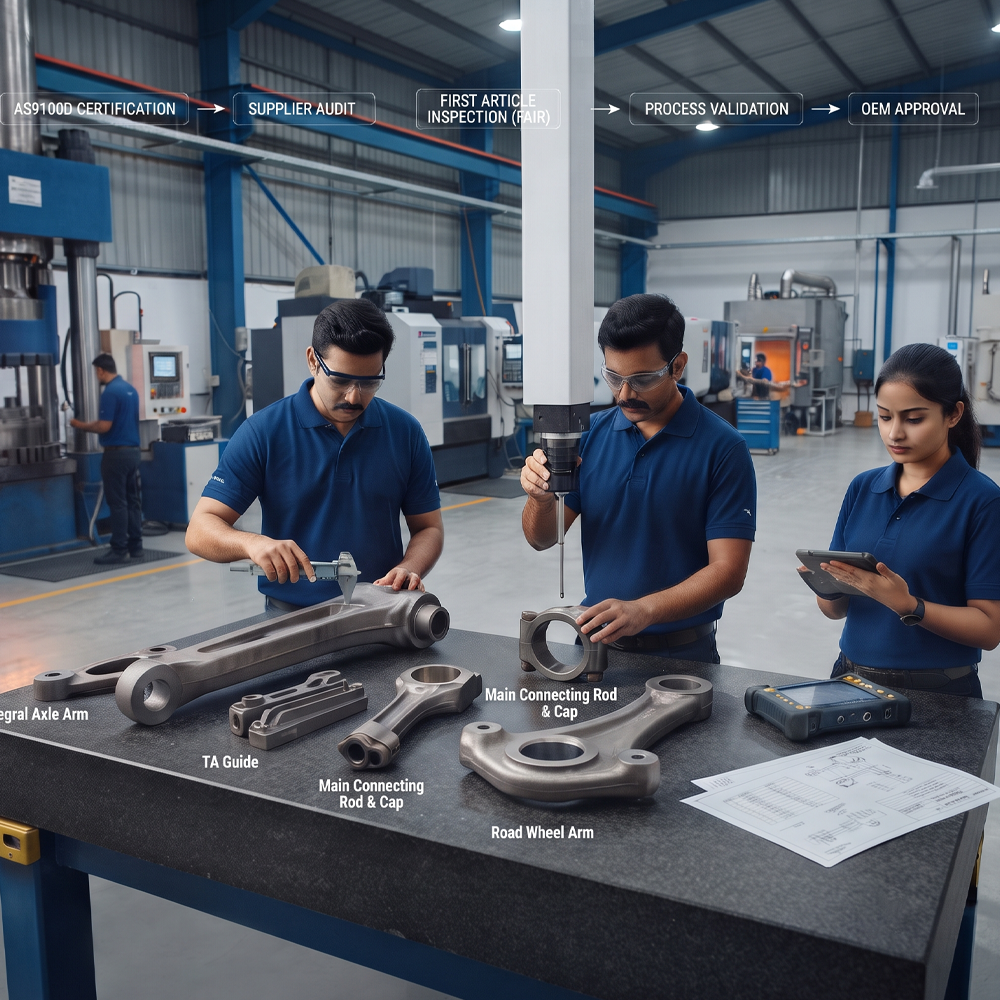
AS9100D aerospace forging qualification is the process by which an aerospace OEM evaluates, tests, and approves an Indian forging manufacturer to supply structural components for a specific aircraft, helicopter, or aeroengine programme. It is not the same as obtaining AS9100D certification — the certificate is the entry gate, not the destination. Qualification is what happens after the certificate, and it is the qualification process, not the certificate, that determines whether a forging supplier actually enters an aerospace supply chain.
The Distinction Between AS9100D Certification and Aerospace Qualification
This distinction is the most important thing to understand before approaching an aerospace OEM as a forging supplier. Many Indian forging manufacturers conflate the two — believing that obtaining AS9100D certification makes them qualified to supply aerospace programmes. It does not.
AS9100D certification — granted by a commercial third-party certification body after an audit of the quality management system — confirms that the supplier’s processes are documented, controlled, and meet the requirements of the standard. It covers the quality management system, not any specific product.
Aerospace qualification — conducted by the OEM’s supplier quality team for a specific component family, material, and process type — confirms that the supplier can produce the specific components required, to the specific drawing and specification, with the specific traceability and documentation expected for that programme.
A supplier can hold AS9100D certification for five years and never be qualified for a single aerospace programme. Qualification requires active engagement with an OEM qualification process — which takes additional time beyond the certification effort.
At a Glance: The Aerospace Forging Qualification Stages
| Stage | Activity | Typical Duration |
| 0 — Pre-qualification | AS9100D in place, capability statement submitted | Pre-condition |
| 1 — Initial assessment | Document review, certification verification, capability evaluation | 2–3 months |
| 2 — Supplier audit | On-site quality system and shop floor capability audit | 2–3 months |
| 3 — First article | Drawing-specific production run, complete FAIR submission | 4–8 months |
| 4 — Process validation | Repeat production runs demonstrating repeatability | 6–12 months |
| 5 — AVL approval | Approved vendor listing for specific component family | 1–3 months |
| Total | First contact to first production order | 18–30 months |
Stage 0: What Must Be in Place Before Approaching an Aerospace OEM
Approaching an aerospace OEM for qualification without the following in place wastes both parties’ time and creates a negative first impression that is difficult to reverse.
Current AS9100D Certificate — Correct Scope
The AS9100D certificate must be current, from an IAQG-recognised certification body, and scoped to cover all processes the supplier will perform for the aerospace programme. If the programme requires titanium forging, heat treatment, and NDT — all three must be within the AS9100D scope. A certificate scoped to “forging only” or “steel forgings only” does not support a titanium aerospace programme.
Relevant Production History
The supplier needs documented production history in a material and weight range relevant to the target programme. Approaching HAL’s Tejas programme for titanium airframe forgings without any previous titanium forging production history produces an instant rejection at Stage 1. The OEM needs evidence that the supplier has actually forged in the material — recent material test reports from titanium production lots are the minimum credibility requirement.
In-House Special Processes
Heat treatment and NDT must be in-house and under the AS9100D scope. Aerospace OEMs treat outsourced special processes as a significant qualification risk. Qualification with outsourced heat treatment requires the OEM to additionally assess the heat treatment subcontractor — effectively doubling the audit effort and halving the probability of qualification success.
NABL-Accredited Testing
Mechanical test results supporting the qualification must come from a NABL-accredited lab. For suppliers with in-house NABL-accredited labs, this is straightforward. For suppliers who outsource testing, the coordination with an external lab adds timeline risk at every subsequent qualification stage.
Stage 1: The Initial Assessment
The OEM’s supplier quality or supply chain team conducts a desk-based assessment of the submitted documentation before any site visit is scheduled.
What Is Reviewed
AS9100D certificate — expiry date, certification body name (verified as IAQG-recognised via OASIS database), scope statement. The scope statement receives the most scrutiny — auditors check that it covers the specific processes and facilities the supplier proposes to use.
Capability statement — specific processes, weight ranges, materials forged with evidence. Generic statements (“we can forge any material”) are flagged immediately. Specific statements supported by recent production records (“we have forged Ti-6Al-4V in the 50–800 kg range in the last 12 months, records available on request”) pass Stage 1.
Equipment list — press capacities, furnace dimensions and temperature ranges, NDT equipment, test equipment. Cross-referenced against the programme requirement. A supplier with a 1,000T maximum press capacity cannot supply a 2,000 kg forging regardless of what their quality manual says.
Customer reference list — existing customers in aerospace or defence supply chains. A supplier already qualified for defence programmes has demonstrated quality system robustness that reduces Stage 1 risk.
Financial health indicators — basic assessment of company stability. A supplier operating in financial distress cannot sustain a multi-year qualification programme or the capital investment required for programme-specific tooling.
Stage 2: The On-Site Audit
The on-site audit is where the claims in the Stage 1 submission are verified against operational reality. Aerospace supplier audits are more thorough and technically detailed than standard commercial quality audits — the auditors are typically aerospace engineers with manufacturing backgrounds, not generic quality auditors.
What Aerospace Auditors Check That Standard Audits Often Miss
Grain flow in demonstration forgings — auditors may ask to review the die design rationale for a recent production forging. Can the supplier explain how the die design orients grain flow to the principal stress direction? A supplier who cannot answer this question for their own production parts raises concern about their aerospace design understanding.
Titanium alpha case control — for suppliers claiming titanium capability, the audit will include review of the atmospheric protection measures during titanium heating — inert gas cover, controlled atmosphere furnace, or protective coating application. An auditor who asks how alpha case is prevented and receives a blank look has found a disqualifying gap.
Temperature measurement at the forging — not just the furnace — furnace temperature is controlled. The billet temperature at the die is what matters. Auditors ask how billet temperature is verified during the forging operation — pyrometer measurement at the press, time-at-temperature calculations based on furnace soak records, or billet temperature measurement immediately before each press stroke.
FAI process understanding — the quality team is asked to walk through how a first article inspection is conducted. Can they describe the ballooning process? Do they understand the difference between key characteristics and general dimensions? Have they submitted FAIRs to aerospace customers previously and can they show examples?
Non-conformance culture — the auditor reviews the NCR log, as always. But aerospace auditors go further — they ask quality team members to describe the last significant non-conformance and what the root cause investigation revealed. They are assessing whether the quality culture produces genuine investigation or superficial containment.
Stage 3: First Article Inspection — The Most Intensive Stage
First article inspection for aerospace is more demanding than for most other defence applications. The FAIR package that an aerospace OEM expects is defined by AS9102 — the First Article Inspection standard — which specifies 21 forms covering every aspect of the forging design and manufacturing process.
The AS9102 FAIR Package for Aerospace Forgings
Not every AS9102 form applies to every forging, but the core forms that are always required include:
Form 1 — Part Number Accountability — confirms the drawing number, revision, and the manufacturing plan reference under which the forging was produced.
Form 2 — Product Design Documentation — confirms that the drawing used in production is the current approved revision, that all referenced specifications are available and current.
Form 3 — Engineering Drawing Inspection — every dimension on the drawing is measured and recorded with actual values, tolerance bands, and pass/fail status.
Form 4 — Design Characteristic Accountability — all key characteristics identified on the drawing are listed, the inspection method for each is defined, and results are recorded.
Form 5 — Material/Raw Material Test Results — mill certificate referenced, independent chemical analysis results, and confirmation that the material meets the applicable AMS or equivalent specification.
Form 8 — Certificate of Conformance — the supplier’s formal declaration that the first article conforms to the drawing and applicable specifications.
Form 9 — Special Process Certificate(s) — copies of the heat treatment procedure approval, the NDT written practice, and the applicable AMS 2750 calibration records confirming furnace compliance.
The complete AS9102 FAIR package for a complex aerospace forging may run to 50–100 pages. Assembling this correctly — with all cross-references consistent, all actual values within tolerance, and all supporting records attached — is a capability test in itself.
Stage 4: Process Validation — Proving Repeatability
A successful first article proves the supplier can make the component once under conditions of maximum attention and preparation. Process validation proves they can make it consistently under normal production conditions.
During process validation the supplier manufactures three to five production lots across different raw material heats. The OEM analyses:
Dimensional consistency — are key dimensions consistent across all batches, or is there drift that suggests the die is wearing or process parameters are varying?
Mechanical property consistency — are tensile strength, yield, elongation, and impact values consistent across heats, or are there unexplained variations that suggest the heat treatment process is not adequately controlled?
NDT result patterns — are there recurring UT indications in the same location across multiple lots? This would suggest a systematic process problem — inadequate reduction in a specific zone, die geometry creating a fold that UT detects — rather than random material variability.
Documentation completeness — is the documentation package for batches two through five as complete as the first article package, or did standards slip once the intensive qualification scrutiny was removed?
The last point is the most revealing. First articles are prepared with maximum care. Process validation batches reveal the normal production standard.
HAL-Specific Qualification Requirements
HAL’s supplier qualification process for aerospace forgings follows the AS9100D-based framework but adds HAL-specific requirements that reflect both HAL’s internal quality management approach and the DGCA/military airworthiness authority requirements applicable to HAL platforms.
HAL Vendor Registration
HAL maintains a centralized vendor registration system covering all divisions — Aircraft Division Bangalore, Helicopter Complex Bangalore, Accessories Complex Lucknow, Aircraft Manufacturing Depot Nasik, and others. Each division manages its own approved vendor list for its specific component requirements.
Initial HAL vendor registration requires :
- Online registration in HAL’s vendor portal
- Submission of AS9100D certificate, company profile, capability statement, and equipment list
- Review by HAL’s Materials and Supply Chain division
- Forwarding to the relevant division’s vendor qualification team if initial screening is passed
HAL Technical Assessment
Following registration, the relevant HAL division conducts a technical capability assessment — effectively Stage 2 of the standard qualification framework but with HAL engineers who are familiar with the specific component families HAL requires. The assessment includes review of previously supplied components to other customers where available, witness of a demonstration forging in a relevant material if the supplier agrees to this, and detailed review of process documentation for the material grade required.
Military Airworthiness Linkage
HAL platforms under military airworthiness authority oversight — the Centre for Military Airworthiness and Certification (CEMILAC) for Indian military aircraft — require that forging suppliers are traceable in the configuration management system. This means the approved supplier, the material specification, and the forging process are all documented in the aircraft’s type design documentation. Any change to supplier, material, or process requires a design change notification and airworthiness authority review — which is why HAL-qualified forging suppliers are extremely difficult to replace.
International Aerospace OEM Qualification Through Offset
For Indian forging manufacturers targeting international aerospace OEM supply — Airbus, Boeing, Safran, GE Aviation, Rolls-Royce — the qualification pathway typically runs through India’s offset mechanism, which provides commercial incentive for the international OEM to qualify Indian suppliers.
The offset qualification process follows the same five stages but with additional requirements specific to the international OEM:
NADCAP for special processes — Airbus, Boeing, and most major international aerospace primes require NADCAP accreditation for heat treatment and NDT in addition to AS9100D. NADCAP assessment is significantly more demanding than AS9100D — achieving NADCAP for heat treatment (AC7102) is a 12–18 month additional effort after AS9100D is in place.
OEM-specific material approvals — international OEMs may specify proprietary material grades or require material from OEM-approved mills specifically. A forging to a Boeing specification may require material from a Boeing-approved mill that supplies specific chemistry and melting practice traceability beyond standard AMS requirements.
Airworthiness authority linkage — for civil aviation components, the supplier may need to be listed in the production approval holder’s manufacturing plan, which is subject to DGCA, FAA, or EASA oversight depending on the aircraft’s certification basis.
Vinir’s Aerospace Qualification Credentials
Vinir Engineering enters aerospace qualification discussions with the primary barriers already removed:
- AS9100D across all four manufacturing units with full forge-to-finish scope
- Titanium forging capability — Ti-6Al-4V production history with ASTM-method mechanical testing
- Inconel capability — 625 and 718 production history
- NABL-accredited in-house test lab for mechanical and chemical testing
- AMS 2750 equivalent furnace pyrometry on all heat treatment equipment
- In-house NDT — UT (contact and immersion), FPI, MT — by ASNT Level II certified operators
- 42 years of documented aerospace and defence forging production history
For aerospace OEM qualification teams beginning supplier assessment, Vinir can provide a complete Stage 1 submission package within five working days.
Frequently Asked Questions — Aerospace Forging Qualification India
What is the difference between AS9100D certification and aerospace qualification?
AS9100D certification is granted by a commercial third-party certification body after an audit of the quality management system — it confirms the system meets the standard requirements. Aerospace qualification is conducted by the OEM for a specific component family, material, and process — it confirms the supplier can produce the specific components required. AS9100D is the entry gate for qualification; qualification is what enables actual supply. A supplier can hold AS9100D for years without being qualified for any aerospace programme.
How long does HAL aerospace forging qualification take?
HAL aerospace forging qualification typically takes 18–30 months from initial vendor registration to first production order. The timeline depends on the component complexity, material family, and whether the supplier has existing HAL vendor registration and production history. Suppliers with existing AS9100D certification, relevant material production history, and all special processes in-house compress the Stage 1 and 2 timeline. New material families — first-time titanium qualification, for example — extend Stage 3 due to process development requirements.
Is NADCAP required for Indian aerospace forging programmes?
NADCAP is not currently a routine requirement for Indian DPSU aerospace programmes (HAL, DRDO). It is increasingly required for Indian suppliers participating in international aerospace OEM offset programmes — Airbus, Boeing, Safran, GE Aviation all require NADCAP for heat treatment and NDT. Indian suppliers targeting international aerospace supply should plan NADCAP accreditation alongside or after AS9100D as part of their capability roadmap.
What is an AS9102 FAIR and when is it required?
AS9102 defines the standard for First Article Inspection Reports in aerospace. It specifies a set of forms covering part number accountability, drawing inspection (every dimension measured and recorded), material test results, key characteristic accountability, special process certificates, and certificate of conformance. A FAIR to AS9102 is required by most aerospace OEMs for every new part number entering their supply chain. It is a comprehensive documentation package that typically runs to 50–100 pages for a complex aerospace forging.
Can an Indian forging manufacturer supply both HAL and international aerospace OEMs simultaneously?
Yes, provided the quality management system and capabilities meet both sets of requirements. HAL requirements are based on AS9100D with CEMILAC/DGCA military airworthiness overlay. International OEM requirements are based on AS9100D with potential NADCAP and airworthiness authority overlay. The qualification processes are separate — being qualified for HAL does not automatically qualify a supplier for an international OEM programme, but the quality system infrastructure and production history from HAL supply significantly strengthens the case for international qualification.