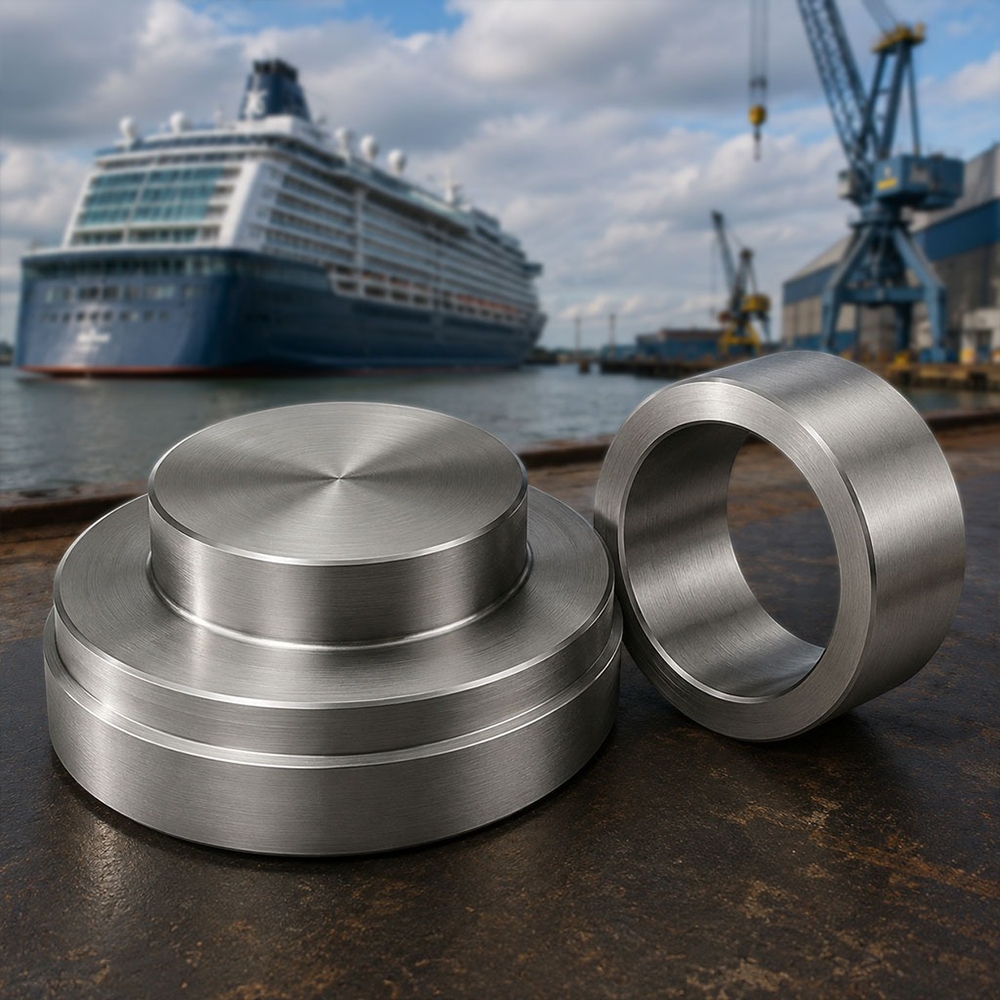
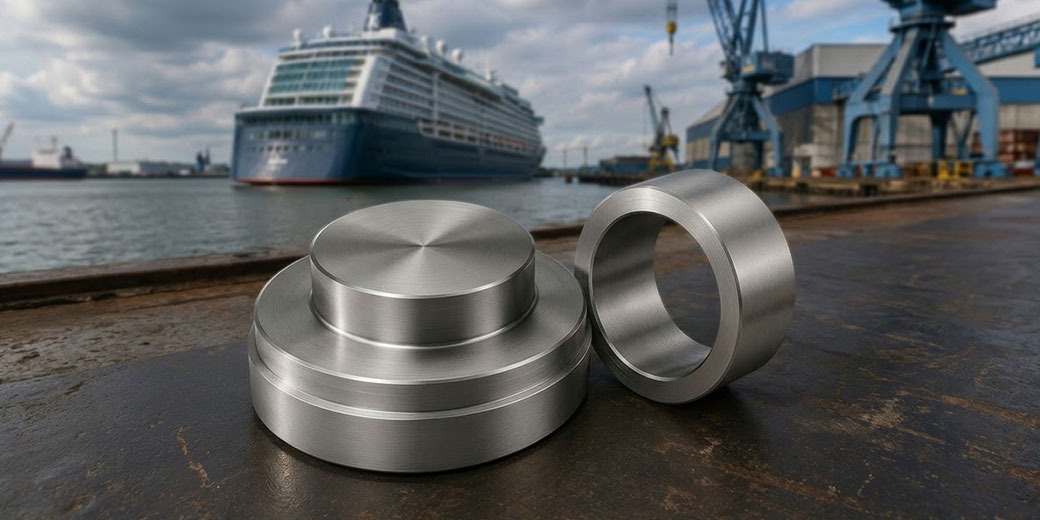
Finland’s marine industry — led by Meyer Turku shipyard (Turku), Wärtsilä Corporation (Helsinki), and Kongsberg Maritime Finland represents the highest concentration of cruise ship and complex ferry shipbuilding technology in the world. Meyer Turku has delivered cruise ships for Royal Caribbean, Carnival, and TUI Cruises. Wartsila designs and manufactures large marine diesel and dual-fuel engines, propulsion systems, and energy storage solutions. Both companies source alloy steel and specialty alloy forged shafts, propulsion components, and structural fittings requiring ABS, Bureau Veritas, or Lloyd’s Register classification.
Company
Product
Key Forging
Classification
Meyer Turku (Turku)
Cruise ships (Icon of the Seas class)
Propulsion shaft, rudder stock, hull fittings
Lloyd’s Register, DNV
Wärtsilä (Vaasa)
W31, W46F marine diesel engines
Crankshaft forgings, connecting rod
ABS / DNV survey
Wartsila (Vaasa)
PropStar, Azipull thrusters
Thruster shaft, propeller hub
ABS / Lloyd’s Register
Kongsberg Maritime Finland
KC thruster, azimuth thrusters
Thruster structural shaft
ABS / DNV
ABB Marine (Helsinki)
Azipod propulsion units
Azipod structural hub, motor shaft
ABS / DNV / LR
Meyer Turku — building the world’s largest and most complex cruise ships at its Turku, Finland shipyard is the most demanding shipbuilding customer for marine forgings in the Baltic region. Royal Caribbean’s Icon of the Seas (228,081 GT, world’s largest cruise ship) was delivered from Turku in 2023. Each mega-cruise ship of this class uses propulsion shaft forgings of 3,000–6,000 kg (typical shaft diameter 700–900mm for electric azipod propulsion systems) and multiple rudder stock forgings and structural hull fittings. Meyer Turku applies Lloyd’s Register or DNV GL classification to cruise ship structural and propulsion components the classification surveyor witnesses heat treatment and mechanical testing at the forge shop before any component can be incorporated in the vessel.
Wartsila — with engine manufacturing in Vaasa, Finland produces the W31 medium-speed marine diesel and the W46F marine four-stroke engine used in cruise ships, ferries, and cargo vessels. The W46F engine powering many Meyer Turku cruise ship installations uses a large marine crankshaft that is either forged from a single alloy steel billet (monoblock crankshaft) or assembled from individual throw forgings. Wärtsilä sources crankshaft forgings from established European forging companies (Valdunes in France, SIFCO in the USA, and select Asian suppliers) with AMS or equivalent classification survey. The crankshaft forging for a W46F engine delivering 680 kW per cylinder over 12–18 cylinders weighs 8,000–25,000 kg in the rough-forged condition at the upper limit of Indian forging capability.
Wartsila’s PropStar and Azipull azimuth thruster systems — compact propulsion units that rotate 360° to provide thrust in any direction without a separate rudder use sealed shaft forgings and propeller hub forgings in alloy steel. The thruster shaft and hub are smaller than main propulsion shafts (500–2,000 kg) and within Indian open die forging capability. Wärtsilä’s thruster supply chain applies ABS or Lloyd’s Register classification survey requirements.
ABB’s Azipod propulsion system — an electric podded propulsor where the electric motor is mounted in a submerged pod rotating on a vertical axis is used on most of Meyer Turku’s cruise ships. The Azipod pod structural hub and motor shaft are forged in alloy steel with ABS or DNV classification. ABB Marine’s Azipod supply chain manages forging procurement through ABB’s industrial procurement team in Helsinki.
Ocean freight Chennai to Turku or Vaasa: 24–30 days.
Frequently Asked Questions
1.What is the Metso Outotec cone crusher main shaft specification and why is 100% UT so critical?+–
Metso’s HP and MP series cone crusher main shafts are forged in 4340 alloy steel, quenched and tempered to tensile strength 1,000–1,200 MPa (yield 900–1,100 MPa), with Charpy impact minimum 35 J at -20°C. The main shaft rotates eccentrically under the full crushing load every revolution subjects the shaft to a complete bending cycle. Any subsurface inclusion in the shaft cross-section is a potential fatigue crack initiation site under this cyclic bending loading. 100% UT before machining is mandatory because machining removes the surface inspection opportunity once a shaft is machined, internal defects cannot be detected without removing all the machined material. A single UT-detectable inclusion missed in inspection that subsequently causes fatigue fracture of a crusher shaft represents a mine production shutdown of days to weeks plus €50,000–150,000 in shaft replacement cost.
2.What is CD4MCu duplex stainless steel and why does Metso use it for slurry pump shafts?+–
CD4MCu is a duplex (austenitic-ferritic) stainless steel casting alloy equivalent to wrought UNS S32550 approximately 26% Cr, 5% Ni, 2% Mo, 3% Cu. In forged shaft form, CD4MCu provides excellent corrosion and erosion resistance in mining slurries containing abrasive solids and corrosive chemicals (acidic leaching solutions, seawater in coastal mining operations). The duplex microstructure gives higher strength than austenitic stainless (yield 550+ MPa versus 200–300 MPa for 316L) while maintaining corrosion resistance superior to ferritic stainless. Metso specifies CD4MCu or equivalent duplex alloys for pump shafts in aggressive slurry service standard carbon or alloy steel would corrode and erode rapidly. Indian forging manufacturers with duplex stainless production capability (solution annealing at 1,120°C with rapid quench, ferrite content 40–55%) can supply CD4MCu pump shaft forgings.
3.How does Konecranes’ global port crane portfolio (Gottwald, Noell) create forging opportunities for Indian suppliers?+–
Gottwald mobile harbor cranes and Noell reach stackers acquired by Konecranes from Demag and TiiM respectively are deployed at ports globally. Each Gottwald harbor crane uses a slew bearing ring forging (42CrMo4, Ø2,000–3,500mm) and multiple structural pin forgings (4340, 50–200 kg). With 1,000+ Gottwald cranes operating at ports on six continents and a new crane production rate of 80–120 cranes per year, Konecranes’ slew bearing ring and structural pin procurement represents a substantial and geographically diverse forging demand. Indian ring rolling manufacturers with 42CrMo4 through-hardening capability and Ø4,500mm capacity can supply Konecranes’ slew bearing requirements with TPI by Bureau Veritas or Intertek as specified.
4.What Finnish industrial quality standards apply to Metso Outotec and Konecranes forging supply?+–
Finland follows European EN standards rather than distinct national standards for industrial equipment. Metso Outotec applies ISO 683 (heat-treated steels) and ISO 6892 (tensile testing) for mechanical property verification, with additional Metso engineering specifications defining geometry, tolerances, and acceptance criteria for each equipment model’s specific shaft and structural forgings. Konecranes applies EN 1090 (structural steel fabrication) for crane structural components and FEM (Fédération Européenne de la Manutention) crane design standards. Both companies apply ISO 9001 as the minimum supplier quality management standard. Indian suppliers who provide material certificates referencing EN standards alongside ASTM equivalents satisfy Finnish OEM incoming inspection requirements.
5.What is the critical minerals processing equipment opportunity for Finnish mining OEMs and Indian forging suppliers?+–
Europe’s Critical Raw Materials Act targets domestic processing of lithium, cobalt, nickel, and graphite for the EV battery supply chain. Finland is positioning itself as a critical minerals processing hub Boliden operates nickel smelting at Harjavalta; Terrafame produces nickel and cobalt at Sotkamo. Metso Outotec supplies the HPGR (High Pressure Grinding Roller) and flotation equipment for these processing operations. HPGR roller shaft forgings in high-chrome alloy steel or hardened alloy steel at 1,400–1,600 MPa tensile represent a new forging category distinct from conventional copper and gold processing equipment. Indian manufacturers with high-strength alloy steel capability and 100% UT can supply Metso Outotec’s expanding critical minerals equipment programme.