
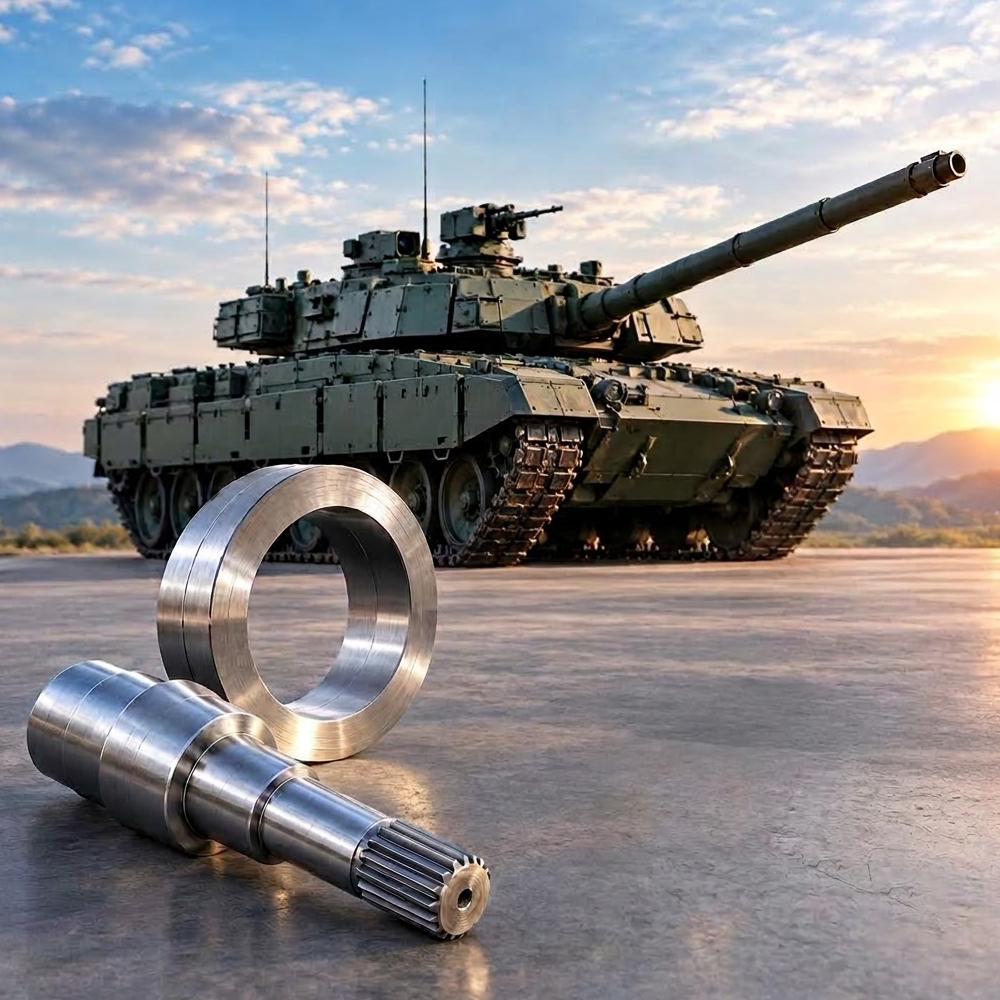
Defence Forging Manufacturer in India: Critical Components, Materials and Manufacturing Capabilities
Defence equipment operates in environments where component failure can have consequences far beyond ordinary production downtime.
Armoured vehicles, naval systems, military aircraft, mobility platforms and other defence equipment require components capable of handling high loads, cyclic stress, shock, vibration and demanding environmental conditions.
For this reason, defence forgings are used across a wide range of structural, transmission, propulsion and mechanical systems.
For global and US defence OEMs evaluating a defence forging manufacturer in India, the most important question is not simply whether a supplier owns a large press or hammer. The real question is whether the supplier can combine the correct forging route, material control, heat treatment, machining, inspection and traceability for the specific programme.
Why Forging Is Used for Defence Components
Defence systems frequently require a combination of high strength and reliability.
Forging plastically works the material while creating the required preform, making it suitable for critical parts where engineers want a controlled wrought structure rather than relying solely on machining geometry from oversized stock.
Depending on the component, defence manufacturers can use:
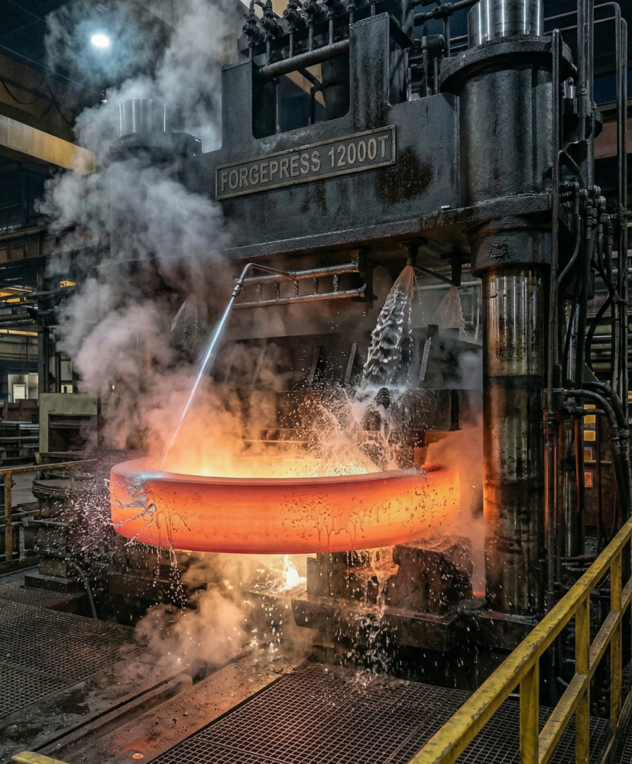
- Closed die forging for repeatable shaped components and near-net preforms.
- Open die forging for large shafts, blocks, discs and low-volume heavy components.
- Radial forging for long shafts, bars and selected tubular preforms.
- Ring rolling for seamless annular components and large forged rings.
The correct route should be selected from the component geometry, material and qualification requirements.
Defence Forged Components
A defence forging supplier may support multiple component families.
Land and Mobility Systems
Potential forged component categories include high-strength shafts, axles, transmission components, gear blanks, hubs, structural preforms and heavy mobility-system hardware.
Naval and Marine Defence
Naval applications can require propulsion shafts, coupling components, high-strength rings, mechanical-system forgings and corrosion-resistant alloy components.
Aerospace Defence
Military aviation can require high-strength steel, titanium, aluminium and nickel-alloy forgings for structural, landing-gear, engine and transmission-related applications.
Defence Energy and Auxiliary Systems
Heavy shafts, rings, pressure-containing components and other custom forgings can also appear across power and support systems.
Actual programme applicability always depends on customer drawings and approvals.
Materials Used in Defence Forgings
| Material Family | Why It May Be Selected |
| High-strength alloy steel | Strength, toughness and fatigue capability |
| Stainless steel | Corrosion resistance + mechanical performance |
| Titanium alloys | High specific strength and corrosion resistance |
| Nickel alloys | High-temperature and corrosion-resistant applications |
| Aluminium alloys | Low density for selected aerospace structures |
| Duplex/super duplex | Severe corrosion environments where specified |
Why High-Mix, Low-Volume Capability Matters
Defence manufacturing is not always a mass-production business.
A programme can require relatively small quantities of highly specialised components, followed years later by additional spares or upgrade requirements.
This places unusual demands on the supplier.
Manufacturing records, material traceability and process configuration can remain important long after the original production run.
A forging company capable of handling high-mix, low-volume critical components can therefore be better aligned with specialised defence procurement than a facility optimised exclusively for very high-volume automotive production.
Traceability in Defence Forging
Traceability should connect the finished component back through its manufacturing history.
Depending on the programme, this can include:
- Raw-material heat identity
- Material certification
- Forging batch
- Heat-treatment cycle
- Mechanical test results
- NDT reports
- Machining and dimensional inspection
- Configuration or drawing revision
This allows a buyer to determine which components are affected if a material or process issue is discovered later.
Defence Forging and Machining Under One Supply Chain
A rough forging is often only the beginning of the component’s manufacturing journey.
Heat treatment establishes final material properties. NDT evaluates relevant internal and surface conditions. Machining creates final interfaces and dimensions.
When these processes are coordinated within an integrated forge-to-finish system, the forging preform can be designed around final machining requirements rather than produced as an isolated intermediate product.
Vinir Engineering as a Defence Forging Manufacturer in India
Vinir Engineering manufactures high-mix, low-volume forged and machined components and operates across closed die forging, open die forging, radial forging, ring rolling, heat treatment and machining.
Its broader forging capabilities cover components from approximately 5 kg to 15,000 kg, enabling manufacturing-route selection across a wide range of critical-component sizes.
For defence programmes, actual supply eligibility and qualification remain customer and programme specific.