
How Forging Improves Grain Structure: Deformation, Recrystallization and Mechanical Properties

One of the main reasons critical components are forged rather than simply cast to final shape is that forging changes the internal material through controlled plastic deformation.
But statements such as “forging improves grain structure” are often repeated without explaining what actually happens inside the metal.
The real mechanism involves the interaction between deformation, temperature, recrystallisation, grain growth and subsequent heat treatment.
The Starting Structure Matters
A cast ingot forms through solidification.
That process can create comparatively coarse structural features, chemical segregation and a different internal morphology from a heavily wrought product.
Subsequent forging introduces mechanical work.
The objective is to transform the starting material into a controlled wrought structure suitable for the final application.
Plastic Deformation Changes the Material
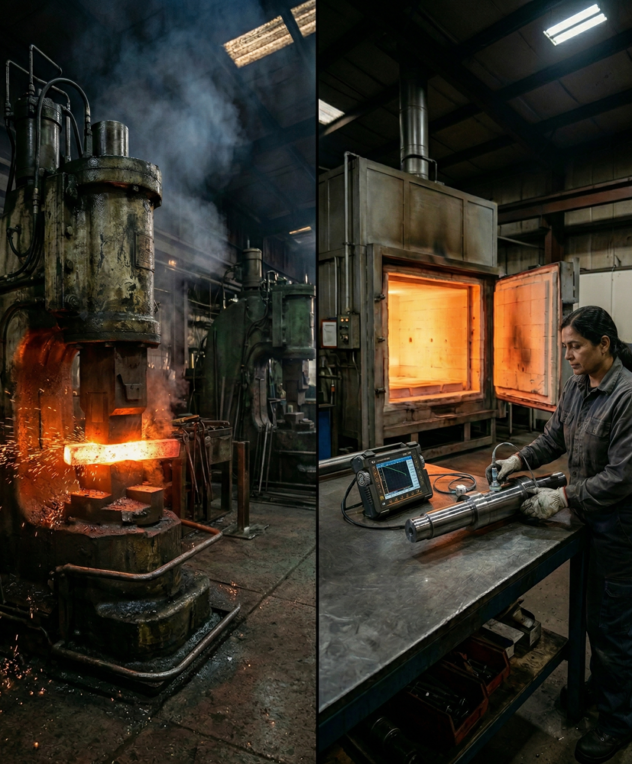
During forging, compressive forces force the material to flow.
Internally, the crystal structure accommodates this deformation through mechanisms including dislocation movement.
As strain accumulates, the material’s internal state changes.
At hot-working temperatures, recovery and recrystallisation can occur simultaneously or subsequently, depending on the alloy and process conditions.
What Is Recrystallisation?
Recrystallisation is the formation of new, relatively strain-free grains within previously deformed material.
Temperature and deformation both matter.
If the forging receives insufficient strain, recrystallisation behaviour may differ from a region that has been heavily worked.
If temperature is excessive or the component remains hot too long after recrystallisation, subsequent grain growth can occur.
The objective is therefore controlled thermomechanical processing.
Forging, Grain Refinement and Mechanical Properties
A properly controlled wrought structure can support desirable mechanical properties, but the final result depends on the alloy.
Important properties can include:
- tensile strength
- yield strength
- toughness
- ductility
- fatigue resistance
- creep or elevated-temperature capability
- ultrasonic inspectability
Heat treatment after forging frequently plays an equally important role in establishing these final properties.
Why Forging Does Not “Remove All Defects”
This is another common misconception.
Forging can alter and sometimes help consolidate certain internal conditions under suitable compressive deformation, but it does not guarantee the elimination of every inclusion, segregation feature or discontinuity.
Starting-material quality remains critical.
This is why high-integrity forgings combine controlled raw material, sufficient deformation, thermal processing and NDT.
The Importance of Uniform Deformation
A component that is heavily worked at the surface but poorly worked at the centre does not have a uniform strain history.
For large sections, process engineers therefore consider how deformation penetrates through the component.
This is particularly important for heavy open die and radial forgings.