
Forging vs Welded Fabrication: When a Forged Part Pays Back
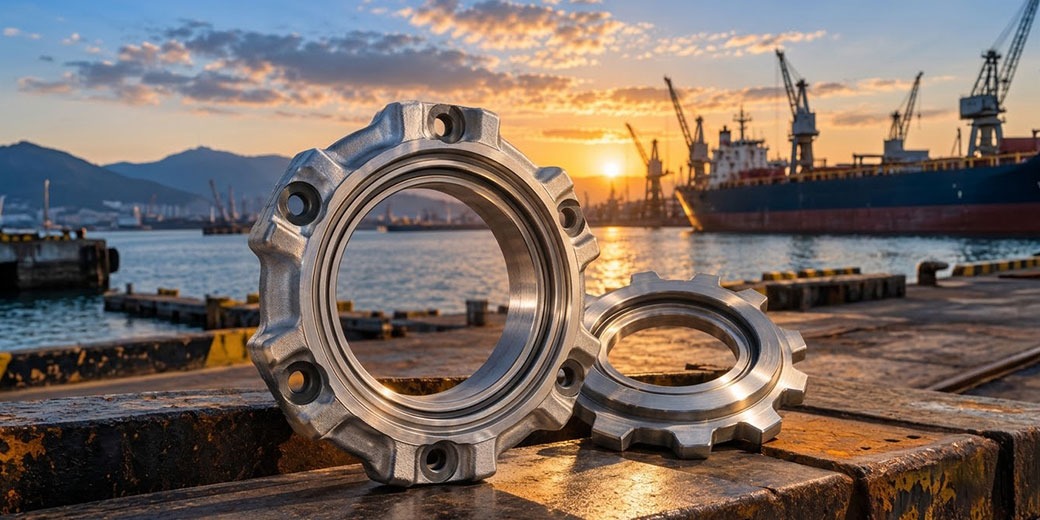
Welded fabrication joins plates, pipes or bars into a shape; forging produces the same shape as one continuous piece of metal. A welded assembly introduces heat-affected zones, residual stresses and weld defects at exactly the points where loads concentrate. A forging has no welds, continuous grain flow and uniform properties. For fatigue-loaded, pressure-containing or safety-critical parts, replacing a fabrication with a forging usually improves reliability and often reduces total cost once welding, inspection and rework are counted.
At a Glance: Forging vs Welded Fabrication
Factor | Forging | Welded Fabrication |
| Structure | One piece, continuous grain flow | Multiple parts joined by welds |
| Weak points | None from joining | Weld metal and heat-affected zone |
| Fatigue performance | High | Lower at weld toes and joints |
| Residual stress | Low after heat treatment | Present unless stress relieved |
| Inspection | UT of the forging body | Weld NDT (RT/UT/MT) on every joint |
| Distortion | Minimal | Welding distortion needs correction |
| Upfront cost | Can be higher for complex shapes | Lower for one-offs and large structures |
| Best for | Load-bearing, fatigue and pressure parts | Large structures, low volumes, low stress |
Why Welds Are the Weak Point
Welding melts and resolidifies metal, creating a weld zone with a cast structure and a heat-affected zone where properties change. Weld toes concentrate stress. Defects such as lack of fusion, porosity, slag inclusions and cracks can occur even with qualified procedures. Under cyclic loading, fatigue cracks typically start at welds.
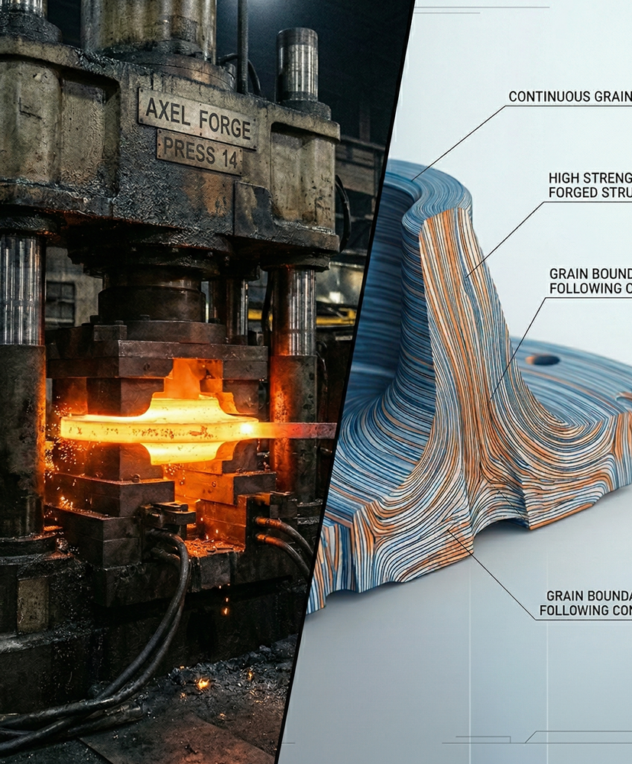
A forging eliminates these features. Grain flow follows the part outline, and properties are uniform after heat treatment.
Inspection and Documentation Burden
Every structural weld needs a qualified welding procedure (WPS/PQR), a qualified welder, and NDT — often radiography or UT of each joint. For code work, inspection costs and documentation multiply with the number of welds. A forging needs one material certificate, one heat treatment record and body NDT.
When Switching to a Forging Pays Back
- Repeated weld repairs or NDT rejections
- Fatigue cracking at welds in service
- Pressure parts where weld integrity is a safety risk
- Medium or high volumes where per-piece welding labour adds up
- Parts needing tight tolerances after welding distortion
- Customer specifications moving to forged or seamless construction
Common Fabrication-to-Forging Conversions
- Welded flanges and nozzles → forged or ring-rolled flanges and nozzles
- Welded hubs and bosses on shafts → one-piece forged shafts
- Fabricated brackets and clevises → closed die forgings
- Welded pipe fittings → forged fittings and manifolds
- Fabricated rings → seamless rolled rings
Where Fabrication Remains the Right Choice
- Very large structures beyond practical forging size
- One-off or prototype parts with low loads
- Thin-walled structures where forging plus machining would waste material
- Designs still changing frequently
Total Cost Comparison
Compare welding labour, consumables, fixturing, distortion correction, post-weld heat treatment, weld NDT, repair rates and the cost of in-service failures. In many medium-volume applications, a forging comes out cheaper overall even when its price looks higher.
How Vinir Engineering Supports Fabrication-to-Forging Conversion
- AS9100D across all four units, with IBR, ABS and API approvals and an NABL-accredited test lab
- Design review of welded assemblies to propose a forged equivalent
- Open die forgings up to 15,000 kg, plus closed die, ring rolling and radial forging
- Forge-to-finish machining to deliver a drop-in replacement