
Forging for Armoured Vehicles in India: Materials, Standards, and Supplier Qualification
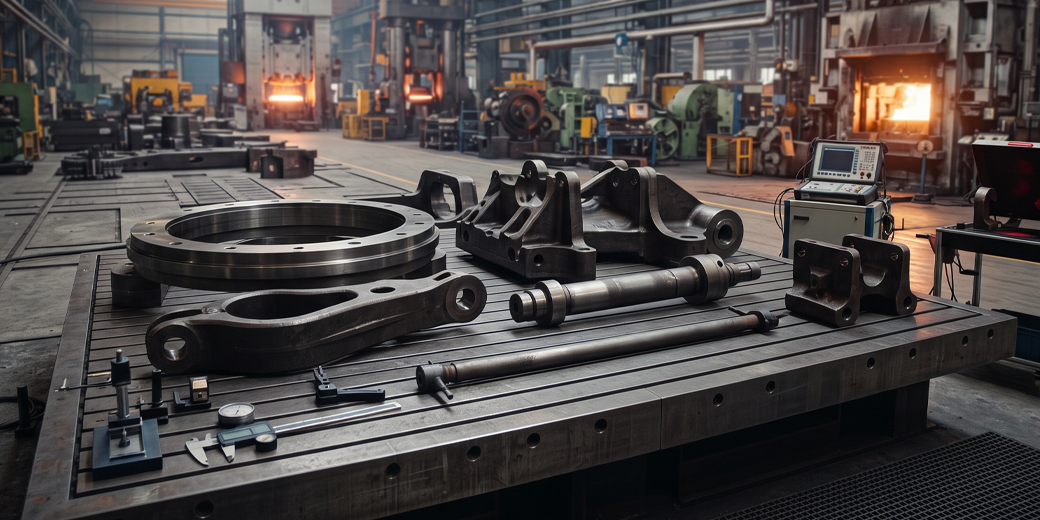
Armoured vehicle forging covers the full range of structurally and ballistically critical forged components used in ground combat and protected mobility platforms — hull structures, turret rings, suspension systems, drivetrain components, weapon mounts, and engine support structures. India operates one of the largest armoured vehicle fleets in the world, spanning the Arjun MBT, T-90S, BMP-II Sarath, and a growing range of wheeled protected vehicles — all requiring ongoing forged component supply for new production, overhaul, and in-service replacement.
Armoured Vehicle Forging: Key Component Categories
| Component | Typical Material | Critical Property | Forging Process |
| Hull structural forgings | ARMOX 500T, Miilux 400 | Ballistic resistance | Open die, large closed die |
| Turret ring forgings | High-strength alloy steel | Rotational load bearing, roundness | Ring rolling |
| Suspension arm forgings | EN24, 4340 | Fatigue life, impact resistance | Closed die |
| Torsion bar forgings | 45CrNiMoVA spring steel | High torsional fatigue | Closed die |
| Drivetrain shafts | EN36, EN24 | Torsional strength, wear | Open die, closed die |
| Roadwheel hubs | Alloy steel | Dynamic load, wear resistance | Closed die |
| Weapon mount structures | Alloy steel | Load bearing, dimensional stability | Closed die |
| Engine mount forgings | Alloy steel | Vibration fatigue, strength | Closed die |
India’s Armoured Vehicle Fleet: The Forging Demand
Arjun Main Battle Tank
India’s indigenously developed MBT uses a broad range of forged components — hull structural members in high-strength steel, the 120mm rifled gun breech assembly, the power pack support structure, and the full complement of running gear components including roadwheels, return rollers, and the drive sprocket assembly. CVRDE (Combat Vehicles Research and Development Establishment) in Chennai manages the technical specifications; Heavy Vehicles Factory Avadi manages production and procurement.
T-90S Bhishma
The T-90S programme has progressive indigenisation requirements for components previously supplied from Russia or Ukraine. Forged components in the drivetrain, suspension, and hull are priority indigenisation categories under the Positive Indigenisation List. Russian material grades (30KhGSNA, 38KhMYuA) have equivalent Indian and international counterparts that qualify suppliers must demonstrate.
BMP-II Sarath and Derivatives
The BMP-II Sarath and its Indian derivatives are produced at Ordnance Factory Medak (now under AVNL). Forging requirements span the complete drivetrain — drive shaft, final drive housings, sprocket assemblies — plus suspension components and hull access fittings. Batch sizes are moderate (200–500 units per year across the fleet) with a long service tail of spares.
Wheeled Protected Vehicles (MRAP, ALSV, WhAP)
India’s growing fleet of wheeled protected vehicles — Mine Protected Vehicles, All-Terrain Light Specialist Vehicles, and the Wheeled Armoured Platform — uses forged components in axle assemblies, suspension knuckles, differential housings, and structural cross-members. These programmes involve private sector OEMs (Tata Defence, Mahindra Defence, Force Motors) who manage their own forging supply chains under AS9100D requirements.
Armour Steel Forging: The Most Demanding Category
Forging armour-grade steels — ARMOX 500T, ARMOX 600T, Miilux 400, RAMOR 500 — requires process knowledge that goes well beyond standard alloy steel forging capability.
The challenge: These steels are delivered from the mill in a pre-hardened or normalised condition with high carbon equivalent values. The forging temperature window is narrow — typically 900–1,100°C — and deviation outside this range either softens the material (losing hardness and ballistic performance) or introduces forging cracks from inadequate ductility.
Reduction ratio control: Excessive reduction degrades through-thickness properties in armour steels. The forging process plan must specify maximum reduction per pass and minimum billet preheat requirements. Grain flow must be oriented to maximise resistance to the primary threat direction.
Post-forge verification: After forging and heat treatment, hardness must be verified across the full cross-section — not just the surface. Through-hardness is a ballistic requirement; surface-only hardness is insufficient. Brinell hardness surveys at multiple depths from the forged surface are standard.
Drivetrain and Suspension Forgings: The Higher-Volume Category
While hull and turret components attract the most attention, drivetrain and suspension forgings are higher in volume and equally critical. A single armoured vehicle platform typically uses 30–60 distinct forged components in the running gear and drivetrain.
Torsion Bars
Torsion bars are among the most fatigue-critical forgings in an armoured vehicle. They carry the full weight and dynamic shock loads of the vehicle through the suspension system. Grade 45CrNiMoVA or equivalent is standard. Critical requirements:
- Controlled grain flow along the bar axis — achieved through correct reduction ratio in the long axis
- Tightly controlled heat treatment to achieve the specified hardness and fatigue strength
- 100% magnetic particle inspection after finish grinding to detect surface cracks
- Shot peening in some specifications to introduce beneficial compressive surface stresses
Drive Shafts and Final Drive Components
Drive shafts, bevel gear blanks, and final drive housings in alloy steels (EN36, EN24, 4340) require closed die or open die forging depending on size, followed by controlled quench and temper heat treatment. Splined sections require particularly accurate dimensional control to ensure correct fit with mating components.
🔗 INTERNAL LINK — anchor text: “closed die forging capability”
→ Link to: /capabilities/closed-die-forging.html
Turret Ring Forgings: Ring Rolling for Armoured Vehicles
The turret ring is one of the most dimensionally critical forgings on an armoured vehicle. It must be round to tight tolerances to allow smooth turret rotation under all operating conditions including after ballistic damage to surrounding structure. Ring rolling is the preferred manufacturing process — seamless, controlled grain flow circumferentially, and capable of the diameters required (typically Ø800mm to Ø2,500mm for MBT-class vehicles).
Key requirements for turret ring forgings:
- Roundness (circularity) tolerance — typically within 1–2mm across the full diameter
- Flatness of bearing surfaces — the surfaces against which the turret rotates
- Material uniformity — consistent hardness across the full ring circumference
- 100% UT inspection — no internal defects acceptable in a safety-critical rotating structural component
Quality Standards for Armoured Vehicle Forgings
AS9100D is the primary quality management requirement for armoured vehicle forging suppliers. Private sector OEMs — Tata, Mahindra, L&T — require AS9100D from their forging supply chains.
DGQA oversight applies to all components entering Indian Army procurement. DGQA inspectors review incoming material at OFB and DPSU production facilities and conduct source inspection at supplier premises for new programmes and new supplier qualifications.
CVRDE specifications for Arjun programme components reference Indian standards (IS) alongside international equivalents. Suppliers must confirm which standards apply and ensure test procedures align.
Batch Sizes in Armoured Vehicle Programmes
Most Indian armoured vehicle forging programmes are low-to-medium volume:
- New production programmes — 100–500 components per year per part number for active fleet build-up
- Overhaul and spares — 20–100 components per year, continuing for the 30–40 year service life of the platform
- Development and first article — 3–10 components per part number
This range makes high-mix low-volume forging capability a requirement rather than an advantage. A supplier must handle multiple part numbers with frequent changeovers, each with its own material, heat treatment, and NDT requirements.
Vinir Engineering’s Armoured Vehicle Forging Capability
Vinir’s closed die forging capability — 10 to 1,400 kg on 1T to 12T hammers and a 3000T press — covers the majority of armoured vehicle suspension, drivetrain, and fitting component requirements. Open die capability to 15,000 kg covers larger structural and hull forgings. Ring rolling to Ø4,500mm covers turret ring forgings for all current Indian armoured vehicle programmes.
In-house heat treatment includes quench and temper cycles for all alloy steel grades used in armoured vehicle applications. NABL-accredited in-house testing covers Charpy impact, tensile, Brinell and Vickers hardness, and chemical analysis — all required for armoured vehicle forging acceptance.
Frequently Asked Questions — Armoured Vehicle Forgings
What is the most critical forged component on an armoured vehicle?
From a structural survivability standpoint, hull and turret ring forgings are the most critical — their failure compromises crew protection. From an operational reliability standpoint, torsion bars and drivetrain shafts are critical because their failure immobilises the vehicle. Both categories require the same rigorous quality management — 100% NDT, full material traceability, certified heat treatment records — regardless of which is deemed more critical by programme definition.
Why are forgings used rather than castings or fabrications for armoured vehicle components?
Forgings have superior grain flow, higher fatigue strength, better impact resistance, and more consistent mechanical properties than castings of equivalent material. For armoured vehicle components subject to shock loads, ballistic impact loads, and high-cycle fatigue — suspension, drivetrain, structural members — the improved mechanical properties of forgings directly translate to vehicle survivability and operational reliability. Fabrications (welded structures) are used for large hull panels but cannot match forging for rotating and load-bearing components.
What materials are used for Indian armoured vehicle forgings?
Alloy steels (EN24, EN36, 4340) dominate drivetrain, suspension, and structural applications. Armour steels (ARMOX 500T, Miilux 400) are used for hull and protective structural components. Spring steel (45CrNiMoVA) is standard for torsion bars. Aluminium alloys are used for weight-sensitive secondary structural components on lighter wheeled platforms. Material selection is determined by the component’s function, threat environment, and vehicle weight budget.
What NDT is required for armoured vehicle forgings?
Magnetic particle inspection (MT) is mandatory for all ferromagnetic alloy steel components — covering surface and near-surface defect detection. Ultrasonic testing (UT) is required for all safety-critical components — drivetrain shafts, torsion bars, turret rings, structural members — to verify internal cleanliness. For armour steel forgings, hardness surveys across the cross-section are an additional quality verification step. All NDT must be performed by ASNT Level II certified operators with written, approved procedures.
How does a forging supplier become qualified for T-90 indigenisation programmes?
T-90 indigenisation programmes are managed through Heavy Vehicles Factory Avadi, DRDO, and the OFB structure with DGQA oversight. Suppliers must be AS9100D certified, DGQA registered, and able to forge in Russian-equivalent material grades (30KhGSNA alloy steel equivalents are EN24 or 4340; 38KhMYuA equivalents are high-strength alloy tool steels). First article testing compares the Indian forging against the original Russian component specification. The process typically takes 18–24 months from initial qualification submission.