

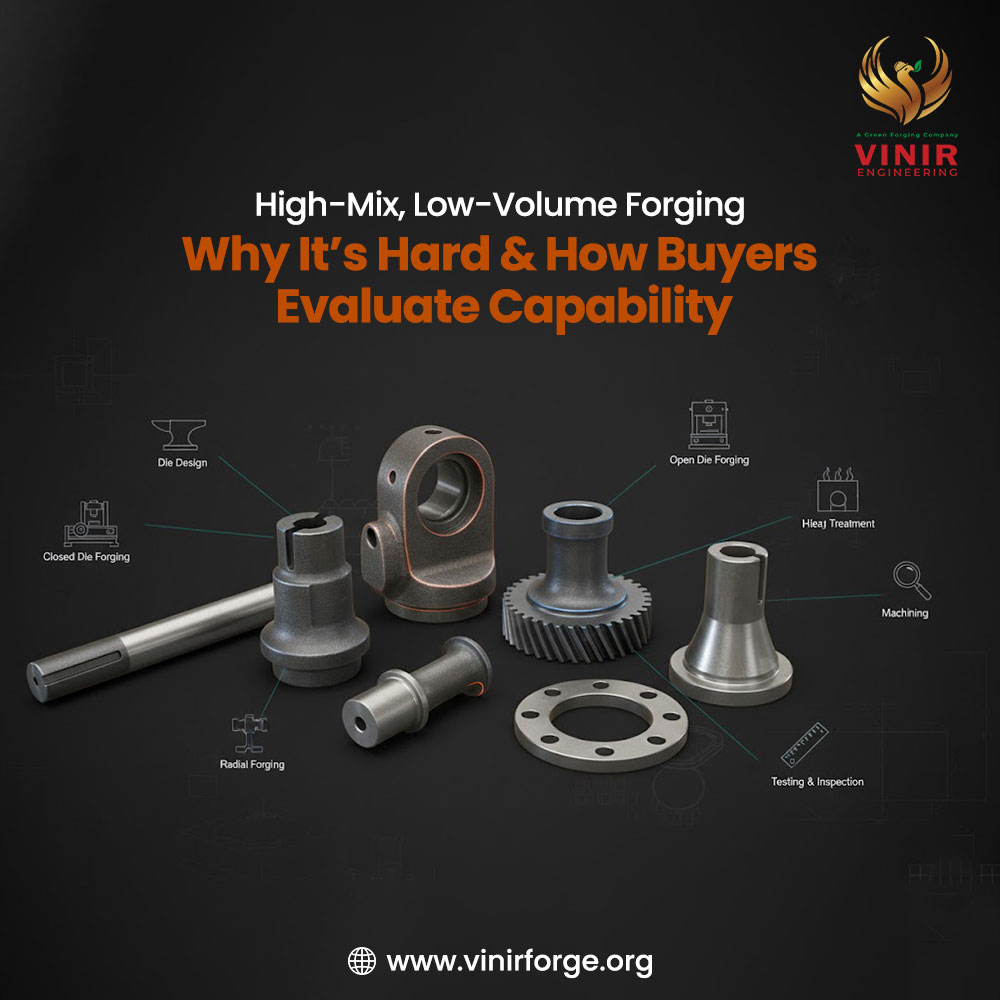
High-mix, low-volume forging: why it’s hard – and how buyers evaluate capability
Most forging websites talk about capacity. Very few talk about complexity.
But in Oil & Gas, Defence, Aerospace, Nuclear, Railways, and Energy projects, buyers are not always sourcing in bulk.
They are sourcing parts that are :
- low volume
- high consequence
- high spec
- frequently customized
- urgently needed
- audit-heavy
This is where high-mix, low-volume (HMLV) forging becomes a different game entirely.
This blog explains:
- what “high-mix, low-volume” really means in forging supply chains
- why many suppliers fail here (even if they are large)
- what buyers look for when qualifying HMLV forging partners
- how Vinir can position this as a moat for global customers
1) What High-Mix, Low-Volume actually means
High-mix, low-volume forging means:
You can reliably produce many part types (mix) in small quantities (volume), without losing control on:
- Tolerances
- Grain flow
- Metallurgy
- Documentation
- Delivery commitments
This is usually the category of :
- Prototypes
- Customized assemblies
- Replacement parts
- Special-grade / niche alloy components
- Parts that sit on critical project timelines
2) Why HMLV forging is harder than large-volume forging
Large-volume forging benefits from repetition:
- stable die sets
- predictable cycle time
- consistent process routes
- standardized inspection
HMLV forging is harder because every order behaves like a “new project”:
- custom die design
- frequent machine / die setup changes
- different alloy behaviors
- different test plans
- unique documentation requirements
- changing inspection criteria
And in critical industries : a single non-conformance can block the entire delivery.
3) Where suppliers fail when handling HMLV work
A) Quoting without true engineering feasibility
Many suppliers quote aggressively and then fail execution because:
- Die design complexity wasn’t assessed
- Forging reductions were underestimated
- Machining allowance wasn’t properly planned
- Lead time assumptions were unrealistic
What buyers interpret : This supplier is not engineered for HMLV.
B) Poor process discipline during frequent changeovers
In HMLV work, changeovers are constant . This creates risk of :
- Wrong die setup
- Wrong forging temperature
- Wrong material mix
- Wrong heat treatment cycle
- Wrong inspection plan
What buyers interpret : This supplier becomes a risk under variability.
C) Traceability breakdown
In HMLV, traceability is harder because:
- Multiple materials are processed in parallel
- Small batches make identification errors easier
- Documentation can become inconsistent
What buyers interpret : No traceability = no qualification.
D) Quality systems not built for “project-based manufacturing”
Most quality systems are designed for repeating production. HMLV quality requires:
- Project-based documentation discipline
- Part-wise traceability
- Inspection planning per drawing
- Stronger internal audits
4) How buyers evaluate HMLV forging suppliers
When buyers evaluate HMLV suppliers, they typically look for proof across 6 areas:
1) Engineering capability
Can you support:
- design inputs
- die design engineering
- manufacturability reviews
- material selection guidance
Evidence buyers trust:
- strong “capabilities” pages
- part validation workflow
- case-stories (sanitized)
- qualification experience across industries
2) Process control + repeatability
Can you ensure consistent outcomes across changing part types?
Evidence buyers trust:
- documented process discipline
- controlled forging temperature + reductions
- heat treatment controls
- inspection and calibration systems
3) Tooling & die manufacturing
Can you design dies quickly and correctly?
Evidence buyers trust:
- in-house die design and manufacturing
- simulation or design methodology
- lead time ability for tooling cycles
4) Quality & testing infrastructure
Can you test as per standards without outsourcing delays?
Evidence buyers trust:
- in-house testing / validation
- NDT capability
- mechanical and metallurgical tests
- audit-ready reports
5) Documentation capability
Can you generate complete dossiers reliably for small batches?
Evidence buyers trust:
- traceability packs
- standardized documentation templates
- audit-ready structure
6) Delivery reliability under complexity
Can you deliver small batches quickly without chaos?
Evidence buyers trust:
- real-time monitoring
- committed lead times
- structured production planning
- consistent dispatch workflow
5) Why HMLV becomes a strategic moat
The world is moving toward:
- specialized programs
- smaller production runs
- higher compliance burden
- more customization
- replacement / retrofit demand
- multi-grade alloy requirements
Most forging suppliers are optimized for : automotive volume.
Critical industries need the opposite: custom + compliant + heavy + documented.
That’s why only a small number of forges can truly handle HMLV for critical sectors.
“High-mix, low-volume custom forgings — with forge-to-finish control, certification, and documentation discipline.”

Leave a Reply