
SMR Forging Supplier for US Nuclear Projects from India: ASME Section III Components
Small modular reactors are moving from an industry concept into an increasingly active US licensing and construction environment.
For forging manufacturers, that matters because nuclear systems depend on a relatively small number of highly controlled pressure-boundary and structural components whose manufacturing histories may need to remain documented for decades.
The commercial opportunity is therefore not simply “more nuclear tonnage.”
SMRs can create demand for smaller, repeatable nuclear-grade forgings manufactured under exceptionally rigorous quality systems.
As of July 2026, the US Nuclear Regulatory Commission lists active advanced-reactor engagement across light-water reactors, high-temperature gas reactors, molten-salt reactors and liquid-metal-cooled designs. The list includes NuScale US460 activity, Holtec SMR-300, Westinghouse AP300, X-energy Xe-100, TerraPower/Natrium and other projects.
For an SMR forging supplier from India, the opportunity is technically significant but qualification requirements are considerably more demanding than ordinary power-generation forging.
What Makes an SMR Different?
The term “small modular reactor” does not describe one single reactor technology.
SMRs are generally smaller in electrical output than conventional gigawatt-scale reactors and are designed to use a greater degree of modular manufacturing.
That manufacturing philosophy has important supply-chain implications.
Instead of fabricating almost every major item uniquely at the construction site, modular reactors seek to shift more manufacturing into controlled factory environments.
For forging suppliers, this can favour repeatable components, standardised documentation and production routes that can be reproduced across multiple modules.
The US SMR Landscape in 2026
The US market is no longer limited to theoretical design studies.
The NRC approved NuScale’s US460 standard design in May 2025. The design uses six 77-MWe modules for approximately 460 MWe total plant output.
In February 2026, the NRC accepted an application associated with early construction activities for a proposed dual-unit Holtec SMR-300 plant at the Palisades Energy Center in Michigan.
In March 2026, the NRC issued a construction permit for TerraPower’s Kemmerer Power Station Unit 1 in Wyoming.
These developments do not mean every project will immediately generate open international forging purchase orders. They do, however, show why suppliers seeking US nuclear qualification need to build capability before large-scale procurement begins.
What Components in an SMR May Be Forged?
The exact component set depends heavily on reactor technology.
Light-water SMRs may require forgings for reactor pressure boundaries, vessel nozzles, flanges, pump-related parts, valve bodies, closures and other pressure-containing components.
Advanced reactors operating at higher temperatures or using alternative coolants can introduce different alloys and Code sections.
This is particularly important because ASME Section III contains different subsections for component classes and reactor technologies.
ASME’s required-code documentation lists Section III Subsection NB for Class 1 components, NCD for Class 2 and Class 3 components, NF for supports and Division 5 for high-temperature reactors.
An SMR forging supplier therefore cannot build one generic “nuclear forging procedure” and expect it to apply across all reactor designs.
ASME Section III
ASME Boiler and Pressure Vessel Code Section III governs construction rules for nuclear facility components.
For safety-related pressure-boundary components, the applicable subsection drives material, manufacturing, examination and documentation requirements.
Class 1 components receive particularly stringent control because their failure can directly affect the reactor coolant pressure boundary.
A forging supplier entering this market must understand how its work sits within the authorised nuclear manufacturer’s quality programme.
SA-508 Grade 3
For conventional light-water reactor pressure vessels, SA-508 Grade 3 Class 1 is one of the most important forging materials.
ASME technical material identifies SA-508 Grade 3 Class 1 forgings for reactor pressure vessel applications under Section III Subsection NB in relevant designs.
The material is a manganese-nickel-molybdenum low-alloy steel designed for large nuclear pressure-boundary components.
Its value comes not from extremely high tensile strength but from the combination of strength, fracture toughness, weldability and long-term service performance needed for thick reactor-vessel sections.
Smaller Components May Be the Practical Entry Point
An Indian forging manufacturer does not need to begin by attempting to supply the largest reactor pressure-vessel shell ring.
Smaller nuclear forgings can offer a more realistic entry point.
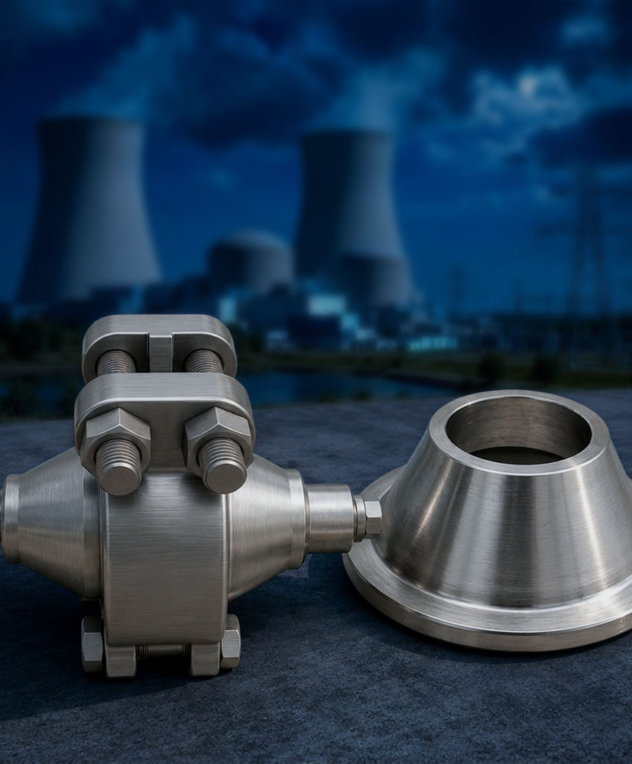
These may include nozzles, pressure-boundary flanges, valve bodies, structural rings, pump-related parts and auxiliary-system components.
The individual component value can still be significant because nuclear qualification, inspection and documentation requirements remain demanding even at lower weights.
NQA-1 and Nuclear Quality Assurance
Nuclear manufacturing differs from ordinary industrial quality control because documentation and process control are tied directly to nuclear safety.
Supplier procedures need to address areas such as document control, material identification, hold points, independent inspection, non-conformance handling, corrective action and quality records.
The organisation integrating the forging into an ASME nuclear component may impose additional programme-specific requirements.
This makes supplier qualification a long-term process rather than a conventional RFQ exercise.
Traceability Can Last for Decades
A nuclear forging’s material and process history may need to remain retrievable throughout the operating life of the plant.
That changes the economics of documentation.
A supplier needs systems that can reliably preserve raw-material certificates, heat-treatment records, NDT results, test reports, manufacturing travellers, deviations and approvals far beyond the normal retention period of an industrial programme.
Electronic files alone are not sufficient unless they are controlled, backed up, migration-resistant and retrievable.
NDT Requirements
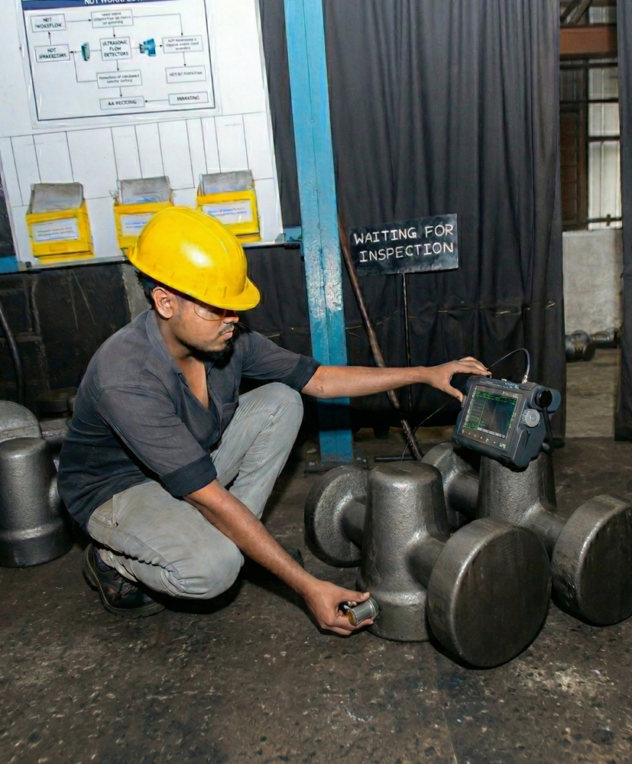
Nuclear pressure-boundary forgings can require highly stringent volumetric and surface examination.
The relevant acceptance criteria are determined by the applicable ASME Code requirements and component classification.
Personnel qualifications, calibration blocks and written procedures become part of the controlled manufacturing system.
For a new nuclear supplier, this can require qualification of inspection methods specifically for nuclear applications rather than relying on existing commercial UT procedures.
Heat Treatment and Mechanical Testing
Heavy nuclear forgings require careful control over through-section mechanical properties.
A component may need tensile testing, impact testing, hardness testing and specialised fracture-toughness-related evaluation depending on the specification.
The heat-treatment cycle must account for large ruling sections and any later fabrication thermal exposure.
For some components, simulated post-weld heat-treatment exposure may be required before final mechanical testing so that the test material reflects the thermal history expected during equipment fabrication.
SMR Forging Opportunity for Indian Suppliers
India has a substantial heavy-engineering and nuclear manufacturing ecosystem, but qualification for US nuclear supply remains customer- and programme-specific.
An Indian manufacturer with strong forging, heat-treatment, NDT and documentation systems has a technical foundation, but entry into a US nuclear programme requires a dedicated nuclear quality pathway.
The opportunity should therefore be treated as strategic supplier development rather than short-term export sales.
Vinir Engineering and US SMR Forging Supply
Vinir’s high-mix, low-volume model is relevant to emerging nuclear programmes because early SMR procurement may involve relatively small quantities of highly engineered components.
Its ability to handle forging, heat treatment, machining and testing within an integrated manufacturing route creates a foundation for programme-specific qualification.
For US nuclear developers, N-certificate holders and Tier-1 suppliers, the logical first step is a technical assessment of specific component categories, materials and quality requirements rather than a broad supplier declaration.