
Hot vs Cold Radial Forging: Process Differences, Material Behaviour and Critical Component Applications
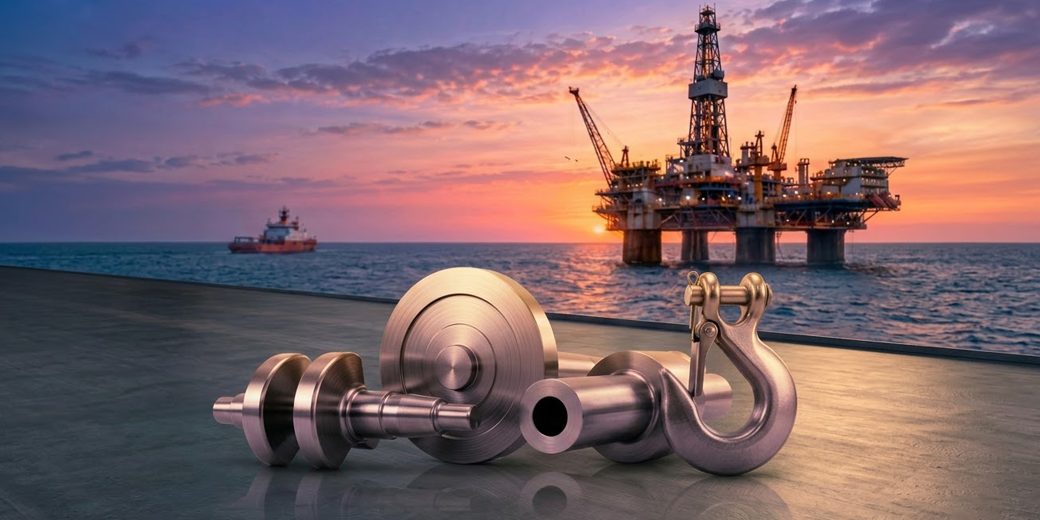
Radial forging is often discussed as though it were a single manufacturing process. In practice, the temperature at which the material is forged has a major influence on deformation force, achievable reduction, dimensional accuracy, surface condition and final mechanical properties.
The two broad approaches are hot radial forging and cold radial forging.
For heavy aerospace, defence, oil & gas, marine, power-generation and industrial components, hot radial forging is generally the more relevant manufacturing route because elevated temperature makes large reductions in high-strength alloys practical. Cold radial forging, on the other hand, can provide tighter dimensional control, improved surface finish and work-hardening benefits for suitable smaller components.
For US OEMs evaluating a radial forging supplier in India, understanding the difference between hot and cold radial forging is important because the correct process depends on the material, starting diameter, required reduction, final geometry and mechanical-property requirements.
What Is Hot Radial Forging?
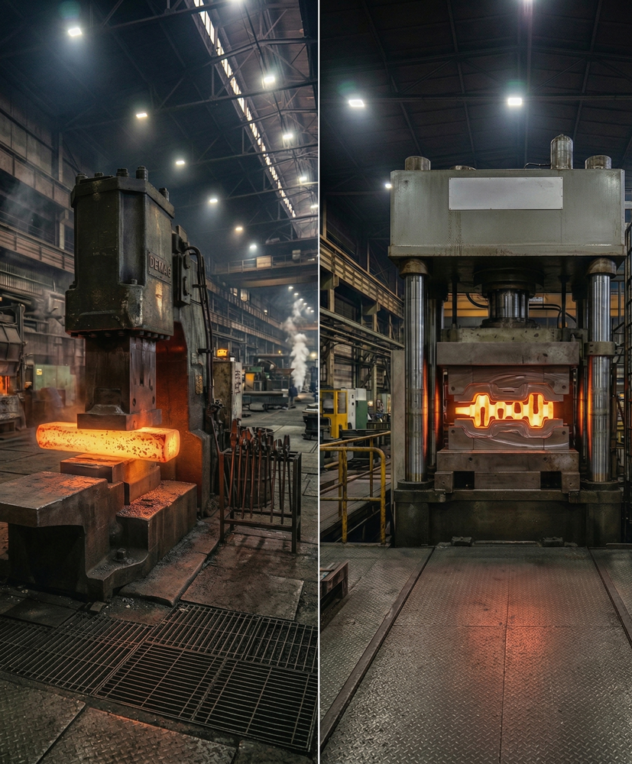
In hot radial forging, the workpiece is heated to a suitable forging temperature before deformation. Multiple dies act around the circumference of the workpiece while the billet is rotated and progressively moved through the forging machine.
At elevated temperatures, metals generally require lower forming forces than they would at room temperature. This makes substantial reductions possible even in large billets and high-strength materials.
Hot radial forging is particularly suitable for components such as:
- Heavy forged shafts: Long shafts with multiple diameter transitions can be brought closer to their final geometry before machining.
- Stepped bars and preforms: Material can be distributed along the component according to the finished profile rather than maintaining one oversized diameter throughout.
- Hollow forged components: Radial forging can be combined with appropriate mandrel-based processes for tubular and hollow geometries.
- Aerospace and defence preforms: High-strength steels, titanium alloys and nickel-based alloys can be processed through carefully controlled hot-working routes.
- Energy and marine shafts: Long rotating components can benefit from controlled reduction and reduced machining stock.
The actual forging-temperature window depends on the alloy. AISI 4340, 300M steel, Ti-6Al-4V and Inconel 718 cannot be processed using the same thermal cycle simply because all of them can potentially be radial forged.
What Is Cold Radial Forging?
Cold radial forging is performed at substantially lower temperatures, often near ambient temperature depending on the material and process.
Because the material has greater resistance to deformation at lower temperatures, cold radial forging requires higher forming forces and is generally more limited in the amount of reduction that can be achieved in a single manufacturing route.
Its advantages can include improved dimensional accuracy, smoother surface condition and strain hardening of the material.
Cold radial forging can therefore be attractive for smaller shafts, tubes and precision components where the required deformation is compatible with the machine and material.
Hot Radial Forging vs Cold Radial Forging
| Parameter | Hot Radial Forging | Cold Radial Forging |
| Workpiece condition | Heated to an appropriate forging range | Near ambient or substantially lower temperature |
| Required forming force | Lower for a given deformation | Higher |
| Heavy-section capability | Excellent | More limited |
| Large reductions | Well suited | Generally more restricted |
| Surface condition | Scale or oxidation may occur | Usually cleaner |
| Dimensional accuracy | Good, but thermal contraction must be considered | Potentially tighter |
| Strain hardening | Limited by recovery/recrystallisation | Can be significant |
| Typical use | Heavy shafts, bars, tubes and critical preforms | Precision shafts, tubes and smaller parts |
Why Hot Radial Forging Is Important for Heavy Components
Consider a large high-strength steel shaft weighing several hundred kilograms.
Attempting major cross-sectional reduction at room temperature would require enormous forming forces. The material would also have significantly less ductility than it has within an appropriate hot-working range.
Heating reduces resistance to plastic deformation, making it possible to move substantial volumes of metal without requiring impractical machine loads.
The temperature still has to remain controlled.
If the workpiece becomes too cold during forging, deformation resistance increases and cracking risk may rise. If it is processed at excessively high temperatures or held hot for too long, undesirable grain growth and other metallurgical changes can occur.
Hot radial forging is therefore fundamentally a thermomechanical process, not simply a mechanical reduction operation.
How Forging Temperature Influences Grain Structure
Temperature determines how the material responds to deformation.
At hot-working temperatures, processes such as recovery and recrystallisation can occur while the metal is being worked. This can help transform the starting microstructure, but only when temperature, strain and time are properly controlled.
For critical forgings, manufacturers therefore need to control more than the initial furnace set point.
Important process variables include:
- Billet heating temperature: The material must enter the forging process within the intended hot-working range.
- Transfer time: Excessive delay between furnace and forging can cause unwanted temperature loss.
- Intermediate temperature: Long components may require temperature monitoring during the forging sequence.
- Finishing temperature: The final stages of deformation should remain within the metallurgically appropriate range.
- Reheating strategy: If reheating is necessary, its effect on the material’s thermal history must be considered.
Why Cold Radial Forging Can Produce Better Surface Finish
Hot metals interact strongly with the surrounding atmosphere.
Carbon and alloy steels can develop oxide scale, while titanium requires particularly careful control of high-temperature surface reactions. These surface layers may later need to be removed by machining, descaling or another approved process.
Cold radial forging avoids much of this high-temperature oxidation.
For suitable components, this can translate into a smoother surface and smaller machining allowance.
Does Cold Radial Forging Increase Strength?
Cold deformation can increase strength and hardness through strain hardening.
As plastic deformation progresses, the internal dislocation structure of the metal changes and further deformation becomes increasingly difficult.
However, greater strength does not automatically mean a better component. Increased strength can be accompanied by reduced ductility and increased residual stress.
The required final balance of strength, toughness, fatigue behaviour and dimensional stability should therefore determine whether cold working is appropriate.
Hot Radial Forging Supplier for US Critical Components
For US aerospace, defence, oil & gas, energy and heavy-engineering OEMs, the correct radial forging route should begin with the finished component requirements rather than a predetermined manufacturing process.
A technical RFQ should ideally include the material specification, finished drawing, heat-treatment condition, NDT requirements, quantities and machining scope.
This allows a radial forging supplier in India such as Vinir Engineering to assess whether hot radial forging, another forging route or a combination of processes offers the most appropriate manufacturing solution.