
AISI 4140 Forging Supplier for USA from India: Heavy-Duty Industrial Components
AISI 4140 is one of the most established chromium-molybdenum alloy steels used in heavy industrial equipment.
For US equipment manufacturers, 4140 forgings are commonly selected where components need substantially higher strength and wear resistance than ordinary carbon steel while retaining useful toughness and machinability.
For buyers evaluating an AISI 4140 forging supplier in India for USA supply, the critical considerations are not limited to price per kilogram. Forging reduction, heat treatment, section size, internal soundness, machining capability and material documentation all influence component reliability.
Why AISI 4140 Is Used for Heavy Equipment
4140 offers an engineering balance of:
- High tensile strength
- Strong fatigue performance
- Good toughness
- Good wear resistance
- Good hardenability
- Established heat treatment behaviour
It is frequently used for:
- Heavy shafts
- Gear blanks
- Pinions
- Couplings
- Spindles
- Hydraulic components
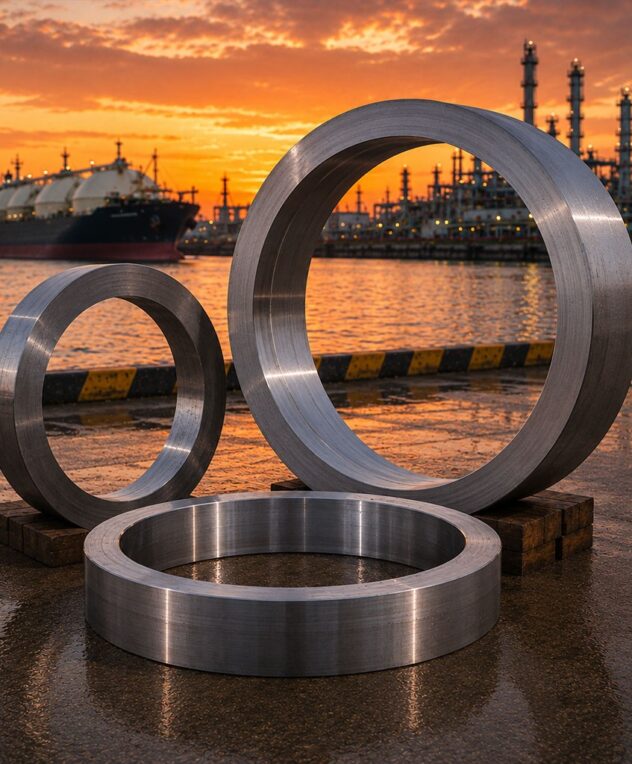
- Forged rings
- Heavy equipment pins
- Axles
- Industrial flanges
- Structural mechanical components
For many components, 4140 offers a cost-effective alternative to more highly alloyed steels.
4140 Forgings for Mining and Construction Equipment
Mining and earthmoving equipment places unusually high loads on mechanical components.
Forgings may experience:
- Impact
- Abrasion
- Repeated bending
- Torsional loading
- High contact stresses
- Shock loading
4140 is frequently selected for components where ordinary carbon steel does not provide adequate strength or wear performance.
Typical applications include pins, shafts, couplings, rollers, drivetrain components and heavy structural parts.
Grain Flow and Fatigue Performance
A key reason to forge a 4140 component rather than machine it completely from plate or bar is the opportunity to control material flow.
During forging, deformation restructures the grain flow through the component.
When die design and forging sequence are engineered correctly, grain flow can follow important load paths.
This becomes valuable in:
- Shafts subjected to torsion
- Pins subjected to bending
- Gear blanks
- Load-bearing connectors
- Components exposed to repeated fatigue cycles
Heat Treatment of 4140 Forgings
4140 is commonly supplied in a quenched-and-tempered condition when higher strength is required.
The process generally involves:
- Austenitising
- Quenching
- Tempering
- Controlled cooling
However, large forgings introduce a central engineering problem: through-section properties.
The surface of a large forging cools much faster than its centre.
If the supplier does not account for this, mechanical properties can vary considerably through the section.
This is why large 4140 forgings require:
- Correct furnace loading
- Controlled soak time
- Appropriate quench media
- Quench agitation
- Controlled transfer time
- Proper tempering
- Representative test locations
4140 vs 4130
US buyers frequently evaluate 4130 and 4140 for similar applications.
The primary metallurgical difference is carbon content.
4140 generally contains more carbon than 4130, allowing higher achievable hardness and strength after heat treatment.
As a simplified engineering rule:
4130: often preferred where weldability and pressure-control applications are important.
4140: often preferred where higher strength, wear resistance and mechanical loading are dominant.
Actual selection must always follow the engineering specification.
Inspection Requirements
Heavy 4140 components may require:
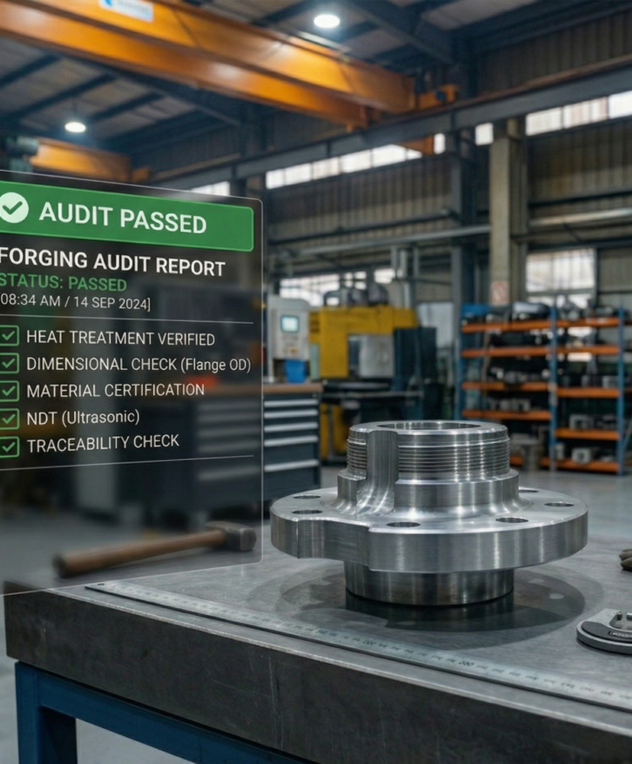
- UT
- MT
- Hardness testing
- Tensile testing
- Impact testing
- Dimensional inspection
- Chemical verification
For large forgings, UT is particularly important because internal soundness cannot be demonstrated by surface inspection.
Machining 4140 Forgings
A supplier’s machining capability can materially affect total procurement cost.
Heavy 4140 parts often require:
- Turning
- Milling
- Boring
- Drilling
- Threading
- Precision dimensional inspection
Shipping a rough forging from one facility to another machine shop adds another supplier interface.
An integrated forging-and-machining supplier can instead maintain traceability through the entire manufacturing route.
Vinir Engineering for 4140 Forgings
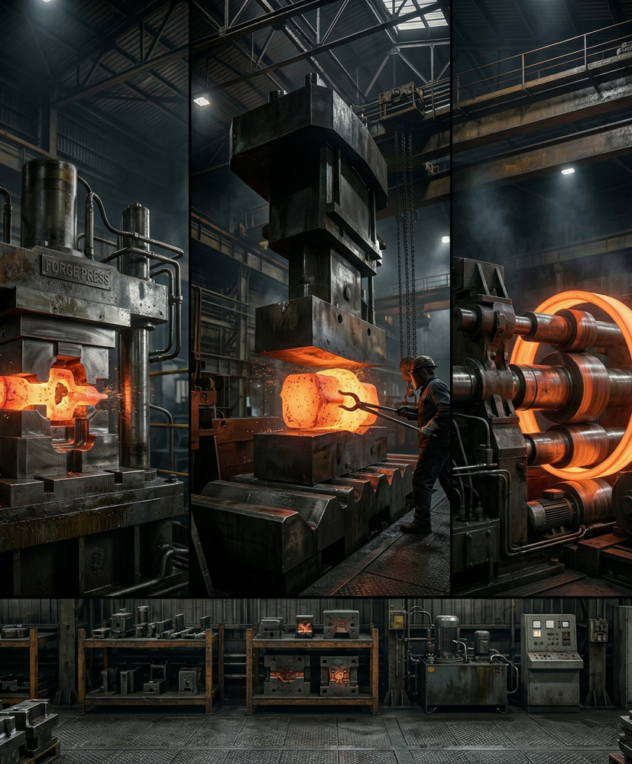
Vinir’s multi-location infrastructure supports closed die forging, open die forging, ring rolling, heat treatment and machining.
The company’s high-mix, low-volume manufacturing model is particularly relevant for US buyers requiring:
- Prototype quantities
- Small production batches
- Replacement components
- Supplier-transition projects
- Complex custom parts
US procurement teams can submit drawings and material specifications for an engineering-led feasibility review.