Poland is Central Europe’s largest economy and NATO’s most rapidly expanding defence spender the Polish government has committed to spending 4% of GDP on defence by 2026, the highest NATO defence spending percentage globally. PGZ (Polska Grupa Zbrojeniowa, the Polish Defence Group) – encompassing 60+ defence companies produces armoured vehicles, artillery systems, and naval vessels. Poland’s energy sector PKN Orlen (oil refining and petrochemicals), PGNiG (gas distribution, now merged with Orlen), and the coal-to-new-energy transition creates substantial API 20B and ASME VIII forging demand. Indian forging manufacturers are positioned to supply both defence and energy sectors.
Company
Sector
Key Forging
Standard
PGZ (Warsaw) — Huta Stalowa Wola
Defence — Krab howitzer, Rosomak
Gun barrel blanks, armoured structural
NATO STANAG, Polish MoD specs
PKN Orlen (Płock)
Oil refining and petrochemicals
Valve bodies, pressure vessel nozzles
API 20B, ASME VIII, Polish TÜV
PGE (Warsaw)
Power generation — coal and new energy
Steam turbine rotor components
EN 10269, ASME A470
Energa / Enea
Power generation and distribution
Transformer structural, pressure components
EN industrial standards
PGNiG (integrated into Orlen)
Gas production and distribution
Pipeline flanges, compressor fittings
API 20B, EN 1092
Poland’s defence expansion — driven by Russia’s invasion of Ukraine and Poland’s front-line NATO position has made Poland the world’s largest defence spender as a percentage of GDP. PGZ’s Huta Stalowa Wola (HSW) produces the Krab 155mm self-propelled howitzer (now supplied to Ukraine) and components for the Rosomak armoured personnel carrier. The Krab howitzer’s gun barrel blank forging in 55NiCrMoV6 or equivalent gun steel, vacuum arc remelted is a high-value precision forging with production rates accelerating as Poland and Ukraine replenish combat losses. Indian forge shops with open die capability and VAR-melted billet sourcing are relevant for Krab barrel blank supply as PGZ looks for additional qualified sources.
PKN Orlen — Poland’s dominant oil and gas company following its merger with PGNiG and Lotos operates the Płock refinery (one of Central Europe’s largest, 16.3 million tonnes per year throughput) and petrochemical complexes at Włocławek and Anwil. Orlen’s Płock refinery expansion (the EFRA project – deep oil processing) requires valve body forgings, pressure vessel nozzle forgings, and heat exchanger component forgings in standard API 20B and ASME VIII materials. Polish TÜV Rheinland (an authorized inspection body in Poland) conducts pressure equipment inspection equivalent to European CE marking requirements under the PED (Pressure Equipment Directive).
Poland’s energy transition — from coal-heavy power generation toward gas, nuclear (Poland’s first nuclear power plant planned at Choczewo, likely AP1000 or APR-1400 technology, FID pending) and renewables creates a multi-decade forging demand evolution. The coal plant decommissioning and gas plant construction create steam turbine rotor forging demand (gas plant steam turbines); the nuclear programme if it proceeds will create nuclear-grade forging demand equivalent to Westinghouse AP1000 programmes in the US.
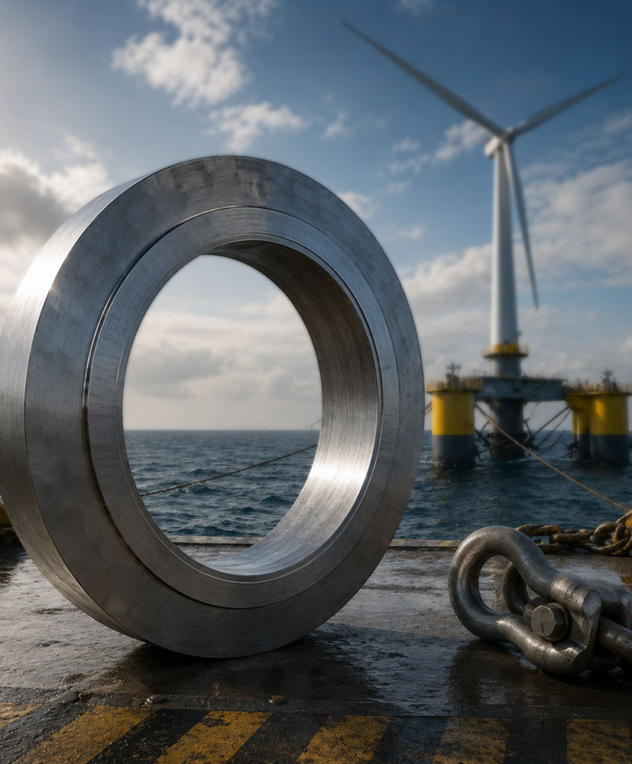
Poland’s offshore wind programme — targeting 5.9 GW in the Baltic Sea by 2030 (Orlen’s Baltic Power, Equinor and Polenergia’s Bałtyk projects, RWE’s FEW Baltic) – creates tower flange and bearing ring forging demand equivalent to other Northern European offshore markets. Baltic Sea offshore wind turbines are in the 10–15 MW class the same Siemens Gamesa and Vestas platforms supplying German and UK offshore markets.
Gun barrel blank forgings in VAR-melted 55NiCrMoV6 for PGZ Krab programme supply consideration.
API 20B PSL 1–3 for PKN Orlen Płock refinery valve body and nozzle forgings.
CrMoV steam turbine rotor forgings for PGE power plant turbine OEM supply chains.
S355NL ring rolling to Ø4,500mm for Baltic offshore wind tower flanges.
NABL Charpy at -20°C and -40°C.
TPI by Bureau Veritas and TUV Rheinland both recognised by Polish industrial buyers.
Ocean freight Chennai to Hamburg then road to Warsaw or Gdańsk: 26–32 days.
Frequently Asked Questions
1.What is Poland’s defence spending commitment and why does it create immediate forging procurement opportunities?+–
Poland’s government has committed to spending 4% of GDP on defence approximately $35 billion annually at current GDP levels — making Poland the highest defence spender in NATO by percentage. This commitment is backed by urgent procurement: Poland has ordered M1A2 Abrams tanks, K2 Black Panther tanks (from South Korea), K9 Thunder howitzers, F-35A fighters, and HIMARS rocket artillery in addition to domestic PGZ production. The speed and scale of Polish procurement creates supply chain pressure PGZ’s Huta Stalowa Wola is expanding Krab howitzer production but faces capacity constraints for gun barrel forging. This constraint creates an opening for qualified international forging suppliers as PGZ seeks additional barrel blank sources to meet accelerated production schedules.
2.What is Poland’s planned nuclear power plant programme and what forging opportunities might it create?+–
Poland has selected two candidate sites for its first nuclear power plants: Choczewo (Pomerania, on the Baltic coast) and Żarnowiec. The technology selection process has progressed the Polish government has expressed preference for Westinghouse AP1000 technology for the first plant, with EDF EPR2 as an alternative. Financial Investment Decision is pending but expected 2025–2026. If AP1000 is selected, the nuclear forging procurement pathway discussed in the US nuclear blogs (Westinghouse NASL qualification, SA-508 Grade 3 nozzle forgings, NQA-1 quality programme) applies directly. Polish nuclear construction would create AP1000 RPV nozzle forging demand equivalent to US AP1000 projects accessible through Westinghouse’s supply chain.
3.What is Poland’s Baltic offshore wind programme and how does it compare to German and UK offshore markets?+–
Poland’s Baltic Sea offshore wind programme targets 5.9 GW of installed capacity by 2030 across several projects: Baltic Power (1,200 MW, Orlen-Copenhagen Infrastructure, Vestas V236-15 MW turbines), Bałtyk II and III (1,440 MW combined, Equinor and Polenergia, Siemens Gamesa), and FEW Baltic (350 MW, RWE). The Baltic Sea is shallower than the North Sea (30–50m typical depth versus 20–80m North Sea), making fixed monopile foundations the standard. Tower base flange diameters for Baltic offshore wind are comparable to German North Sea Ø4,500–5,500mm for 14–15 MW turbines. Polish offshore wind procurement flows through the turbine OEM supply chains (Vestas, Siemens Gamesa) rather than through Polish operators directly.
4.What is PED (Pressure Equipment Directive) and how does it affect Indian forging supply to Polish petrochemical buyers?+–
The EU Pressure Equipment Directive (PED 2014/68/EU) governs the design, manufacture, and conformity assessment of pressure equipment sold in the EU – including forged pressure components. Under PED, pressure equipment above certain pressure-temperature thresholds must carry CE marking, evidencing conformity with PED essential safety requirements. For imported forgings, CE marking is applied by the EU-based pressure vessel fabricator (who assembles the forging into a complete pressure vessel) rather than by the forging manufacturer. Indian forging manufacturers supply CE-marked-compatible forged blanks that meet the material specifications (EN 10222 for forged pressure components) the CE conformity assessment is the fabricator’s responsibility. Indian manufacturers must provide EN-referenced material certifications (not just ASTM) for EU PED-governed projects.
5. How does Poland’s position as a NATO frontline state create long-term defence forging demand?+–
Poland’s 1,200 km border with Russia (via Kaliningrad exclave) and Belarus makes it NATO’s primary land barrier in the northeast. This geography has driven Poland to build the most capable conventional ground force in NATO by end of the decade — 300,000 active duty soldiers target, 1,000+ tanks, 1,400+ armoured vehicles. This force structure requires: continuous production of ammunition (155mm shells, which themselves require forged driving bands and fuze bodies), sustained vehicle maintenance (armoured vehicle drivetrain forgings as replacement parts), and new platform production (K2 tanks licensed for production at Bumar-Łabędy plant, requiring gear blank and torsion bar forgings). The Polish defence programme is not a single procurement cycle but a multi-decade force-building commitment creating sustained long-term forging demand.