
Forging Supplier for South Korea: Shipbuilding, Defence, and Nuclear Industry
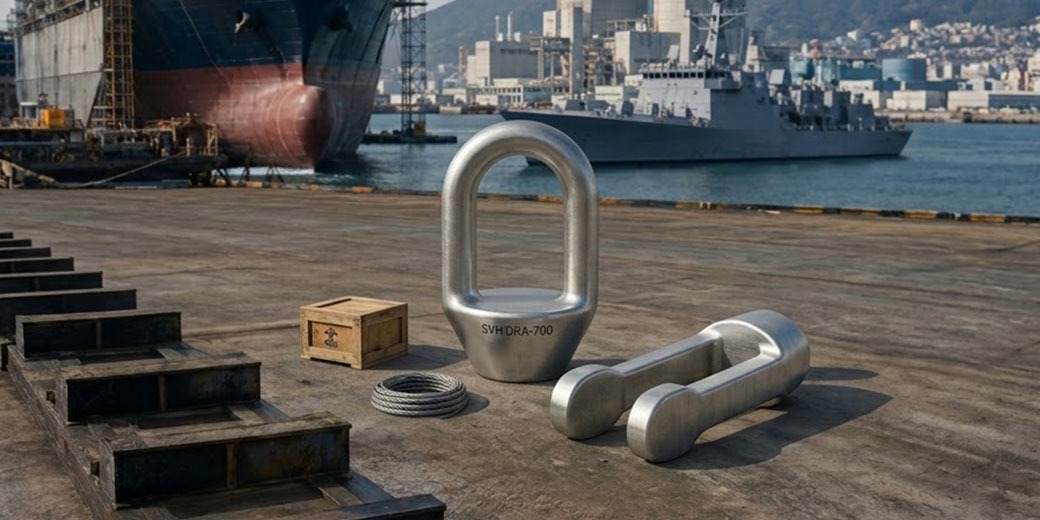
South Korea is the world’s largest shipbuilder (HHI, Samsung Heavy Industries, DSME/Hanwha Ocean), a major global defence exporter (K2 tank, K9 howitzer, FA-50 fighter, Type 214 submarine), and operates the world’s most nuclear-intensive electricity system outside France. Korean shipyards build 30–40% of global merchant tonnage annually, consuming massive quantities of propulsion shaft and structural hull forgings. The Korean defence export boom Poland, Australia, Norway, Egypt, UAE all purchasing Korean systems creates demand for specialty alloy steel forgings at volumes exceeding domestic Korean forge shop capacity. Indian forging manufacturers can supply into Korean industrial and defence supply chains.
| Company | Sector | Key Forging | Standard |
| Hyundai Heavy Industries (Ulsan) | Shipbuilding — VLCCs, container ships | Propulsion shaft, rudder stock, crankshaft | ABS / DNV / Lloyd’s Register |
| Samsung Heavy Industries (Geoje) | Shipbuilding — LNG carriers, FPSOs | Propulsion shaft, LNG structural fittings | ABS / DNV |
| Hanwha Ocean / DSME (Geoje) | Shipbuilding, naval submarines | Pressure hull fittings, propulsion shaft | ROKN specs, ABS |
| Hyundai Rotem (Seoul) | Defence — K2 tank, railway vehicles | Final drive gear blanks, torsion bars | DAPA (Korean MoD) |
| KEPCO NF (Daejeon) | Nuclear fuel / reactor maintenance | SA-508 Grade 3 nozzle forgings | KEPIC, ASME Section III |
Hyundai Heavy Industries — the world’s largest shipbuilder builds VLCCs (Very Large Crude Carriers), container ships, LNG carriers, and naval vessels at its vast Ulsan shipyard complex. HHI builds 70–90 vessels per year across all types, each requiring multiple propulsion shaft forgings. A VLCC propulsion shaft in 4340 alloy steel weighs 15,000–25,000 kg at the upper limit of Indian open die capability but within reach of Bharat Forge’s higher-capacity presses. Smaller intermediate shaft and coupling forgings (2,000–8,000 kg) are more accessible. HHI’s Korean Classification Society (KR) certification is required for Korean-flagged vessels but ABS, DNV, and Lloyd’s Register are accepted for international vessel orders.
South Korea’s defence export success — driven by the K9 Thunder howitzer, K2 Black Panther tank, and FA-50 light combat aircraft has created production demands that stretch Korean domestic forging capacity. The K9 howitzer alone is on order from 11 countries (Poland, Norway, Egypt, India, Australia, Estonia, Finland, Australia among others) with total orders exceeding 2,000 vehicles. K9 barrel blank forgings in 55NiCrMoV6 gun steel are produced by Korean domestic forgers but the production rate acceleration creates potential for qualified international forging sources. India, which has its own K9 Vajra-T programme (100 vehicles assembled by L&T), has an established Korea-India defence manufacturing relationship.
KEPCO Nuclear Fuel Company (KNF) and KEPCO Engineering & Construction Company manage South Korea’s nuclear programme 26 APR-1400 reactors operating and under construction domestically, plus APR-1400 export contracts for UAE (Barakah, four units operational) and potential new export programmes in Saudi Arabia, Czech Republic, and Poland. Korean nuclear forging procurement applies KEPIC (Korean Electric Power Industry Code) equivalent to ASME Section III as discussed in the UAE blog. The large scale of the Korean nuclear programme creates sustained SA-508 Grade 3 nozzle forging demand through KEPCO NF’s procurement organisation.
Samsung Heavy Industries — specialising in LNG carriers and FPSOs builds vessels with complex LNG containment systems requiring cryogenic-grade stainless steel structural fittings. SHI’s LNG carrier propulsion shafts and structural fittings require ABS or DNV classification survey the same requirements as European LNG carrier construction. SHI has built over 200 LNG carriers the world’s largest LNG carrier orderbook making it one of the most significant single-site consumers of marine propulsion forgings globally.
Vinir Engineering — Capability for this Market
- AS9100D.
- ABS approved manufacturer for Korean shipbuilding propulsion shaft and structural forgings — HHI, SHI, and Hanwha Ocean supply chain access.
- 4340 alloy steel propulsion shaft forgings to 15,000 kg with ABS Grade 3/4 survey.
- A182 F316L cryogenic structural fittings for SHI LNG carrier programmes.
- KEPIC-compatible quality system for KEPCO NF nuclear nozzle forging supply.
- 45CrNiMoVA and 55NiCrMoV6 for Korean defence howitzer and armoured vehicle programmes.
- Ocean freight Chennai to Busan or Ulsan: 10–14 days — among the shortest ocean transit times from India.