France is Europe’s second-largest aerospace manufacturing economy – home to Safran Group (Paris), Airbus France (Toulouse), Dassault Aviation (Paris), Thales Avionics, and MBDA missile systems. Safran alone employs over 91,000 people and produces aircraft engines (CFM International, with GE), landing gear, nacelles, and aircraft interiors. Indian AS9100D certified forging manufacturers with AMS specification compliance, Ti-6Al-4V and Inconel 718 production history, and NADCAP-relevant process capability are positioned to supply France’s aerospace supply chain at 20–30% cost advantage.
Company
Programme
Key Forging
Material
Safran Aircraft Engines
LEAP-1A/1B, CFM56, GE90
Compressor discs, fan hubs, seal rings
Inconel 718, Ti-6Al-4V
Safran Landing Systems
Boeing 787, 777X, A350
Main gear beam, trunnion, torque links
Ti-6Al-4V, 300M, 4340
Airbus France (Toulouse)
A320neo, A350, A330neo
Fuselage frames, wing fittings, pylons
7075-T73, Ti-6Al-4V
Dassault Aviation
Rafale, Falcon jets
Structural bulkheads, wing fittings
Ti-6Al-4V, 4340
MBDA France
Meteor, SCALP, Aster
Missile body rings, fin root fittings
Ti-6Al-4V, Inconel 625
Safran Aircraft Engines — the joint venture partner with GE in CFM International produces the LEAP engine family (powering A320neo and 737 MAX) and the CFM56 legacy engine. Safran’s Villaroche facility near Paris manufactures compressor and turbine modules using Inconel 718 and Ti-6Al-4V disc forgings. Safran applies the same NADCAP requirements as GE Aerospace for rotating component forging supply – NADCAP AC7102 for heat treatment and AC7114 for NDT are mandatory for compressor disc and turbine disc suppliers.
Safran Landing Systems — headquartered in Vélizy-Villacoublay designs and manufactures landing gear systems for Airbus, Boeing, and military aircraft. The main gear beam for a Boeing 787 is a large Ti-6Al-4V STA forging weighing 400–600 kg in the rough-forged condition. Landing gear forgings require 100% immersion UT to AMS 2154 Class AA and 100% FPI after machining identical to aerospace rotating component requirements.
Airbus France in Toulouse — the headquarters of Airbus and the primary assembly site for A320 family and A330 aircraft sources structural forgings through the Airbus Group supply chain. Airbus applies AIPI (Airbus Internal Process Instructions) and AIPS (Airbus Internal Process Specifications) that supplement AMS and AS9100D requirements. Indian suppliers entering the Airbus supply chain typically do so as tier-2 or tier-3 suppliers to established French aerospace manufacturers (Latecoere, Stelia Aerospace, Daher).
Dassault Aviation — producer of the Rafale multirole fighter and Falcon business jets applies DGA (Direction Générale de l’Armement, French defence procurement) requirements for Rafale programme forgings alongside AS9100D. Rafale programme forgings in Ti-6Al-4V are ITAR-equivalent sensitive under French defence export control – CIEO (Commission Interministérielle pour l’Étude des Exportations de Matériels de Guerre) authorisation is required for French defence technical data transmitted to India.
AS9100D full scope, Bureau Veritas, OASIS verifiable.
Ti-6Al-4V STA forgings with alpha case control for Safran Landing Systems and Dassault applications.
Inconel 718 double ageing in AMS 2750-calibrated furnaces (TUS at 718°C and 621°C) for Safran Aircraft Engines supply.
7075-T73 aluminium forgings under AMS 2770 for Airbus France structural applications.
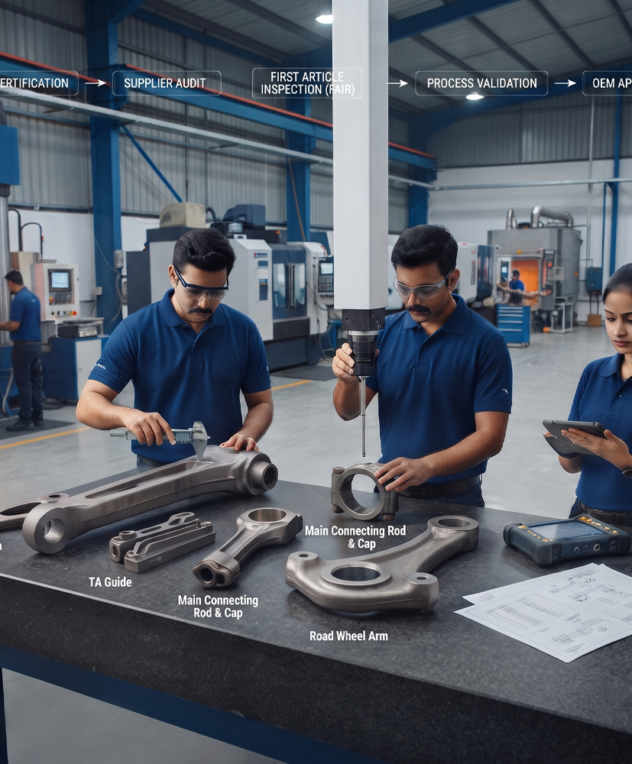
AS9102 FAIR experience.
NABL-accredited testing.
Ocean freight Chennai to Toulouse (via Marseille or Le Havre): 22–28 days.
Frequently Asked Questions
1.What French export control regulations apply to Dassault Rafale programme forging drawings transmitted to India?+–
CIEO (Commission Interministérielle pour l’Étude des Exportations de Matériels de Guerre) is the French interministerial commission that controls exports of war materials and related technical data. Rafale programme drawings which contain aerodynamic performance and structural design information are subject to CIEO export control. The French prime contractor (Dassault) must obtain CIEO authorisation before transmitting Rafale technical data to Indian suppliers. The process is less bureaucratically intensive than US ITAR (no Technology Control Plan requirement) but similarly requires formal government authorisation. Indian suppliers should confirm CIEO compliance with their Dassault contact before requesting Rafale programme drawings.
2.How does Safran’s LEAP engine supply chain differ from GE’s for Indian forging manufacturers?+–
The LEAP engine is co-produced by CFM International a 50/50 joint venture between Safran Aircraft Engines and GE Aerospace. Forging supply decisions for LEAP components are managed by each partner for their respective module responsibilities: Safran manages the compressor module and fan module supply chain from France; GE manages the combustor and turbine module supply chain from the US. An Indian forging manufacturer seeking LEAP programme supply engages either Safran (through the French supply chain) or GE (through the US supply chain) depending on which module the forging belongs to. Both apply equivalent NADCAP requirements and AS9100D.
3.What is the Airbus Supply Chain Network and how does an Indian forging manufacturer qualify within it?+–
Airbus manages its supply chain through a structured network of tier-1, tier-2, and tier-3 suppliers registered in Airbus’s SupplyOn platform. Indian forging manufacturers register in SupplyOn, complete the Airbus supplier self-assessment questionnaire, and are evaluated against Airbus’s Supply Chain Quality Management (SCQM) requirements. For structural forging supply to Airbus programmes, AS9100D is the minimum quality system requirement. Direct Airbus tier-1 qualification takes 18–24 months; entry as a tier-2 supplier to an established Airbus tier-1 (Premium Aerotec, Stelia, Spirit AeroSystems France) takes 10–16 months.
4.What makes Ti-6Al-4V landing gear forgings technically different from standard structural Ti-6Al-4V forgings?+–
Landing gear forgings require the STA (solution treated and aged) heat treatment condition rather than the mill-annealed condition used for many structural titanium forgings. STA achieves minimum tensile strength of 1,034 MPa (150,000 psi) versus 896 MPa (130,000 psi) for mill-annealed the extra strength allows thinner walls and lighter gear structures while meeting the ultimate load requirements. STA forgings also require 100% immersion UT to AMS 2154 Class AA — more stringent than AMS 2154 Class A used for non-critical structural applications — because landing gear is safety-critical and any internal defect that causes gear fracture under hard landing loads is a catastrophic event.
5.What is the typical lead time for aerospace forging delivery from India to French aerospace facilities?+–
Ocean freight from Chennai to Le Havre or Marseille via the Suez Canal takes 22–26 days. Total lead time from purchase order to French port is 14–20 weeks for standard structural aluminium and titanium forgings – covering raw material procurement (2–4 weeks), forging (2–4 weeks), heat treatment (1–2 weeks), NDT and FPI (1–2 weeks), AS9102 FAIR for first articles (2–3 weeks for new part numbers), documentation preparation (1 week), and ocean freight. French aerospace OEMs who plan Indian forging sourcing from their supply chain planning stage (12–18 months before assembly) can accommodate this lead time without programme impact.