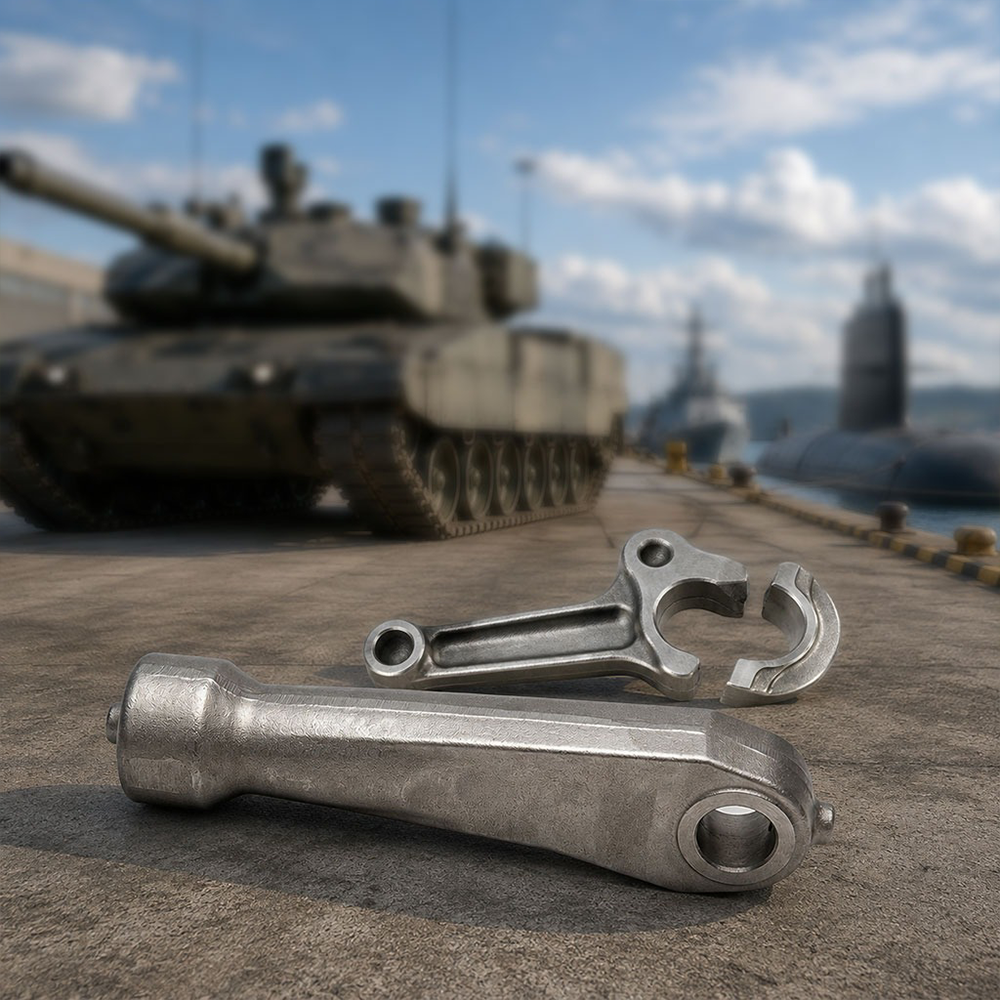
Germany’s defence industry anchored by Rheinmetall AG (Düsseldorf), Krauss-Maffei Wegmann (Munich), KNDS Deutschland, and ThyssenKrupp Marine Systems is in a period of significant expansion following Germany’s commitment to NATO 2% GDP defence spending. Rheinmetall’s Lynx infantry fighting vehicle, the Leopard 2 main battle tank upgrade programmes, and ThyssenKrupp’s Type 212CD submarine programme all generate demand for high-strength alloy steel, armour steel, and titanium forged structural components. Indian AS9100D certified forging manufacturers with German defence material experience are positioned to supply these programmes.
OEM
Platform
Key Forging
Material
Rheinmetall Landsysteme
Lynx KF41 IFV
Hull structure, drivetrain pins
4340, armour steel
Krauss-Maffei Wegmann
Leopard 2A7+
Final drive gear blanks, torsion bars
EN36, 45CrNiMoVA
KNDS Deutschland
PzH 2000 SPH
Gun barrel blanks, breech ring
CrMo6 gun steel
ThyssenKrupp Marine
Type 212CD submarine
Pressure hull fittings, shafts
HY-80 equivalent, 4340
Diehl Defence
IRIS-T SL missile
Body section rings, fin roots
Ti-6Al-4V, Inconel
Rheinmetall’s Lynx KF41 infantry fighting vehicle programme which has won contracts in Hungary, Australia, and the Czech Republic with US and European production ambitions uses drivetrain and suspension forgings similar to the Abrams and Bradley discussed in the US defence blogs. EN36 case-hardening steel gear blanks, 4340 drive shaft forgings, and 45CrNiMoVA torsion bars are the primary forging categories. German defence OEM supply qualification for Indian manufacturers requires: AS9100D (not NADCAP, which is aerospace-specific), familiarity with German material standards (DIN specifications alongside ASTM equivalents), and in some cases approval from the German Federal Office of Bundeswehr Equipment (BAAINBw).
KMW’s Leopard 2A7+ upgrade programme involves substantial replacement of drivetrain components and the installation of additional armour packages. Torsion bar replacement forgings 45CrNiMoVA spring steel achieving minimum yield strength 1,400 MPa are a recurring replacement parts opportunity as upgraded Leopard 2 vehicles are distributed to NATO allies. German and European allies who operate Leopard 2 tanks all require torsion bar and final drive component replacements through the KMW supply chain.
The PzH 2000 — Germany’s primary self-propelled howitzer uses a chrome-molybdenum gun barrel blank forging produced in 55NiCrMoV6 or equivalent gun steel. Gun barrel blank forgings require: exceptional steel cleanliness (vacuum melted), 100% UT to demanding acceptance criteria, and controlled reduction ratio during forging to ensure full grain refinement through the tube wall thickness.
ThyssenKrupp Marine Systems’ Type 212CD next-generation submarine ordered by Germany and Norway creates demand for pressure hull structural forgings in HY-80 equivalent steel and propulsion shaft forgings. These forgings have similar requirements to the Virginia class programme discussed in the US naval blog though without US ITAR and DCMA regulatory requirements.
45CrNiMoVA torsion bar forgings with yield strength >1,400 MPa.
EN36 gear blank forgings soft anneal or pre-hardened.
4340 drive shaft and structural pin forgings, 10–5,000 kg.
DIN/EN material standard equivalency documentation available alongside ASTM.
100% UT per ASTM A388 equivalent.
NABL Charpy at -30°C.
Ocean freight Chennai to Hamburg or Bremen: 22–28 days.
Frequently Asked Questions
1.What German DIN/EN material standards apply to Rheinmetall ground vehicle forging supply?+–
Rheinmetall applies DIN EN ISO standards and German Bundeswehr technical standards (TL – Technische Lieferbedingungen) for military vehicle material specifications. Common material equivalencies relevant to ground vehicle forgings: DIN EN 18CrNiMo7-6 ≈ ASTM A534 Grade 1 (case hardening steel), DIN 30CrMoV9 ≈ ASTM A470 Class 8 (CrMoV steel), DIN 42CrMo4 ≈ AISI 4140 (alloy steel). Indian forging manufacturers must provide material certifications referencing both the DIN/EN specification and the ASTM equivalent to satisfy Rheinmetall’s incoming material inspection requirements.
2.Does the BAAINBw (German federal procurement office) conduct direct audits of foreign forging suppliers?+–
BAAINBw conducts regulatory oversight of German prime contractors (Rheinmetall, KMW, ThyssenKrupp) rather than direct audits of their tier-2 and tier-3 suppliers. For Indian forging manufacturers supplying German defence programmes, the German prime contractor’s quality team is the direct audit contact. BAAINBw may review prime contractor supplier qualification documentation as part of programme reviews but does not typically travel to Indian facilities for direct assessment. Indian suppliers with AS9100D and demonstrated German defence supply track record have the credentials required for BAAINBw-compatible programme supply.
3.What are the export control implications of supplying forgings to the German defence supply chain?+–
Germany applies the EU Common Position on arms exports and German War Weapons Control Act (KWKG) to defence-related exports. For Indian forging manufacturers receiving German defence drawings, the applicable regulation is German export control law which may require German export licences for certain technical data. Unlike US ITAR, German export control does not impose Technology Control Plan requirements on the Indian facility. However, the German prime contractor’s export compliance team determines which drawings require export authorisation before transmission. Indian manufacturers should establish this framework at the beginning of the supply relationship.
4.What is the gun steel specification for PzH 2000 barrel blank forgings and can Indian forge shops meet it?+–
PzH 2000 gun barrel blanks are produced in 55NiCrMoV6 (European designation) or equivalent chrome-nickel-molybdenum-vanadium gun steel. The specification requires vacuum arc remelted material (to eliminate hydrogen inclusions that cause delayed fracture in ultra-high-strength steel), minimum tensile strength of 1,400–1,600 MPa after final heat treatment, and 100% UT with tighter-than-commercial acceptance criteria. Indian forge shops with open die capability above 3,000 tonnes and access to VAR-melted 55NiCrMoV6 billet from European steel mills can produce PzH 2000 barrel blanks. The primary challenge is sourcing the VAR-melted billet typically from Deutsche Edelstahlwerke or Böhler rather than the forging process itself.
5.How does Lynx KF41 IFV forging procurement differ from M2 Bradley forging procurement for Indian suppliers?+–
The primary difference is regulatory framework: Lynx is a German export-controlled product under German and EU regulations, while Bradley is US ITAR-controlled. For Indian forging manufacturers, German export control is less burdensome than ITAR no Technology Control Plan requirement, no mandatory TAA process. Material standards also differ: Lynx applies DIN/EN material specifications while Bradley applies ASTM/MIL-SPEC. The physical manufacturing requirements 4340 structural pins, EN36 gear blanks, 45CrNiMoVA torsion bars are essentially identical between the two platforms. Indian suppliers with existing Lynx qualification can leverage that technical track record when approaching the Bradley supply chain, and vice versa.