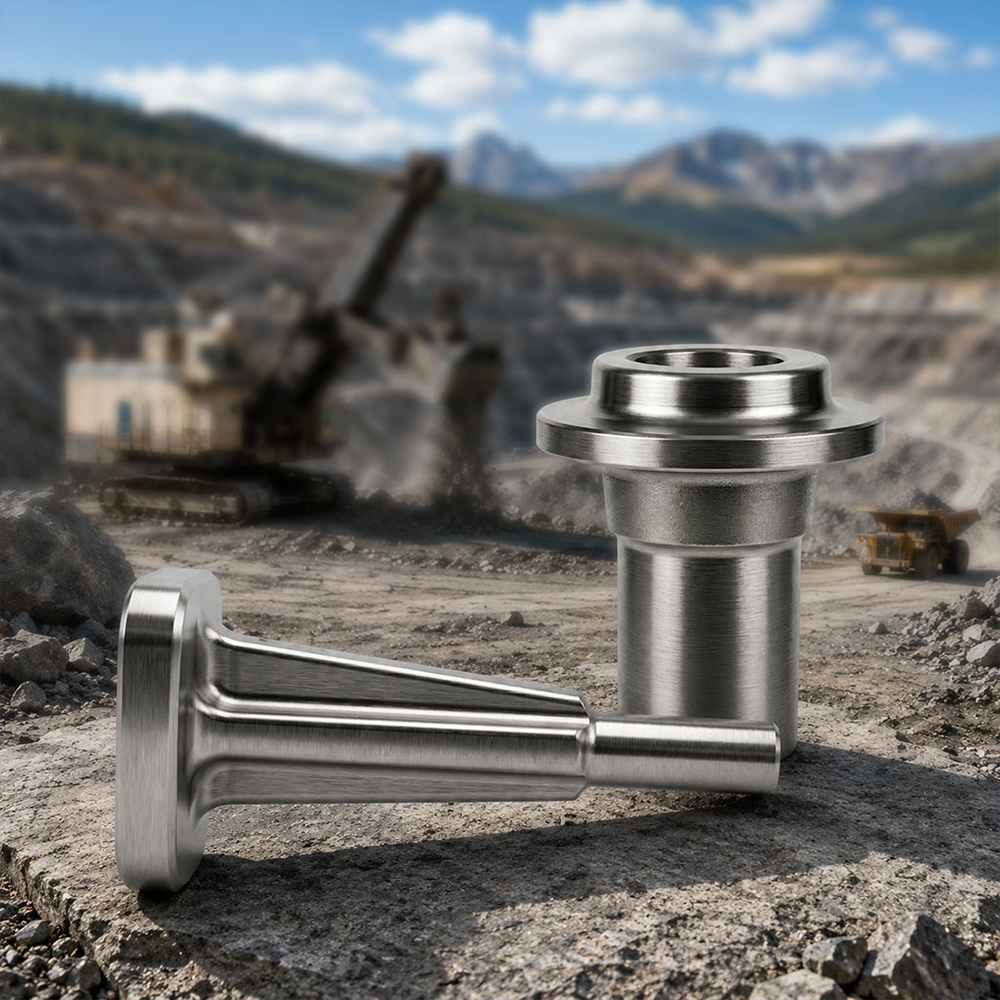
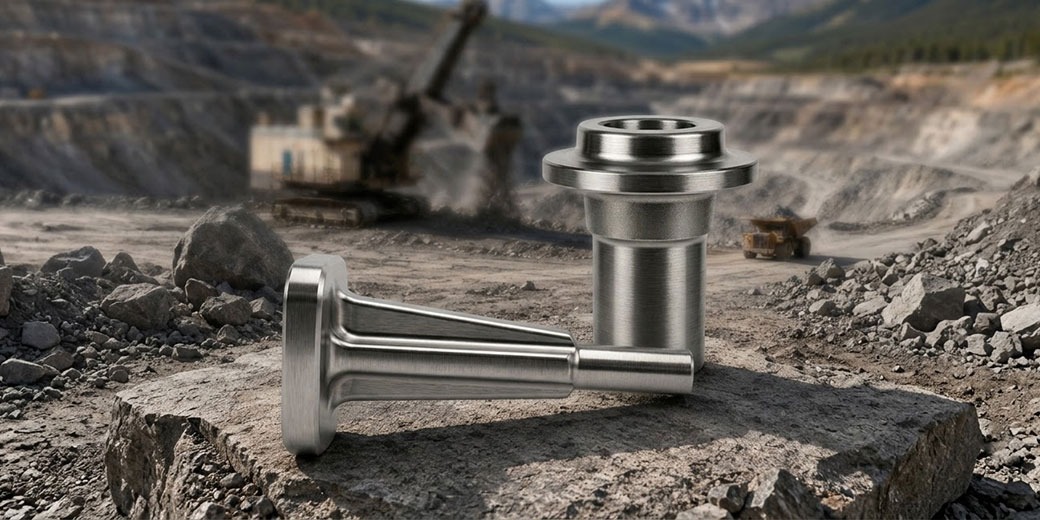
Canada is the world’s fourth-largest mining nation by output — producing copper, gold, potash, nickel, uranium, and iron ore from operations across British Columbia, Ontario, Quebec, Alberta, and the northern territories. Teck Resources (Vancouver), Barrick Gold (Toronto), Agnico Eagle (Toronto), First Quantum Minerals (Vancouver), and Cameco (uranium, Saskatoon) operate large-scale mining equipment fleets that generate substantial forging demand for structural pin forgings, crusher shaft forgings, and drilling equipment components. Indian forging manufacturers with AS9100D and 4340/4140 alloy steel production history are positioned to supply the Canadian mining equipment market.
Company
Commodity
Key Equipment
Primary Forging
Teck Resources
Copper, zinc, steelmaking coal
Caterpillar 6060/6040 shovels, P&H drills
Boom pins, drill collar forgings
Barrick Gold
Gold, copper
Komatsu shovels, Epiroc drill rigs
Structural pins, drill rod connections
Agnico Eagle
Gold (underground)
Sandvik jumbos, Epiroc loaders
Feed beam, rotation head forgings
Cameco
Uranium
Specialized underground loaders
Custom structural forgings
First Quantum
Copper (surface)
Liebherr T 284 haul trucks
Suspension pins, front spindle
Canada’s mining equipment fleet is dominated by the same OEMs that serve the US market – Caterpillar, Komatsu, Epiroc, and Sandvik with Canadian operations managed through the North American supply chains of these global equipment manufacturers. The Canadian mining equipment aftermarket (replacement parts) provides the most accessible Indian forging supply entry point, as aftermarket distributors operate independently of OEM new equipment supply chains with more streamlined qualification processes.
Teck Resources — the largest diversified mining company headquartered in Canada operates Highland Valley Copper (British Columbia), the Steelworkers coal mines in the Elk Valley (British Columbia), and the Red Dog zinc-lead mine in Alaska. Heavy surface mining equipment at these operations includes Caterpillar 6060 electric rope shovels and P&H blast hole drilling rigs both consuming structural pin forgings and drill collar forgings in 4340 and 4140 alloy steel.
Agnico Eagle’s underground gold mines — LaRonde, Goldex (Quebec), Meliadine, Amaruq (Nunavut), and Malartic (Quebec) use Sandvik and Epiroc underground drilling and loading equipment. The Canadian underground mining environment imposes additional requirements on structural forgings: cold temperature performance is critical, as underground mines in northern Ontario and Nunavut operate in ambient temperatures that can reach -40°C in winter even in underground settings where ventilation draws cold external air. Charpy impact testing at -40°C is specified by some Canadian mining operators for surface-exposed structural forgings.
The Canadian mining sector’s geographic distribution — from southern British Columbia to the Nunavut Arctic means that equipment operating conditions range from temperate coastal environments to subarctic conditions. This temperature range drives more stringent low-temperature toughness requirements for structural pin forgings than comparable US surface mining applications, which are more geographically concentrated in warmer climates.
4340, EN24, 4140 structural pin and shaft forgings, 10–5,000 kg, closed and open die.
NABL Charpy at -20°C and -40°C — critical for Canadian arctic and sub-arctic mining applications.
100% UT per ASTM A388.
MT of all forging surfaces.
Hardness verification after heat treatment at multiple locations.
Ocean freight Chennai to Vancouver (Pacific route): 20–25 days.
Chennai to Montreal/Toronto (Suez/Atlantic route): 28–35 days.
Frequently Asked Questions
1.What Charpy impact temperature is appropriate for structural pin forgings in Canadian northern mining operations?+–
For surface mining operations in southern British Columbia and Ontario, -20°C Charpy impact is the standard minimum the same as for most US and European industrial applications. For northern Canadian operations (Nunavut, northern Quebec, northern Ontario) and Alaskan operations in the Teck supply chain, -40°C Charpy impact is the appropriate requirement for exposed structural components. Underground forgings that are not exposed to external ambient temperatures may use -20°C as the test temperature even in northern operations. Indian forging manufacturers must confirm with the Canadian mining OEM or operator which Charpy test temperature is specified the NABL laboratory scope must explicitly cover the specified test temperature.
2.How does Canadian mining equipment procurement differ from US mining equipment procurement for Indian suppliers?+–
The technical requirements are essentially identical same Caterpillar, Komatsu, Epiroc, and Sandvik OEM supply chains, same 4340/4140 alloy steel specifications, same AS9100D quality system expectation. The primary differences are: lower temperature Charpy requirements for northern Canadian operations (-40°C versus -20°C for most US applications), potential preference for metric dimensional specifications (Canada is officially metric while US mining uses imperial for some components), and Canadian customs procedures. Import duty on steel forgings entering Canada under the Canada-India CEPA (Comprehensive Economic Partnership Agreement) discussions is ongoing current MFN duty is typically 0–8% depending on HTS classification.
3.What is the Canadian mining aftermarket parts market and why is it accessible to Indian forging suppliers?+–
The Canadian mining equipment aftermarket replacement structural pins, wear components, and drive train parts is served by Canadian-based distributors (Finning International for Caterpillar, Strongco for Volvo CE) and independent parts suppliers. These distributors maintain inventory of high-turnover replacement items and procure from qualified suppliers globally. For Indian forging manufacturers, aftermarket distributors typically require: material certification, dimensional drawing compliance, ISO 9001 minimum quality system, and competitive pricing all of which Indian manufacturers can readily provide. The aftermarket qualification process is 6–10 months versus 12–18 months for OEM new equipment supply, making it the natural first step in the Canadian mining market.
4.What Caterpillar mining equipment is most active in Canadian operations and what forgings does it consume?+–
Teck Resources and other Canadian copper and coal miners operate Caterpillar 6060 and 6040 electric rope shovels among the world’s largest mining shovels. Each Cat 6060 shovel uses boom and arm structural pin forgings of 200–400 kg each (7 major pin positions), crowd rope drum shaft forgings, and swing drive output shaft forgings. At an operating life of 25,000+ hours with pin replacement intervals of 4,000–8,000 hours, each shovel generates 4–6 full sets of structural pin replacement orders over its service life. Canadian mining operations with fleets of 5–10 Cat 6060 shovels represent 20–60 structural pin sets replaced per year substantial sustained forging demand.
5.What are the environmental and social governance (ESG) considerations affecting forging supply to Canadian mining companies?+–
Canadian mining companies particularly TSX-listed companies like Teck, Barrick, and Agnico Eagle operate under significant ESG scrutiny from institutional investors, Indigenous rights frameworks, and Canadian environmental regulations. This ESG focus increasingly extends to supply chains: Canadian mining companies are beginning to assess the ESG credentials of major suppliers, including forging manufacturers. Indian forging manufacturers who can demonstrate: environmental management (ISO 14001 or equivalent), safety management systems, community engagement, and responsible sourcing of raw materials will have a competitive advantage in Canadian mining procurement as ESG due diligence requirements evolve. The GreenCo certification held by Vinir (a CII certification for environmental performance) is directly relevant to this emerging Canadian mining supply chain ESG requirement.