
Titanium Forgings for Aerospace in India: Materials, Process Requirements, and Supplier Qualification
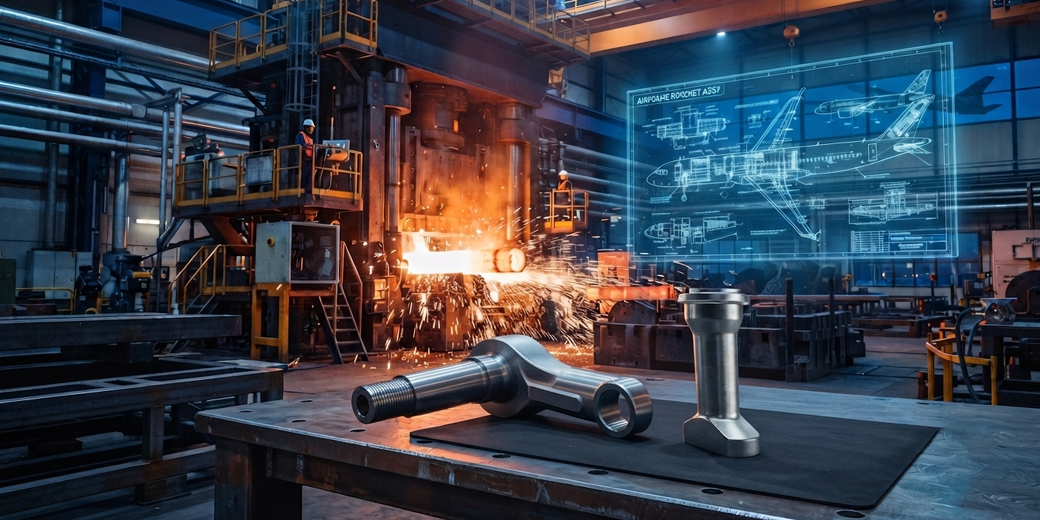
Titanium aerospace forgings are forged components manufactured from titanium alloys for use in aircraft structures, helicopter rotor systems, aeroengines, and aerospace defence platforms. Titanium’s combination of high strength-to-weight ratio, excellent corrosion resistance, and biocompatibility with structural adhesives makes it the dominant material for weight-critical aerospace structural applications. In India, titanium aerospace forging demand is growing rapidly as HAL’s Tejas production ramps, ALH Dhruv and LCH Prachand programmes expand, and international aerospace OEM offset obligations drive qualification of Indian titanium forging suppliers.
Why Titanium Is Specified for Aerospace Structural Forgings
The decision to use titanium over alloy steel or aluminium in an aerospace structural application is driven by one of three primary factors — or a combination of them.
Weight saving where structural performance cannot be compromised: Ti-6Al-4V achieves tensile strength of 895–1,100 MPa at a density of 4.43 g/cm³. The equivalent alloy steel (4340) achieves similar strength at 7.85 g/cm³ — nearly twice the density. For a structural member carrying the same load, titanium saves 44% weight. In aircraft design this weight saving directly improves range, payload, or both.
Fatigue performance in cyclic loading environments: Titanium alloys have a genuine endurance limit — below a certain cyclic stress amplitude, fatigue crack initiation does not occur regardless of the number of cycles. High-strength steels do not have a true endurance limit — they will eventually initiate fatigue cracks under any cyclic loading. For aircraft structural components subject to millions of load cycles over a service life, this fatigue advantage is significant.
Corrosion resistance without protective coating: Titanium is essentially immune to atmospheric and mild aqueous corrosion. Steel and aluminium require protective coatings that add weight, require maintenance, and can fail. In locations where coating maintenance access is limited — internal structural members, complex geometry fittings — titanium’s inherent corrosion resistance eliminates a maintenance burden that would otherwise accumulate over a 30-year airframe life.
Titanium Alloy Grades Used in Indian Aerospace Forgings
Ti-6Al-4V (Grade 5) — The Dominant Aerospace Grade
Ti-6Al-4V accounts for approximately 50% of all titanium alloy usage in aerospace globally and the vast majority of titanium aerospace forgings. The alloy contains 6% aluminium (alpha stabiliser) and 4% vanadium (beta stabiliser), producing a two-phase alpha-beta microstructure that provides an excellent balance of strength, ductility, and fatigue resistance.
Standard aerospace specification: AMS 4928 for bar and billet, AMS 4935 for sheet and plate. Forging from AMS 4928 qualified billet is the standard for Indian aerospace titanium programmes.
Mechanical properties (annealed condition):
- Ultimate tensile strength: 895 MPa minimum
- Yield strength (0.2% offset): 828 MPa minimum
- Elongation: 10% minimum
- Reduction of area: 25% minimum
Mechanical properties (solution treated and aged — STA):
- Ultimate tensile strength: 1,103 MPa minimum
- Yield strength: 1,000 MPa minimum
The STA condition is used for maximum-strength aerospace applications — landing gear structural members, highly loaded airframe fittings. The annealed condition provides better fatigue and fracture toughness and is used for the majority of aerospace structural forgings.
Ti-6Al-4V ELI (Grade 23) — Extra Low Interstitials
ELI grade has tighter limits on interstitial elements — oxygen, nitrogen, carbon, iron — than standard Grade 5. The lower interstitial content improves fracture toughness and fatigue crack growth resistance. Specified for the most fatigue-critical aerospace applications where the STA condition is required alongside maximum fracture toughness — rotor hub forgings, highly loaded structural fittings in fatigue-critical locations.
AMS 4930 is the applicable specification for ELI bar and billet.
Ti-3Al-2.5V (Grade 9) — Tubing and Moderate-Strength Applications
Lower alloy content than Grade 5, easier to form. Used primarily for hydraulic tubing in aerospace (not forging applications) but appears in some lightweight structural fitting forgings where the Grade 5 strength is not required and better formability is valued.
Near-Beta and Beta Titanium Alloys — High-Strength Applications
Beta-rich titanium alloys (Ti-10V-2Fe-3Al, Ti-15V-3Cr-3Al-3Sn, Ti-3Al-8V-6Cr-4Zr-4Mo “Beta-C”) achieve higher strength than Ti-6Al-4V in the aged condition — tensile strengths above 1,200 MPa — with better ductility than ultra-high-strength steels at equivalent strength. Specified for:
- Boeing 777 and 787 landing gear components where beta titanium replaced steel to reduce weight on the largest commercial aircraft landing gear ever designed
- High-strength aerospace structural fittings where both strength and corrosion resistance are required
Beta titanium alloys are significantly more expensive than Ti-6Al-4V and require more complex heat treatment — solution treatment followed by ageing at controlled temperatures. They are not yet routinely produced by Indian aerospace forging manufacturers but will become relevant as the Indian aerospace supply chain matures.
Titanium Forging Process: The Critical Differences from Steel
Titanium can be forged on the same equipment as steel but requires process controls that are fundamentally different in several respects. A manufacturer who understands steel forging but has not developed specific titanium process knowledge will produce titanium components that look correct but fail FAI or fail in service.
Forging Temperature Range
Ti-6Al-4V is forged in two distinct temperature regimes:
Below the beta transus (~995°C for Ti-6Al-4V) — alpha-beta forging. The material retains both phases during forging. The resulting microstructure has a fine, equiaxed alpha grain structure with intergranular beta — optimal for fatigue resistance and ductility. This is the standard condition for most aerospace structural forgings.
Above the beta transus — beta forging. All alpha transforms to beta above the transus temperature. Beta forging produces a Widmanstätten (basket-weave) alpha microstructure on cooling — high fracture toughness but lower fatigue initiation resistance than alpha-beta forging. Specified for some specific fatigue-tolerant design applications.
The beta transus temperature varies between heats of Ti-6Al-4V within a range of approximately 980–1,010°C. For alpha-beta forging, the forging temperature must be below the beta transus of the specific heat being forged — not a generic temperature. Forging above the beta transus when alpha-beta forging is required produces an incorrect microstructure that will fail metallographic examination.
Heat-specific beta transus testing is therefore required for each incoming heat of titanium billet before forging begins. This is a requirement that steel forging manufacturers routinely overlook when first transitioning to titanium.
Alpha Case Formation and Control
Alpha case is the single most discussed process risk in titanium aerospace forging. It is a brittle, oxygen-enriched surface layer that forms when titanium is heated in the presence of atmospheric oxygen and nitrogen at forging temperatures. The oxygen dissolved from the atmosphere into the surface layer stabilises the alpha phase and significantly reduces fatigue life — the most critical property for aerospace titanium components.
Alpha case forms rapidly at titanium forging temperatures (900–980°C). Even brief exposure to atmosphere at temperature — during transfer from furnace to press, during inter-pass cooling on the press — can produce alpha case of 0.1–0.3mm depth. At 0.5mm depth, alpha case is typically a rejection criterion for fatigue-critical aerospace components.
Methods to control alpha case:
Inert atmosphere furnace — argon or vacuum atmosphere eliminates alpha case formation during heating. Most capital-intensive but provides absolute protection.
Protective coating — a glass-based or ceramic coating applied to the billet surface before heating prevents atmosphere contact. The coating is removed after forging by grit blasting or chemical stripping. Alpha case beneath intact coating is minimal. Areas where coating is damaged or missing are at risk.
Controlled atmosphere cover during transfer — argon gas blanket over the billet during transfer from furnace to press reduces exposure time. Less complete protection than an inert atmosphere furnace but practical for larger components that cannot be heated in a vacuum furnace.
Time-temperature management — minimising time at temperature during transfer. A billet transferred from furnace to press in 15 seconds has significantly less alpha case than one transferred in 60 seconds. Documented transfer time limits are part of the titanium forging procedure.
Alpha Case Detection and Verification
After forging and prior to machining, alpha case depth is verified on a sacrificial witness piece. The witness piece is either:
Chemically milled — the surface is etched in a solution that removes metal at a controlled rate. After chemical milling to a defined depth, the surface is inspected visually and by FPI. If alpha case is present at a depth greater than the metal removed, it becomes visible as a brittle surface layer with a characteristic appearance.
Metallographic cross-section — a coupon is cut from a sacrificial piece of the same heat and thermal cycle, polished, etched, and examined metallographically under a microscope. Alpha case appears as a distinctive layer with different etching response than the bulk material. Depth is measured directly.
The acceptance limit for alpha case depth is specified in the quality plan — typically 0.13mm (0.005 inch) for most aerospace applications, with tighter limits for the most fatigue-critical components.
Heat Treatment of Titanium Aerospace Forgings
Mill Annealing
The most common heat treatment for Ti-6Al-4V aerospace forgings. Performed at 700–790°C for 1–2 hours followed by air cooling. Achieves a partially recrystallised microstructure that balances fatigue resistance with adequate strength and ductility. The annealing temperature must be above the recrystallisation temperature but below the beta transus — entering the beta field during annealing coarsens the alpha structure and reduces fatigue resistance.
Solution Treatment and Ageing (STA)
For maximum strength applications. Solution treatment is performed above or near the beta transus, followed by rapid quench (water quench for most section sizes) and then ageing at 480–595°C for 2–8 hours. The ageing precipitates fine alpha platelets within the beta matrix, increasing strength significantly above the annealed condition.
STA titanium requires careful section size consideration — the quench must be fast enough throughout the cross-section to retain sufficient beta for the ageing response. Thick sections that cool too slowly during quench produce a microstructure with lower strength than the STA specification requires, even with correct ageing.
Stress Relieving
After machining of complex geometry aerospace titanium forgings, stress relieving at 480–650°C for 1–4 hours in vacuum or inert atmosphere reduces residual machining stresses that could reduce fatigue life if left in the finished component. The inert atmosphere requirement applies equally to stress relief as to initial heating — alpha case formation during stress relieving is as damaging as alpha case formation during forging.
NDT Requirements for Titanium Aerospace Forgings
Fluorescent Penetrant Inspection (FPI)
FPI is the mandatory surface inspection method for titanium aerospace forgings. Visible dye penetrant is not acceptable for most aerospace titanium applications — the sensitivity is insufficient for the tight fatigue cracks that are the critical defect type in titanium.
FPI process :
- Surface cleaning — alkaline cleaner followed by rinse and dry
- Penetrant application — fluorescent penetrant applied and allowed to dwell (typically 20–60 minutes)
- Rinse — excess penetrant removed with water rinse
- Developer application — draws entrapped penetrant from defects
- Inspection under UV light — indications visible as bright yellow-green fluorescence
FPI is performed after final machining on the finished surface. Surface finish must meet the specification requirement before FPI — rough machined surfaces mask tight crack indications.
The applicable standard for aerospace titanium FPI is typically AMS 2647 — the most demanding penetrant inspection specification applied in aerospace. Penetrant system qualification, process parameters, and acceptance criteria are all defined in AMS 2647.
Ultrasonic Testing
UT of titanium aerospace forgings uses higher frequencies than typical steel forging UT — 5–10 MHz versus 2–5 MHz for steel — to achieve the sensitivity required for the acceptance criteria. Immersion UT is typically specified for aerospace titanium to achieve consistent coupling and the near-surface sensitivity required to detect subsurface alpha case.
The applicable UT standard for aerospace titanium forgings is AMS 2154 for bar stock or customer-specific standards for forgings. Acceptance criteria are defined by class (A, B, C, D, AA) with Class AA being the most demanding — typically required for engine rotating components.
Qualification Specific Requirements for Titanium Aerospace Forgings
When an aerospace OEM qualifies a supplier specifically for titanium forging, the qualification programme includes elements not present in alloy steel qualification:
Beta transus characterisation — the qualification supplier must demonstrate that they test beta transus for each incoming heat and use the results to establish forging temperature limits.
Alpha case control procedure — a written procedure describing the atmospheric protection measures, transfer time limits, and verification method for alpha case must be submitted and approved before first article production.
Alpha case verification on the first article — the FAIR for a titanium aerospace forging includes alpha case depth measurement on a sacrificial witness piece from the same heat and thermal cycle.
FPI capability demonstration — the supplier’s FPI process is assessed — penetrant type and sensitivity (typically Type 1, Method D, Level 3 or 4 fluorescent penetrant), dwell time, developer application, UV lamp intensity, and inspector dark adaptation time.
Microstructure characterisation — metallographic examination of a representative cross-section from the first article confirms that the required microstructure (equiaxed alpha-beta for alpha-beta forging) was achieved.
Titanium Aerospace Forging Demand in India: Where It Comes From
HAL Tejas Programme
The Tejas Mk1A, with a production target of 24 aircraft per year, is the largest current domestic driver of titanium aerospace forging demand. Airframe structural forgings in Ti-6Al-4V — bulkhead components, longeron fittings, wing attach brackets, fin attachment structure — are required in quantities of 50–200 pieces per aircraft build lot depending on the specific part. HAL sources these from a combination of HAL’s own forging division and qualified external suppliers.
HAL Helicopter Programmes
The ALH Dhruv and LCH Prachand use titanium rotor hub forgings, pitch change link fittings, and structural frame members. Helicopter rotor system titanium forgings are among the most fatigue-critical aerospace components — subject to high-cycle loading from rotor vibration throughout the helicopter’s service life. The qualification requirements for rotor system forgings are correspondingly the most demanding in HAL’s aerospace forging supply chain.
DRDO and Future Programmes
GTRE’s Kaveri engine development and the planned AMCA advanced medium combat aircraft will generate significant new titanium forging demand as development programmes transition to production. Suppliers who qualify for current Tejas and Dhruv programmes establish the track record that positions them for AMCA supply.
International Offset
Airbus’s purchase of MRTA (multi-role transport aircraft) and C295 aircraft for Indian customers includes offset obligations. Airbus has identified titanium forgings as a preferred offset category. Similarly, Boeing’s Apache and Chinook helicopters for India carry offset obligations that have driven qualification of Indian titanium forging sources.
Vinir Engineering’s Titanium Aerospace Forging Capability
Vinir Engineering produces Ti-6Al-4V aerospace forgings from AMS 4928 qualified billet sourced from approved international mills. The forging process includes heat-specific beta transus characterisation, alpha case control through a combination of glass coating and controlled transfer time limits, and post-forge alpha case verification on witness pieces.
Closed die forging covers Ti-6Al-4V in the 5–500 kg range — the primary range for most HAL airframe and rotor system structural forgings. Heat treatment capability includes mill annealing and STA in calibrated furnaces. In-house FPI to AMS 2647 and immersion UT to AMS 2154 class levels are performed by ASNT Level II certified operators.
AS9100D certification covers titanium forging within the scope. NABL-accredited mechanical testing (tensile, impact, hardness) and chemical analysis are performed in-house. Alpha case characterisation is performed in the NABL-accredited metallography lab.
Frequently Asked Questions — Titanium Aerospace Forgings India
What is alpha case in titanium aerospace forgings and why is it a rejection criterion?
Alpha case is a brittle, oxygen-enriched surface layer that forms on titanium when heated in the presence of atmospheric oxygen at forging temperatures. The oxygen dissolves into the titanium surface and stabilises the alpha phase, creating a layer that is significantly more brittle than the bulk alloy. Fatigue cracks initiate preferentially at the alpha case layer, reducing fatigue life — the most critical property for aerospace titanium — to a fraction of the design value. Acceptance specifications for aerospace titanium define maximum alpha case depth (typically 0.13mm for most applications). Components with alpha case exceeding this limit are rejected regardless of all other properties.
What is the beta transus and why must it be measured for each heat of titanium?
The beta transus is the temperature above which all alpha phase transforms to beta phase in titanium alloys. For Ti-6Al-4V the nominal beta transus is approximately 995°C, but it varies between heats within a range of approximately 980–1,010°C depending on the exact chemistry within the specification limits. Forging titanium above the beta transus when alpha-beta forging is required produces an incorrect Widmanstätten microstructure that fails metallographic examination. Because the beta transus varies by heat, it must be measured on a sample from each incoming heat before forging temperature limits are established for that heat.
What NDT methods are required for titanium aerospace forgings?
Fluorescent penetrant inspection (FPI) to AMS 2647 is mandatory for all aerospace titanium forgings — it detects surface-breaking defects including alpha case breakthrough and forging cracks. Ultrasonic testing (UT) at 5–10 MHz, typically immersion UT, is required for volumetric inspection — detecting subsurface defects and verifying internal cleanliness. Both methods are required in combination — FPI for surface integrity and UT for bulk cleanliness. Visible dye penetrant is not acceptable for aerospace titanium applications.
Can Indian suppliers source titanium from domestic mills for aerospace forgings?
Indian titanium sponge production exists (KMML in Kerala) but aerospace-grade billet to AMS 4928 specification is not yet widely available from Indian mills to the standard required for aerospace certification. Most Indian aerospace titanium forging manufacturers source billet from established international titanium mills — TIMET, ATI, VSMPO-AVISMA — whose material carries AMS 4928 certification and the heat-specific test data required for aerospace FAI. As Indian titanium processing capabilities develop, domestic sourcing will become more feasible but the international mill chemistry traceability requirement will remain.
What is the difference between annealed and STA condition Ti-6Al-4V for aerospace forgings?
Annealed Ti-6Al-4V (700–790°C, air cool) produces a microstructure with good fatigue resistance, ductility, and fracture toughness — it is the standard condition for most aerospace structural forgings. Solution treated and aged (STA) Ti-6Al-4V (solution at or near beta transus, water quench, age at 480–595°C) achieves higher tensile and yield strength than annealed condition but with somewhat lower ductility and fracture toughness. STA is specified where maximum strength is the design driver — highly loaded fittings, landing gear structural members — and where the lower ductility is acceptable based on the stress state in the application.