
Upstream Oil & Gas Forging in India: Wellhead, Choke Body, and Pressure Housing Components
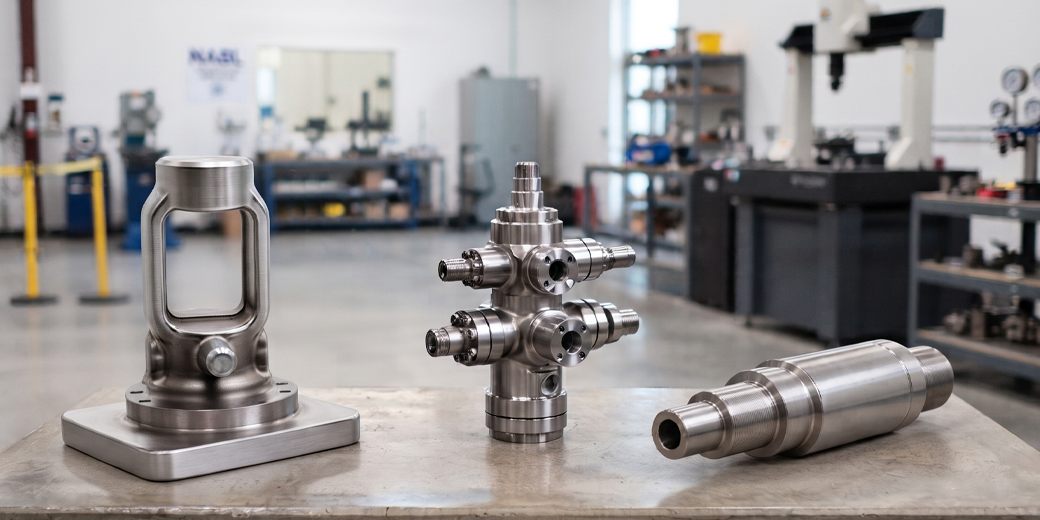
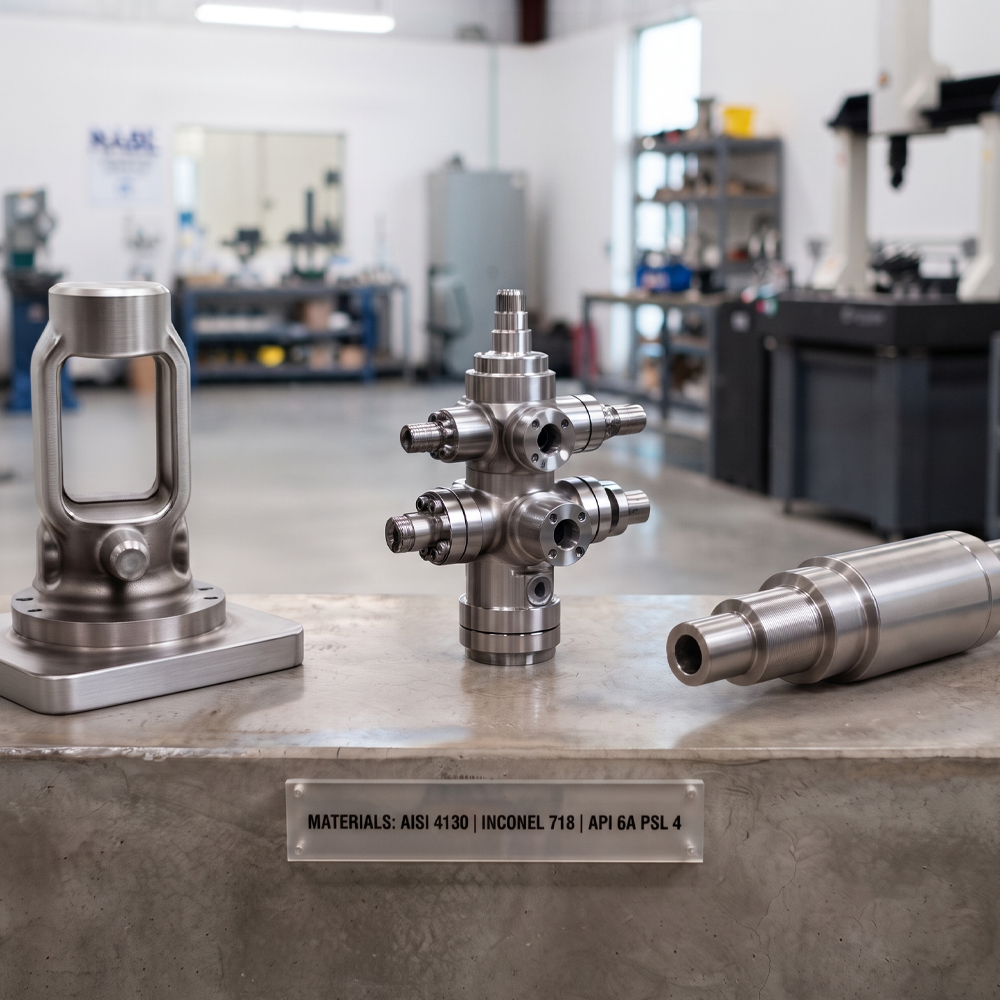
Upstream oil and gas forging covers forged components used in the exploration, drilling, and production phases of oil and gas development — the wellhead assemblies that control flow from the wellbore, choke bodies that regulate production rates, pressure housing components for downhole tools, and structural forgings for drilling equipment. Upstream forgings operate at the highest pressures in the oil and gas value chain — up to 20,000 psi working pressure for deep high-pressure wells — in environments that may simultaneously contain H₂S, CO₂, chlorides, sand, and produced water at elevated temperatures. These conditions make upstream forging the most technically demanding forging category in the oil and gas industry.
At a Glance: Upstream Oil & Gas Forging Requirements
| Parameter | Requirement |
| Primary standard | API 6A — Wellhead and Christmas Tree Equipment |
| Forging quality | API 20B (carbon/alloy steel), API 20C (CRA) |
| Working pressure ratings | 2,000 / 3,000 / 5,000 / 10,000 / 15,000 / 20,000 psi |
| Temperature ratings | K (-60°F), L (-50°F), N (-50°F), P (-20°F), S (ambient), T (ambient) |
| Sour service standard | NACE MR0175 / ISO 15156 mandatory for H₂S service |
| Key materials | AISI 4130, 4130M, ASTM A105, Inconel 625/718 for HPHT |
| Traceability | Heat number to finished component — mandatory |
| NDE | 100% UT above threshold weight; 100% MT or PT all surfaces |
| Third-party inspection | Mandatory for all API 6A equipment |
The API 6A Standard: What It Governs
API 6A — Specification for Wellhead and Christmas Tree Equipment — is the primary standard governing upstream oil and gas forging applications. It defines the design, material, manufacturing, testing, and documentation requirements for all equipment that controls flow from the wellbore to the surface production system.
For forging manufacturers, API 6A is relevant because it specifies:
Material requirements — the allowable materials for each product specification level (PSL), the minimum mechanical properties required, and the additional requirements for sour service (H₂S) environments.
Heat treatment requirements — all forgings must be heat treated. Quench and temper is standard for alloy steel grades. The heat treatment procedure must be qualified and documented.
NDE requirements — ultrasonic testing, magnetic particle inspection, and hydrostatic pressure testing requirements that escalate with PSL level.
Documentation requirements — material traceability, test records, and certification requirements that form the documentation package for every API 6A component.
Product Specification Levels — PSL 1 through PSL 4, with increasing requirements at each level. PSL 1 is baseline. PSL 4 is the most demanding, required for the highest-criticality sour service and HPHT applications.
Upstream Forging Categories and Components
Wellhead Equipment Forgings
The wellhead is the assembly of equipment at the surface that seals the annular space between the casing strings and provides the mechanical foundation for the Christmas tree. Forged components in a wellhead system include:
Casing head housings — the lowest component in the wellhead stack, welded to the conductor casing and supporting all subsequent casing strings and the Christmas tree. Forged in AISI 4130 or carbon steel. Large, heavy components — wellhead housings for 30-inch conductor casing may weigh 500–800 kg. Forged to provide the flange connections for the casing head spools above.
Casing head spools — intermediate wellhead components that support each successive casing string and provide the annulus access between casings. Forged body with integral flanges top and bottom. The side outlets for annulus access valves are part of the forging geometry or are welded-in fittings.
Tubing head spools — sits above the casing head stack and supports the production tubing. The tubing hanger lands in the tubing head and seals the production annulus. Forged in AISI 4130 for standard service, 4130M (modified for sour service) for H₂S environments.
Flanged end connections — all wellhead flanges are forged to API 6A dimensional standards. Ring groove faces are machined to API 6A ring gasket specifications. Flange face flatness and ring groove geometry are critical dimensions that must be achieved within API 6A tolerances.
Christmas Tree Valve Body Forgings
The Christmas tree sits above the tubing head spool and provides the valves and flow control equipment that manages production from the well. For oil and gas production wells, the Christmas tree typically includes:
Master valve bodies — the primary isolation valves between the wellbore and the production system. Two master valves in series are standard on most Christmas trees — upper master valve (UMV) and lower master valve (LMV). Master valve bodies are forged in AISI 4130 for standard service or Inconel 625 for HPHT and extreme sour service. Pressure ratings up to 15,000 psi are common for high-pressure gas wells.
Wing valve bodies — isolation valves on the production and kill wing outlets of the Christmas tree. Forged in the same material as the master valves for the specific service conditions.
Swab valve bodies — the topmost valve on the Christmas tree, providing access for wireline and coiled tubing operations. Must seal against full wellbore pressure when closed during production but must accept wireline tools through the bore when open.
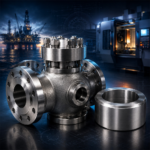
Choke body forgings — the flow control component on the production wing of the Christmas tree. The choke regulates the production flow rate by restricting the flow through a replaceable choke trim. Choke bodies experience the most erosive flow conditions in the Christmas tree — high-velocity multiphase flow with entrained sand and scale particles.
Choke Body Forgings: The Most Demanding Upstream Component
Choke bodies deserve specific attention because they represent the most technically demanding upstream forging from both material and dimensional perspectives.
Erosion resistance requirement — production choke bodies experience severe erosive wear from high-velocity production fluids carrying sand, scale, and solid particles through a restricted flow path. The choke body material must resist erosion while maintaining pressure containment integrity. AISI 4130 or 4140 at elevated hardness (28–32 HRC) provides better erosion resistance than standard quench and temper condition. For the most abrasive service, hard-faced or Inconel-lined choke bodies are used.
HPHT choke bodies — for high-pressure high-temperature wells where both pressure (above 10,000 psi working pressure) and temperature (above 150°C) are elevated, Inconel 718 is the standard choke body material. Inconel 718 maintains strength at elevated temperature while providing the corrosion resistance required for sour and high-CO₂ service.
Dimensional accuracy — the choke body bore and seat pocket must be machined to close tolerances for the replaceable choke trim to seat correctly and seal at working pressure. The forging geometry must provide adequate wall thickness throughout to maintain pressure integrity at maximum working pressure, while the bore and seat pocket geometry must be achievable within the specified tolerances.
Pressure Housing Forgings for Downhole Tools
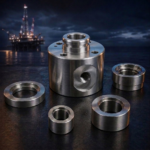
Downhole tool pressure housings are among the most technically demanding forgings in the upstream oil and gas supply chain. These cylindrical forgings house the electronics, sensors, batteries, and hydraulic systems of measurement-while-drilling (MWD), logging-while-drilling (LWD), and completion tools that operate inside the wellbore.
Extreme service conditions — downhole tools operate at wellbore temperatures up to 175–200°C, pressures up to 20,000 psi (138 MPa), and in production fluids that may contain H₂S, CO₂, brine, and oil. The pressure housing must maintain a sealed internal environment protecting sensitive electronics while withstanding these external conditions.
Material requirements — AISI 4140 or 4145H at high strength (140,000 psi minimum yield for standard service, up to 175,000 psi for high-strength grades) for standard temperature service. Inconel 718 for elevated temperature service above 150°C where alloy steel loses too much strength.
Geometry — downhole tool housings are cylindrical with threaded connections at each end for tool string assembly. The cylindrical geometry with internal bore is ideally suited to radial forging — which produces uniform grain structure and wall thickness throughout the cylinder length, and which can produce the hollow form directly rather than requiring extensive machining from a solid forging.
API 6A Product Specification Levels for Upstream Forgings
Understanding which PSL applies to the specific upstream application determines the complete set of requirements the forging must meet.
PSL 1 — Standard Service
For surface wellhead equipment in non-sour, non-extreme environments. Basic material requirements (ASTM A105 or equivalent), normalise and temper heat treatment acceptable, basic NDE. PSL 1 covers the majority of onshore wellheads in non-sour oil fields.
PSL 2 — Improved Service
Mandatory Charpy impact testing at -20°F (-29°C). Tighter chemistry requirements than PSL 1. Required for offshore wellheads and for onshore wells where low-temperature rating is specified. Quench and temper heat treatment mandatory for alloy steel grades.
PSL 3 — Demanding Service
100% volumetric NDE (UT) of all forgings. Wet fluorescent MT of all surfaces. Hardness testing of every component. Tighter dimensional tolerances. Required for most offshore and subsea Christmas tree components, and for high-pressure onshore wellheads.
PSL 4 — Critical Sour and HPHT Service
All PSL 3 requirements plus: full NACE MR0175 compliance verification including SSC and HIC testing of representative material from each heat. Charpy impact testing at -50°F (-46°C). Additional chemistry restrictions on sulphur, phosphorus, and carbon equivalent. Required for deep offshore subsea trees, HPHT wells, and all sour service above defined H₂S partial pressure thresholds.
Materials for Upstream Oil and Gas Forgings
AISI 4130 — The API 6A Standard Material
AISI 4130 (chromium-molybdenum alloy steel) is the standard material for API 6A wellhead and Christmas tree forgings in general service. Quenched and tempered to achieve the required API 6A mechanical properties for the specified working pressure class. Available from multiple international and domestic mills to API 6A material requirements.
For sour service, 4130 must meet NACE MR0175 hardness limits — maximum 22 HRC (250 HBW) at any location. The combination of API 6A minimum yield strength (75,000 psi for standard service) and NACE maximum hardness defines the heat treatment target zone.
4130 Modified (4130M) — Sour Service Specific
4130M is a modified chemistry version of 4130 with tighter restrictions on carbon equivalent and sulphur content to improve resistance to hydrogen-induced cracking (HIC) and sulphide stress cracking (SSC) in sour environments. For PSL 4 sour service wellheads and Christmas trees, 4130M or equivalent is typically specified.
ASTM A105 — Standard Carbon Steel
For lower-pressure upstream flanges and fittings where alloy steel is not required for the pressure rating. Normalise and temper heat treatment acceptable for most A105 upstream applications.
Inconel 625 and 718 — HPHT and Extreme Sour Service
For High Pressure High Temperature (HPHT) upstream applications — typically defined as above 10,000 psi working pressure and above 150°C (300°F) reservoir temperature — nickel alloys provide the combination of elevated temperature strength and corrosion resistance that no steel alloy achieves.
Inconel 625 — used for choke body trim components, seal areas on tree bodies, and valve internal components where corrosion resistance is the primary driver and moderate strength is sufficient. Solution annealed condition.
Inconel 718 — where both elevated temperature strength and pressure containment are required — HPHT Christmas tree body components, downhole tool pressure housings operating above 150°C. Solution annealed and double aged to develop the gamma double prime precipitate strengthening.
NACE MR0175 and Sour Service Upstream Forgings
Sour service — any upstream application where the H₂S partial pressure exceeds 0.0003 MPa (0.05 psia) — requires compliance with NACE MR0175/ISO 15156 for all metallic components in contact with the production fluid. For upstream forged components this means:
Maximum hardness limits — 22 HRC (250 HBW) for carbon and low alloy steels including 4130 and 4130M. 310 HV10 for duplex and super duplex stainless steels. Alloy-specific limits for nickel alloys per NACE MR0175 Part 3.
100% hardness testing — every component intended for sour service must be hardness tested at multiple locations. A single measurement above the maximum hardness limit is a rejection — the component cannot be used in sour service regardless of all other test results.
SSC and HIC testing — for PSL 4 and for major operator specifications (Saudi Aramco SAMSS-012, for example), sulphide stress cracking (SSC) testing per NACE TM0177 and hydrogen-induced cracking (HIC) testing per NACE TM0284 are required on representative material from each heat. These are destructive tests on witness specimens — they add time and cost to the qualification programme but are non-negotiable for critical sour service upstream supply.
Carbon equivalent control — incoming raw material must meet the carbon equivalent limits specified for sour service compliance. This must be verified from the actual heat chemistry of each incoming billet — not assumed from the nominal specification limits.
India’s Upstream Oil and Gas Market: Domestic Demand
India’s domestic upstream oil and gas sector generates significant demand for wellhead and Christmas tree forgings from the ONGC, Oil India, and private sector operators active in Indian basins.
ONGC Mumbai High — India’s largest offshore field, operated by ONGC from Mumbai. The platform complex uses extensive wellhead and Christmas tree equipment. Ongoing production maintenance, well workover operations, and new well completions generate demand for replacement API 6A forged components.
KG Basin deepwater — Reliance Industries and ONGC — The Krishna-Godavari Basin deepwater fields, including Reliance’s KG-D6 and ONGC’s deepwater blocks, use subsea Christmas trees and manifolds requiring API 6A PSL 3 and PSL 4 forgings. Deepwater service conditions at water depths of 1,000–3,000 metres impose the most demanding upstream forging specifications.
Rajasthan onshore — Cairn Oil and Gas — India’s most prolific onshore oil production area. Surface wellhead equipment requirements are extensive, covering the full range of PSL 1 through PSL 3 depending on H₂S content and pressure rating.
NELP and OALP exploration blocks — India’s New Exploration Licensing Policy and Open Acreage Licensing Policy have opened new exploration blocks to private operators. Exploration drilling and early production from these blocks generates demand for wellhead equipment and associated forged components.
How Vinir Engineering Serves Upstream Oil and Gas
Vinir Engineering manufactures upstream oil and gas forgings — wellhead housing forgings, Christmas tree valve bodies, choke body forgings, and pressure housing components — under API 20B certification across all four manufacturing units in Bangalore and Hosur.
Closed die forging — wellhead spool bodies, valve bodies, and choke bodies in AISI 4130, ASTM A105, duplex 2205, and Inconel 625 in the 10–1,400 kg range.
Open die forging — large wellhead housing forgings and structural components in the 1,400–15,000 kg range.
Radial forging — cylindrical downhole tool pressure housings with controlled wall thickness and uniform grain structure throughout the cylinder length.
In-house heat treatment — quench and temper for 4130 and 4130M with 100% hardness verification for sour service components. Solution annealing with rapid quench for duplex grades with ferrite content verification. Double ageing for Inconel 718.
NABL-accredited mechanical testing — tensile, Charpy impact (including low-temperature tests at -20°C, -29°C, and -46°C), hardness, and chemical analysis. SSC and HIC testing coordinated with NACE-qualified test laboratories where required.
TPI coordination — established working relationships with Bureau Veritas, DNV, SGS, and Intertek for all API 6A and API 20B TPI requirements.
Frequently Asked Questions — Upstream Oil and Gas Forging India
What is API 6A and how does it differ from API 20B for upstream forging manufacturers?
API 6A is the equipment specification for wellhead and Christmas tree systems — it defines what the finished wellhead equipment must achieve in terms of pressure rating, temperature rating, material requirements, and testing. API 20B is the forging manufacturer qualification standard — it defines the quality system, processes, and documentation requirements that a forging manufacturer must meet to supply forgings for oil and gas pressure-retaining applications. A wellhead manufacturer specifying API 6A equipment will require their forging suppliers to hold API 20B certification. API 6A governs the equipment; API 20B governs the forging supplier.
What is the difference between API 6A PSL 1 and PSL 4 for wellhead forgings?
PSL 1 covers standard service onshore wellheads — basic material requirements, normalise or quench and temper heat treatment, basic NDE. PSL 4 covers the most demanding sour service and HPHT applications — adds 100% UT and wet fluorescent MT, mandatory SSC and HIC testing per NACE TM0177 and TM0284, Charpy impact at -46°C, tighter chemistry restrictions including carbon equivalent limits, and maximum hardness of 22 HRC at all locations for sour service compliance. Most offshore and subsea upstream equipment is specified at PSL 3 or PSL 4.
What is HPHT and what special forging requirements does it create?
HPHT (High Pressure High Temperature) defines wells where reservoir pressure exceeds 10,000 psi and reservoir temperature exceeds 150°C (300°F). Standard alloy steels lose significant strength above 150°C and standard elastomeric seals fail above 175°C. HPHT upstream forgings are therefore produced in Inconel 718 (retaining strength to above 650°C) rather than 4130 alloy steel. The forging process for Inconel 718 is significantly more demanding than for steel — higher forging loads, narrow forging temperature window, solution annealing plus precise double ageing, and stringent UT inspection to AMS 2154 equivalent acceptance criteria.
What does sour service mean for upstream forging specification and why does hardness matter?
Sour service refers to any upstream environment where H₂S partial pressure exceeds 0.0003 MPa. In sour service, hydrogen atoms generated by the H₂S corrosion reaction can diffuse into the steel lattice. High-hardness steels — above 22 HRC in carbon and alloy steels — are susceptible to sulphide stress cracking (SSC) under the combined effect of absorbed hydrogen and tensile stress. Hardness above 22 HRC is therefore a rejection criterion for sour service forgings regardless of all other test results, because a harder component will crack in sour service even if its static tensile and yield strength are acceptable.
Can Indian upstream oil and gas forging manufacturers supply to international operators directly?
Yes. Indian API 20B certified forging manufacturers can supply to international operators and EPC contractors subject to operator-specific vendor qualification, applicable export regulations, and TPI by an operator-approved inspection company. Major international operators including Saudi Aramco, ADNOC, QatarEnergy, BP, Shell, and Equinor have all qualified or assessed Indian forging suppliers. The pathway to international upstream supply typically involves first qualifying for an Indian operator (ONGC, Oil India) to build the API 6A track record, then approaching international operators with the production history and TPI records from domestic supply.