
Titanium Forging Supplier for Global Aerospace: Ti-6Al-4V Structural Applications
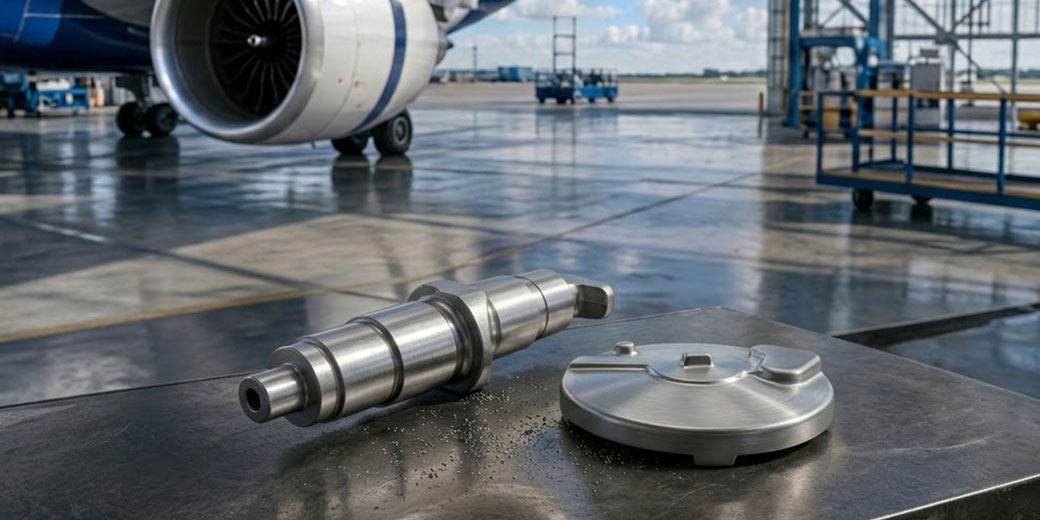
Ti-6Al-4V (Grade 5 titanium alloy, AMS 4928/4935) is the single most important aerospace structural material by procurement volume used for compressor discs, fan discs, structural bulkheads, landing gear beams, and engine pylons in virtually every commercial and military aircraft flying today. Global Ti-6Al-4V aerospace forging demand exceeds 50,000 tonnes annually, consumed by Boeing, Airbus, GE Aerospace, Pratt & Whitney, Rolls-Royce, and Safran supply chains. Indian AS9100D certified forging manufacturers with alpha case control capability, AMS 4928 billet sourcing from qualified mills, and AMS 2154 immersion UT qualification are positioned to supply global aerospace titanium forging demand.
| Application | Spec | Heat Treatment | Key Property | OEM |
| Compressor discs, fan discs | AMS 4928 (STA) | Solution treat + age | Min 130 ksi UTS | GE, P&W, Rolls-Royce, Safran |
| Structural bulkheads, frames | AMS 4928 (mill anneal) | Mill anneal 704°C | Good fracture toughness | Boeing, Airbus, BAE |
| Landing gear (main gear beam) | AMS 4935 (STA) | Beta anneal + STA | Max strength 150 ksi UTS | Safran, Liebherr |
| Engine pylon structure | AMS 4928 (STA) | Solution treat + age | High fatigue life | Spirit, Triumph, GKN |
| Rotor head (helicopter) | AMS 4928 (STA) | Solution treat + age | High fatigue, 3D shape | Airbus Helicopters, Leonardo |
Ti-6Al-4V is an alpha-beta titanium alloy — the alpha phase (hexagonal close-packed) provides creep resistance at elevated temperature; the beta phase (body-centred cubic) stabilised by vanadium provides higher strength. The two-phase microstructure is highly sensitive to heat treatment parameters small changes in solution treatment temperature, quench rate, and ageing temperature produce significant changes in tensile strength, fracture toughness, and fatigue life. This microstructural sensitivity makes heat treatment process control the most critical aspect of aerospace titanium forging manufacturing.
Alpha case — the oxygen-enriched surface layer that forms on titanium when heated above approximately 500°C in the presence of oxygen is the primary quality concern specific to titanium forging. Alpha case is brittle compared to the bulk Ti-6Al-4V microstructure and, if not completely removed by machining, can initiate fatigue cracks under the cyclic loading of aircraft structural components. Prevention requires controlled-atmosphere heating (inert gas or vacuum); verification requires etching of finished machined surfaces at 10× magnification. AMS 2801 specifies the alpha case control requirements for aerospace titanium forgings.
AMS 4928 is the primary specification for Ti-6Al-4V billet and forging stock for aerospace applications specifying chemistry, ultrasonic inspection of billet, and mechanical properties for the mill-annealed condition. For STA condition forgings, AMS 4928 specifies heat treatment temperature ranges, quench conditions, and ageing parameters. Billet must come from qualified mills for Indian forging manufacturers, qualified sources include TIMET (USA), ATI (USA), Arconic (USA), and emerging Indian suppliers.
The VSMPO supply disruption — following Western aerospace OEM decisions to exit Russian titanium supply following the 2022 Ukraine invasion has created meaningful supply chain pressure, driving aerospace OEM procurement teams to actively evaluate previously under-utilised titanium forging sources. This market dislocation creates a window of opportunity for Indian titanium forging manufacturers who can demonstrate billet sourcing from non-Russian qualified mills.
Vinir Engineering — Capability for this Market
- AS9100D full scope, OASIS verifiable.
- Ti-6Al-4V STA (solution treat 954°C, water quench, age 538°C) and mill anneal conditions.
- Alpha case control per AMS 2801 – controlled atmosphere heating with inert gas purge, etching and inspection of finished surfaces.
- AMS 4928 billet from TIMET or ATI (non-Russian qualified sources).
- AMS 2154 Class A and Class AA immersion UT.
- FPI to AMS 2647.
- Closed die forgings 1–1,400 kg.
- AS9102 FAIR capability.
- NABL-accredited mechanical testing.
- Ocean freight Chennai to US, European, and Asian destinations: 14–28 days.