
Inconel 718 Forging Supplier for Global Aeroengine: Compressor and Turbine Disc Supply
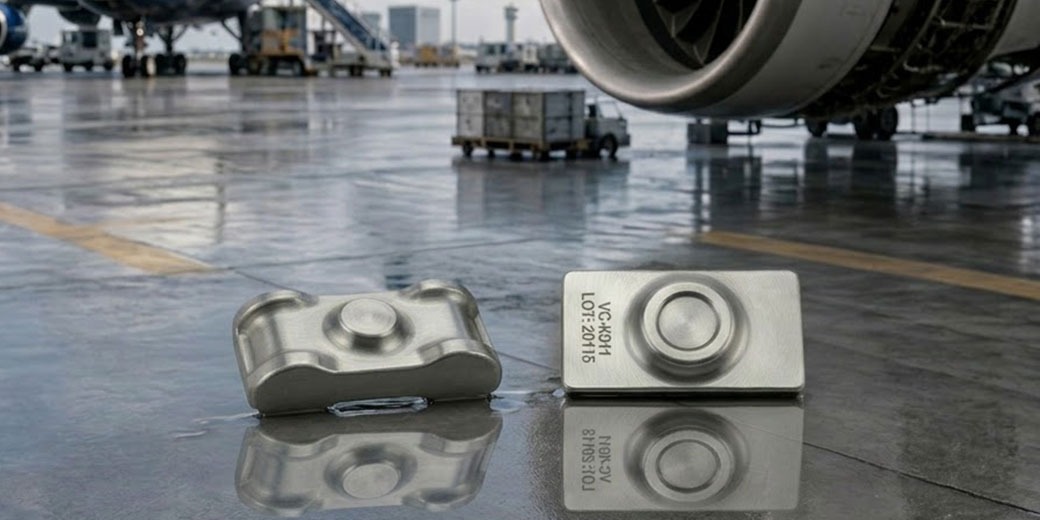
Inconel 718 (UNS N07718, AMS 5663) is the most widely used nickel superalloy in commercial and military aeroengine manufacturing accounting for approximately 35% of all nickel superalloy consumption in aerospace. It is used for compressor discs, turbine discs, shafts, structural rings, and seals in virtually every high-bypass turbofan engine flying today including the CFM LEAP, GE9X, Pratt & Whitney GTF, and Rolls-Royce Trent families. Global Inconel 718 aeroengine forging demand exceeds 15,000 tonnes annually. Indian AS9100D certified forging manufacturers with double ageing capability, AMS 2154 immersion UT, and AMS 5663 billet sourcing from qualified mills are positioned to supply this market.
| Application | Temp Range | Critical Property | OEM Engine | Weight |
| HP compressor disc | Up to 650°C | High tensile + creep resistance | GE9X, Trent XWB, LEAP | 100–800 kg |
| LP compressor disc | Up to 400°C | Fatigue + tensile | Trent 1000, GEnx, GTF | 50–300 kg |
| Turbine structural ring | Up to 500°C | Creep, oxidation resistance | All major engines | 100–3,000 kg |
| Fan disc (large engine) | Ambient to 200°C | Low-cycle fatigue | GE9X, Trent XWB | 200–500 kg |
| LP turbine disc | Up to 650°C | High-temp fatigue + creep | All major engines | 100–500 kg |
Inconel 718 achieves its exceptional mechanical properties through precipitation hardening the double ageing heat treatment (718°C for 8 hours + 621°C for 8–10 hours, per AMS 5663) precipitates gamma-prime (Ni₃Al) and gamma-double-prime (Ni₃Nb) phases in the nickel matrix. The gamma-double-prime precipitate is the primary strengthening phase it provides yield strength exceeding 1,000 MPa at room temperature, maintained to approximately 650°C. Above 650°C, the gamma-double-prime phase begins to dissolve, defining the maximum application temperature for Inconel 718 in aeroengine hot section applications.
The forging process for Inconel 718 aeroengine discs is more complex than for titanium or aluminium structural forgings. Inconel 718’s high flow stress at forging temperature (50–100 MPa at 1,000°C versus 10–15 MPa for Ti-6Al-4V) requires much higher forging press forces a compressor disc forgeable in Ti-6Al-4V on a 2,000T press requires a 10,000T+ press in Inconel 718. The limited plastic strain before cracking requires slow, controlled press speed and careful die design with adequate lubrication.
The AMS 5663 double ageing heat treatment requires precisely controlled furnace temperatures (718°C ± 8°C and 621°C ± 8°C) over 8-hour minimum cycles. The temperature uniformity survey (TUS) per AMS 2750 must demonstrate that the furnace achieves ±8°C uniformity throughout the load. For aeroengine Inconel 718 disc forging supply, NADCAP AC7102 Heat Treatment accreditation specifically verifies TUS compliance this is the NADCAP audit finding that most frequently causes aerospace forging suppliers to fail their first NADCAP assessment.
Billet quality is as critical as process control. AMS 5383 (billet specification for Inconel 718) requires vacuum arc remelted (VAR) or triple-melt (VIM+VAR+VAR) material for rotating component applications ensuring freedom from segregation, freckles, and white spots. Qualified Inconel 718 billet suppliers include Special Metals (USA), Carpenter Technology (USA), VDM Metals (Germany), and Haynes International (USA).
Vinir Engineering — Capability for this Market
- AS9100D full scope.
- Inconel 718 double ageing at 718°C ± 8°C and 621°C ± 8°C in AMS 2750-calibrated multi-zone furnaces.
- TUS records at both ageing temperatures demonstrating ±8°C uniformity.
- AMS 5383 VAR or triple-melt billet from Special Metals or Carpenter Technology.
- Immersion UT with Inconel 718 calibration standard to AMS 2154 Class AA.
- FPI to AMS 2647. Closed die forgings 10–1,400 kg.
- AS9102 FAIR capability. NABL-accredited OES and mechanical testing.
- NADCAP — foundation quality system in place; NADCAP pursuit timeline on request.