

Subsea Connector and Clamp Forging Supplier for USA from India: API 17D Components for Deepwater Systems
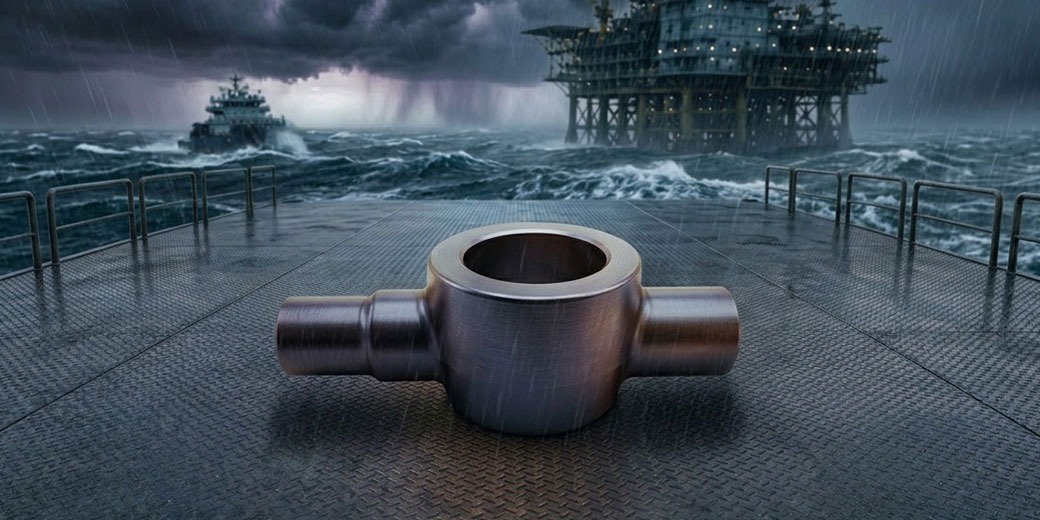
Subsea oil and gas equipment operates in an environment where access is difficult, intervention is expensive, and a single component failure can interrupt production thousands of feet below the ocean surface. That changes the way procurement teams evaluate forgings.
A connector or clamp used on land can often be inspected, repaired or replaced relatively easily. A similar component installed in a deepwater production system may spend years exposed to seawater, external hydrostatic pressure, cyclic mechanical loading and highly pressurised process fluids.
For US subsea OEMs evaluating a subsea connector and clamp forging supplier from India, the supplier therefore needs to demonstrate much more than the ability to forge a large steel component. Material selection, forging integrity, heat treatment, dimensional control, corrosion resistance, NDT and traceability all become part of subsea reliability.
API’s current catalogue identifies API Specification 17D specifically as the specification for subsea wellhead and tree equipment. Its licensing categories include flanged connectors, threaded connectors, flowline and umbilical connectors, other end connectors including clamp-hub types, tree connectors and tubing-head connectors.
Why Subsea Connectors Are Structurally Critical
A subsea production system consists of multiple pressure-containing pieces of equipment that must remain mechanically connected throughout operation.
Connections can be required between wellheads, trees, flowlines, jumpers, manifolds and associated equipment. Depending on the design, these interfaces may need to resist internal pressure as well as external mechanical loads produced by installation, pipeline movement, thermal expansion, vibration or subsea structural movement.
A forged connector body therefore performs several functions simultaneously.
It must provide the required geometry for sealing and mechanical engagement, retain enough strength around highly loaded sections, tolerate repeated service loads and maintain dimensional stability after heat treatment and machining.
These requirements explain why connector forgings are usually treated as engineered pressure-equipment components rather than commodity forged rings or blocks.
API 17D and the US Subsea Supply Chain
API 17D is directly relevant to subsea wellhead and tree equipment. API lists its third edition and shows that Addendum 2 was issued in March 2025, making it important for suppliers to work from the revision specified by the customer rather than relying on older internal procedures.
One useful example of the level of detail involved appears in API’s published 17D addendum. It includes requirements around equipment identification and, for certain equipment, unique serial numbers. It also specifies bolting considerations for subsea completion equipment.
For a forging manufacturer, this matters because finished-equipment requirements often flow down into the component supply chain.
A connector forging may need specific raw-material properties, heat treatment, NDT, hardness, dimensional inspection and traceability even if the forging supplier itself is not manufacturing the complete subsea assembly.
The correct manufacturing plan therefore starts with the buyer’s drawing and purchase specification.
Clamp Hub and Connector Forgings
Clamp-type connections are attractive in subsea equipment because they can create compact high-integrity mechanical interfaces.
The geometry commonly includes hubs, tapered or profiled load-bearing surfaces, seal interfaces and substantial wall sections around the pressure boundary.
The forged blank must provide enough material for machining these features while maintaining structural soundness throughout the component.
A poor forging design can create excessive machining stock, unnecessary raw-material consumption or regions that do not receive the desired deformation.
A strong supplier should therefore collaborate with the buyer on forging-envelope development rather than merely manufacturing a large cylindrical blank.
Material Selection for Subsea Connectors
Subsea connectors may be manufactured from several material families depending on pressure, mechanical loading and corrosion environment.
Low-alloy steels can be used where high mechanical strength is required and corrosion is managed through coatings, cathodic protection or system design.
For wetted components exposed directly to aggressive seawater or chloride-bearing process fluids, stainless steels, duplex stainless steels, super duplex stainless steels or nickel alloys may become appropriate.
The choice should be driven by the engineering specification.
A manufacturer should not treat “subsea grade” as a material designation because there is no single universal subsea alloy.
Hydrostatic Pressure Is Only One Load
Deep water creates considerable external hydrostatic pressure, but it is important not to reduce subsea design to water depth alone.
A connector can simultaneously experience internal production pressure and mechanical loading from attached equipment.
Temperature changes can introduce additional loads because pipelines and flowlines expand and contract.
Installation and retrieval operations can also create transient forces not present during steady-state production.
This is why subsea forgings require appropriate toughness and fatigue performance in addition to static tensile strength.
Forging Reduction and Internal Integrity
Subsea connector forgings frequently contain thick sections.
Large-section forging introduces an important metallurgical challenge: deformation needs to penetrate sufficiently through the component.
Simply hitting the exterior of a large billet does not automatically ensure adequate structural working at its centre.
Initial billet dimensions, reduction ratio, forging sequence, equipment capacity and reheating strategy must therefore be engineered together.
The objective is a homogeneous forging with acceptable internal soundness and mechanical properties after heat treatment.
Heat Treatment of Heavy Connector Forgings
Large-section components can be difficult to heat treat uniformly.
The centre of a heavy forging responds more slowly to furnace heating and quenching than its surface.
This creates the possibility of differences in microstructure or mechanical properties through the section if heat treatment is poorly controlled.
Manufacturers must account for ruling section, furnace uniformity, soak time, transfer time and quench capability.
Where low-alloy steels are supplied quenched and tempered, the quench system needs sufficient capacity to produce the required properties through the relevant section.
For duplex and super duplex materials, the objective is different: solution heat treatment and rapid cooling are needed to preserve the required duplex microstructure and minimise harmful phase formation.
NDT for Subsea Connector Forgings
A pressure-containing connector cannot be qualified by dimensional inspection alone.
Ultrasonic examination may be used to evaluate internal soundness. Magnetic particle testing can detect surface and near-surface indications in ferromagnetic steels, while liquid penetrant examination can be used for suitable stainless and non-ferromagnetic alloys.
The acceptance standard matters just as much as the inspection method.
A supplier saying that it performs UT tells the buyer very little unless the procedure, calibration, examination extent and acceptance criteria are also defined.
For critical subsea programmes, the customer may require qualification of NDT procedures and personnel before production begins.
Dimensional Accuracy and Sealing Geometry
The sealing and load-transfer surfaces of subsea connectors can be dimensionally demanding.
Machining may involve concentric diameters, seal pockets, hub profiles, bolt patterns and accurately controlled axial relationships.
CMM inspection can therefore be useful for complex geometry.
Integrated forging and machining also allows the forging envelope to be optimised around the final component rather than being developed independently by two suppliers.
This can reduce material waste and simplify corrective action if machining exposes a forging-related issue.
Why Forge-to-Finish Matters for US Subsea Buyers
Every additional supplier in a critical-component process creates another traceability and coordination interface.
A separate forge, heat treater, NDT provider and machine shop may all be capable individually, but the buyer must ensure that part identity and specification control survive each transfer.
A forge-to-finish model reduces those interfaces.
For high-mix, low-volume subsea components, this can be particularly valuable because an individual part number may not have automotive-scale volume to absorb repeated setup and supplier-management costs.
Subsea Connector Forgings at Vinir Engineering
Vinir Engineering manufactures forged and machined components across alloy steels, stainless steels, duplex, super duplex and nickel-based alloys.
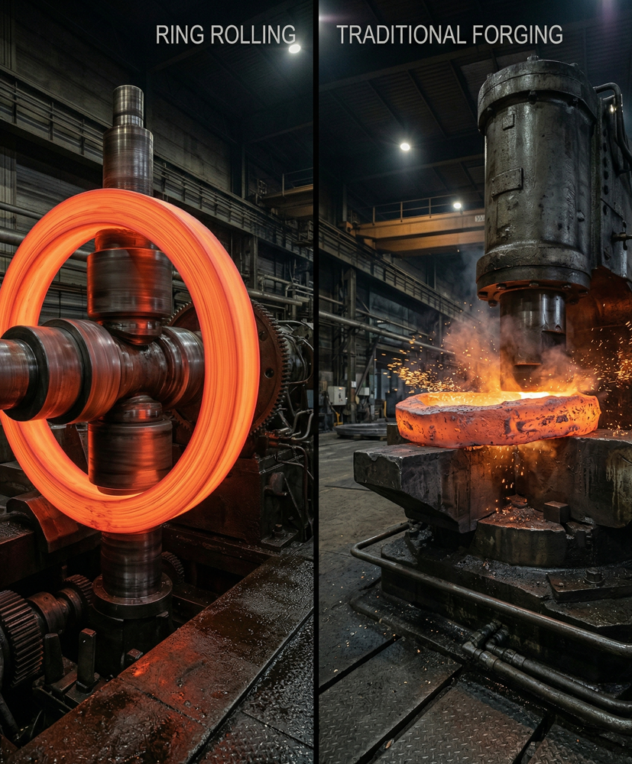
Its available manufacturing routes include open die forging, closed die forging, ring rolling, heat treatment and machining, with component weights extending to heavy custom-forging ranges.
For US subsea OEMs, drawings can be reviewed for material grade, forging envelope, heat-treatment requirements, NDT, machining and documentation before a manufacturing route is finalised.