
Mining Equipment Forging Supplier for Australia: BHP, Rio Tinto, and Fortescue
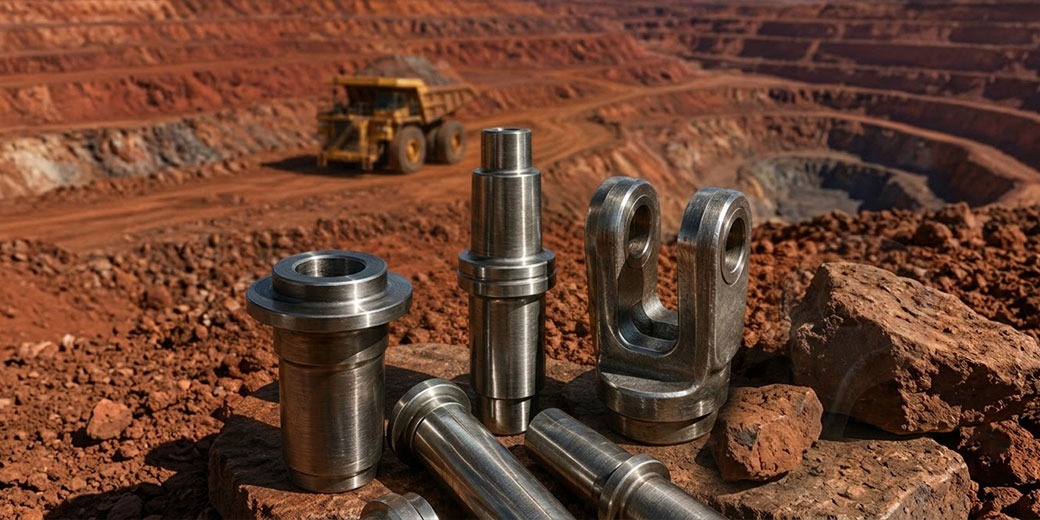
Australia is the world’s largest exporter of iron ore (BHP, Rio Tinto, Fortescue), the second-largest exporter of coal (BHP, Yancoal, Glencore Australia), and a major producer of copper, gold, and nickel. The Pilbara iron ore mines in Western Australia among the world’s largest mining operations use fleets of Caterpillar 797F haul trucks, Komatsu PC8000 shovels, and large rotary blast hole drill rigs consuming substantial structural pin and shaft forgings. Indian forging manufacturers with 4340 alloy steel, cold weather toughness capability, and established OEM supply relationships are positioned to supply the Australian mining equipment market.
| Company | Operation | Equipment | Primary Forging |
| BHP (Pilbara, WA) | Olympic Dam copper, Pilbara iron ore | Cat 797F haul trucks, P&H shovels | Front spindle (500kg), boom pins, drive shafts |
| Rio Tinto (Pilbara, WA) | Tom Price, Brockman iron ore mines | Komatsu 930E haul trucks, rope shovels | Structural pins (100–400kg), crusher shafts |
| Fortescue (Pilbara, WA) | Iron Bridge magnetite, Cloudbreak | Liebherr T 284 haul trucks, Epiroc drills | Suspension pins, drill collar forgings |
| Newcrest / Newmont (QLD, VIC) | Cadia, Telfer gold mines | Sandvik underground loaders, drill jumbos | Feed beam, rotation head, structural fittings |
| South32 (WA, QLD) | Worsley Alumina, Cannington silver-lead | SAG mill, conveyor systems | Mill shaft, drive shaft, gear blank forgings |
BHP’s Pilbara iron ore operations — centred on the Eastern Ridges (Mt Whaleback), Western Ridge (South Flank), and the new Jansen potash development in Canada operate one of the world’s largest mining equipment fleets. Each Cat 797F haul truck (363-tonne payload) uses a front spindle forging of approximately 500 kg, two rear suspension pin assemblies, and multiple drivetrain pin forgings with replacement intervals of 8,000–15,000 operating hours. BHP’s Pilbara fleet of 600+ haul trucks at various sites generates continuous replacement forging demand that Indian manufacturers can access through the OEM aftermarket supply chain.
Rio Tinto’s Pilbara operations — producing approximately 330 million tonnes of iron ore annually from 15 mines connected by 1,700 km of railway to four port terminals represent the highest-concentration mining equipment fleet outside of Chinese coal mining. Rio Tinto’s AutoHaul system (the world’s first autonomous long-distance haul railway) and its autonomous haul truck programme mean that equipment operates at very high utilisation rates accelerating the replacement cycle for structural pin and wear forgings. Rio Tinto’s supply chain organisation (Rio Tinto Procurement, based in Brisbane and Perth) manages forging procurement through both OEM channels and direct independent procurement for non-proprietary components.
Fortescue Metals Group (FMG) — founded by Andrew Forrest and headquartered in Perth has grown rapidly to become the world’s fourth-largest iron ore producer. Fortescue’s Iron Bridge magnetite project uses HPGR (High Pressure Grinding Roller) technology for magnetite ore processing the same Metso Outotec HPGR technology discussed in the Finland mining blog. HPGR roller shaft forgings in high-chrome alloy steel are a specific forging opportunity arising from Fortescue’s magnetite processing expansion.
Australia’s critical minerals mining — lithium from the Pilgangoora and Greenbushes deposits in WA (Pilbara Minerals, Albemarle/Talison), nickel from WA operations (IGO, Nickel West/BHP), and cobalt from various sources uses similar mining equipment to iron ore and gold mining but in smaller equipment scales (50–100 tonne haul trucks rather than 300-tonne class) and with underground operations for some deposits.
Vinir Engineering — Capability for this Market
- AS9100D.
- 4340, EN24, 4140 structural pin and shaft forgings, 10–5,000 kg, closed and open die.
- 100% UT per ASTM A388.
- NABL Charpy at -20°C for standard Australian mining applications.
- Hardness uniformity verification.
- High-chrome alloy steel HPGR roller shaft forgings for Metso Outotec equipment in Australian critical minerals processing.
- Caterpillar 797F and Komatsu 930E size-range structural pin experience.
- TPI by Bureau Veritas and Intertek both recognised by BHP and Rio Tinto procurement.