
Duplex and Super Duplex Stainless Steel Forging Supplier: Global CRA Applications
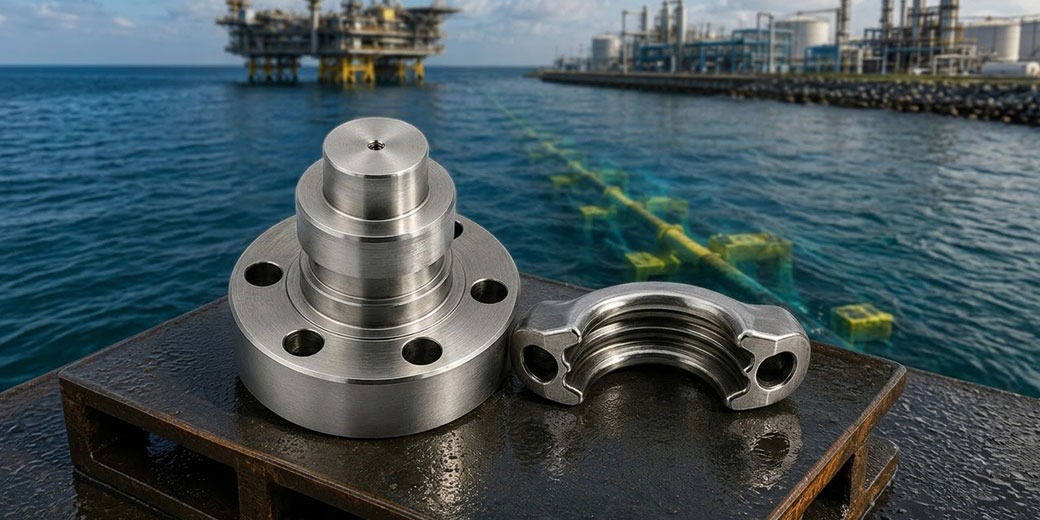
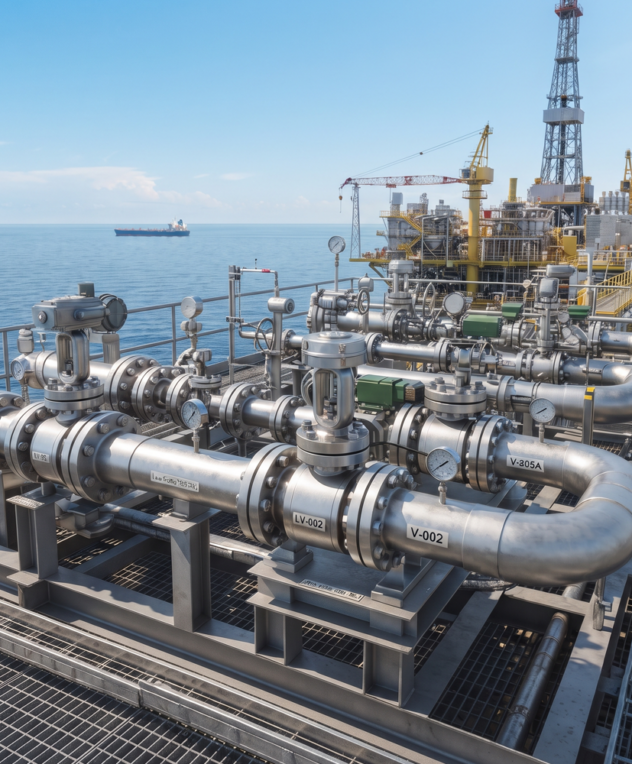
Duplex stainless steel (2205, UNS S31803) and super duplex stainless steel (2507, UNS S32750) are the dominant corrosion-resistant alloy (CRA) grades for subsea production equipment, offshore topside process piping, desalination systems, and chemical processing in aggressive chloride environments. Global duplex and super duplex forging demand exceeds 15,000 tonnes annually driven by oil and gas deepwater expansion, seawater desalination growth in the Middle East and North Africa, and LNG infrastructure development. Indian API 20B certified forging manufacturers with solution annealing capability, NACE-compliant testing, and G48 corrosion test infrastructure are positioned to supply global CRA forging demand.
| Grade | UNS | PREN | Max Service Temp | Key Application |
| Duplex 2205 | S31803 / S32205 | ≥34 | 250°C | Topside piping, heat exchangers, seawater systems |
| Super duplex 2507 | S32750 | ≥41 | 250°C | Subsea trees, manifolds, high-chloride seawater |
| Hyper duplex 2707 | S32707 | ≥48 | 300°C | Ultra-harsh seawater, umbilical tubing |
| Lean duplex 2101 | S32101 | ≥22 | 200°C | Storage tanks, non-pressure structural |
| Zeron 100 (25Cr super duplex) | S32760 | ≥40 | 300°C | High-temperature subsea, flowline fittings |
Duplex stainless steels achieve their exceptional combination of strength and corrosion resistance through a two-phase microstructure approximately equal volumes of austenite (face-centred cubic, the same phase as 316L) and ferrite (body-centred cubic, similar to carbon steel). The austenite phase provides ductility and corrosion resistance; the ferrite phase provides high strength (yield strength 450–550 MPa for duplex 2205 versus 200–300 MPa for 316L) and resistance to stress corrosion cracking. The result: better pitting resistance than austenitic stainless, twice the strength, and better resistance to chloride stress corrosion cracking.
The critical quality parameter for duplex forging — ensuring adequate corrosion resistance is the phase balance: the forging must contain 35–65% ferrite. Excessive ferrite (above 65%) indicates insufficient austenite stabilisation producing lower corrosion resistance. Too little ferrite (below 35%) reduces strength and stress corrosion cracking resistance. Phase balance is verified by ferritescope measurement at multiple locations on each forging.
The solution annealing heat treatment for duplex and super duplex stainless requires rapid quenching from the annealing temperature (1,020–1,100°C for duplex 2205, 1,060–1,120°C for super duplex 2507). The quench must suppress sigma phase formation during cooling through the 600–900°C temperature range water quench from the annealing temperature, with the component reaching below 300°C within 3 minutes, is the standard requirement.
For offshore oil and gas applications, the G48 corrosion test (ferric chloride test, ASTM G48 Method A) is the definitive verification of solution annealing adequacy. The test temperature (22°C for duplex 2205, 40°C for super duplex 2507) is calibrated to discriminate between adequate and inadequate heat treatment. An Indian forging manufacturer producing duplex and super duplex forgings to NORSOK M-630 and API 20B standards must have G48 test capability as a core laboratory function.
Vinir Engineering — Capability for this Market
- API 20B PSL 1–3.
- Duplex 2205 (A182 F51) and super duplex 2507 (A182 F53) forgings, 1–5,000 kg, closed and open die.
- Solution annealing at 1,020–1,100°C (2205) or 1,060–1,120°C (2507) with immediate rapid water quench (under 3 minutes to below 300°C).
- Ferritescope measurement at minimum 6 locations per forging.
- G48 corrosion test at 22°C (2205) or 40°C (2507) — NABL accredited or NABL-verified subcontract.
- Charpy impact at -46°C minimum 45 J average (NORSOK M-630).
- PMI on 100% of CRA components.
- NACE MR0175 hardness compliance.
- TPI by Bureau Veritas and DNV.
- NORSOK M-630 documentation package.