
Indigenisation in Defence Forging: India’s Make in India Opportunity for Forging Suppliers
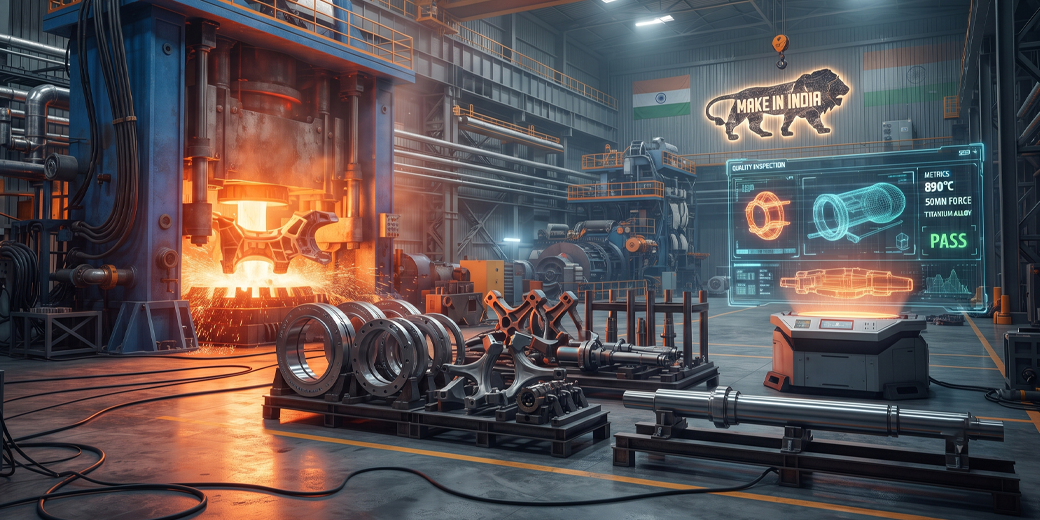
Defence forging indigenisation is the replacement of imported forged defence components with domestically manufactured equivalents — a core pillar of India’s Aatmanirbhar Bharat and Make in India defence initiatives. For Indian forging manufacturers with the right certifications and process capability, indigenisation represents the most significant structural demand shift in the domestic defence supply chain in decades. It is not a future opportunity — it is an active procurement requirement with contractual deadlines.
What the Policy Actually Requires
The Defence Acquisition Procedure (DAP) 2020 and its subsequent updates introduced a Positive Indigenisation List — a schedule of defence items that cannot be imported after specified cutoff dates. Multiple editions have been published, each expanding the range of components that must be sourced domestically. For forged components specifically this means:
- OEMs and DPSUs that previously imported forgings from Germany, UK, Sweden, France, or the USA are now contractually required to qualify Indian sources
- New defence platform programmes require progressive indigenous content percentages — rising to 60–65% of total component value in the coming years
- Import licences for listed items are no longer issued after the notified cutoff dates
This is not aspirational policy. It is written into procurement contracts and enforced by DGQA and the Ministry of Defence.
Which Forging Categories Are Being Indigenised First
| Category | Previous Import Source | Key Requirement |
| Titanium airframe forgings | USA, France, UK | AS9100D, AMS material standards |
| Alloy steel armour components | Sweden, Germany | Ballistic property validation |
| Inconel engine forgings | USA, UK | High-temp process capability |
| Naval propulsion shaft forgings | Germany, UK | ABS, large open die capability |
| Missile structural forgings | Import or DRDO fabrication | Tight traceability, small batch |
| Artillery gun barrel forgings | Germany, France | Bore tolerance, 100% UT |
| Large structural open die | UK, Germany | 3000T+ press, heavy section |
The Capability Gap: Why Not Every Indian Forging Company Can Qualify
The indigenisation policy creates demand but not every Indian forging manufacturer can serve it. The capability requirements are significant and specific.
Certification: AS9100D is the minimum. Most import-substitute programmes additionally require specific customer approvals — HAL, DRDO, Indian Navy — that take 18–36 months to obtain even after AS9100D is in place.
Material capability: Titanium, Inconel, duplex, and armour steel forging require specialised process knowledge, dedicated tooling, and furnace capability that standard automotive forging plants do not have and cannot develop quickly. A manufacturer who has never forged Ti-6Al-4V cannot simply buy titanium billet and produce acceptable aerospace components.
Traceability depth: International defence forgings carry full heat-to-component traceability matching or exceeding AS9100D requirements. The Indian substitute must carry equivalent documentation — component serialisation, witness coupon testing, furnace charts, NDT reports — all referenced to the same heat number.
Low volume capability: Indigenised defence components are often required in quantities of 5–50 per year initially. Standard high-volume forging plants cannot handle this economically — minimum order quantities, setup amortisation, and documentation burden make small batches unviable.
The Import Substitution Qualification Process: Step by Step
Step 1 — Drawing and specification release
The OEM or DPSU releases the drawing, material specification, and quality plan for the component to be indigenised. Registered suppliers with the relevant AS9100D scope receive the package.
Step 2 — Feasibility assessment
The supplier reviews the drawing and specification and confirms process route, material source, lead time, and certification applicability. Suppliers without titanium or Inconel capability are eliminated at this stage. A credible feasibility assessment takes 24–72 hours from drawing receipt.
Step 3 — Development order
A small development order of 3–10 components is issued. The supplier manufactures to drawing with full documentation — traveller, material test report, heat treatment records, NDT reports, dimensional inspection.
Step 4 — Comparative testing
Development samples are tested against the original imported component specification. Chemical, mechanical, dimensional, and NDT results are compared. Some programmes additionally conduct functional testing — hardness profiles through cross-section, fatigue testing, ballistic testing for armour components.
Step 5 — Approval and production transition
Successful development leads to domestic source approval. The OEM transitions procurement from the international to the Indian source. Pricing, lead time, packaging, and documentation requirements are formalised into a long-term supply arrangement.
Common Failure Points in Indigenisation Programmes
Wrong material grade assumed: Specifying EN24 when the import was 4340H produces slightly different hardenability behaviour. Material equivalency must be verified through testing, not assumed from nominal chemistry comparison.
Inadequate NDT sensitivity: European defence forgings are typically 100% UT tested to stringent cleanliness levels (ASTM A388 or tighter). If the Indian supplier’s UT capability — equipment sensitivity, probe frequency, calibration standards — cannot match this, the comparison test fails.
Incomplete documentation package: International suppliers provide complete packages — material certificates referenced to international standards, furnace charts with temperature profiles, dimensional reports with statistical analysis. Indian suppliers often provide partial packages that do not satisfy DGQA requirements on first submission.
Surface finish assumptions: Some imported forgings arrive semi-machined to allow inspection of critical surfaces. Indian suppliers sometimes quote for as-forged delivery without understanding the machining allowance expectation, leading to scope disagreements.
International Standards in Indian Indigenisation
One of the less discussed challenges in defence forging indigenisation is that many original imported forgings were manufactured to US or European standards — AMS 2301 cleanliness for aerospace steels, AMS 4928 for titanium, DIN 17350 for tool steels, EN 10250 for open die forgings.
Indian suppliers must demonstrate compliance with these same standards — not adapt to Indian equivalents. This requires:
- Raw material procurement from mills whose certificates reference the relevant AMS or ASTM standard
- Mechanical testing to the method specified in the standard (ASTM E8 for tensile, ASTM E23 for Charpy impact)
- NDT to the acceptance level specified — often AMS 2154 for ultrasonic inspection of aerospace quality bar
Suppliers unfamiliar with international material standards often underestimate this requirement and find their development samples fail comparative testing despite appearing to meet nominal properties.
How Vinir Approaches Indigenisation Programmes
Vinir Engineering has been engaged in defence forging indigenisation programmes for over a decade — before the policy formalised the requirement. Several specific capabilities make Vinir well-positioned for indigenisation:
The four-manufacturing-unit setup ensures programme continuity and parallel capacity for development while serving ongoing production programmes. Multi-material capability — titanium, Inconel, duplex, armour steel — means Vinir does not need to decline development orders based on material unfamiliarity. Existing AS9100D, IBR, and ABS certifications eliminate the 12–18 month certification lead time that other suppliers face before they can even submit a feasibility response. NABL-accredited in-house testing means mechanical test results are immediately acceptable to DGQA without third-party lab coordination.
For OEMs and DPSUs beginning an indigenisation programme, Vinir provides a technical feasibility assessment within 24 hours of receiving a drawing — process route, material source, lead time, certification applicability, and documentation package scope.
Frequently Asked Questions — Defence Forging Indigenisation
What is the Positive Indigenisation List in Indian defence procurement?
The Positive Indigenisation List is a schedule of defence items notified by the Ministry of Defence that cannot be imported after specified cutoff dates. Multiple editions have been published, each expanding the range of components requiring domestic sourcing. Items include forged components for armoured vehicles, aircraft, naval vessels, missile systems, and artillery. Suppliers wishing to participate in indigenisation programmes must be registered with the relevant DPSU or OEM vendor development system with applicable certifications in place.
Does the Indian substitute forging need to be made from Indian-origin steel?
Not always. For specialised alloys — titanium, Inconel, armour steels — Indian-origin raw material may not be available to the required specification. The forging can be manufactured from imported raw material sourced from approved international mills, with full material certification, while the manufacturing value-add — forging, heat treatment, testing — is performed in India. The indigenous content credit applies to the manufacturing activity, not the raw material origin.
How long does a typical defence forging indigenisation programme take?
From initial drawing release to domestic source approval, most defence forging indigenisation programmes take 12–24 months. This includes feasibility assessment (1–2 months), development order manufacturing (3–6 months), comparative testing and review (3–6 months), and approval documentation (1–3 months). Programmes involving new material families for the supplier or first article failures take longer.
What happens if the Indian substitute fails the comparative test?
Failed comparative testing results in a corrective action cycle. The supplier investigates root cause, modifies the process or material approach, and resubmits development samples. The programme is not cancelled unless no Indian supplier can meet the specification after multiple development cycles, in which case an import waiver may be issued on a time-limited basis while domestic qualification continues.
Can a forging supplier be on the Positive Indigenisation List as an approved domestic source?
The Positive Indigenisation List identifies items that must be sourced domestically — it does not list suppliers. Suppliers qualify as domestic sources through the DPSU or OEM vendor qualification process for each specific component. Being on a DPSU’s approved vendor list for a Positive Indigenised item is what converts the policy demand into a supply opportunity.