
Grain Flow in Aerospace Forgings: Why Aircraft Structural Components Are Forged Instead of Machined
Aircraft structural components experience millions of cyclic loading events throughout their service life. Landing gear absorbs repeated impact loads during take-off and landing. Wing attachment fittings continuously transfer aerodynamic loads between the wing and fuselage. Engine mounts are subjected to vibration, thermal cycling, and fluctuating thrust loads. These components are expected to perform reliably for decades without failure while operating under demanding mechanical and environmental conditions.
Meeting these performance expectations depends not only on selecting the correct alloy but also on controlling the internal structure of the material. Two components manufactured from the same grade of titanium or alloy steel can exhibit significantly different fatigue performance depending on how their grain structure has been developed during manufacturing.
This is where grain flow becomes one of the defining advantages of forging—and where experienced aerospace forging manufacturers like Vinir Engineering play a critical role in ensuring consistent, high-performance outcomes.
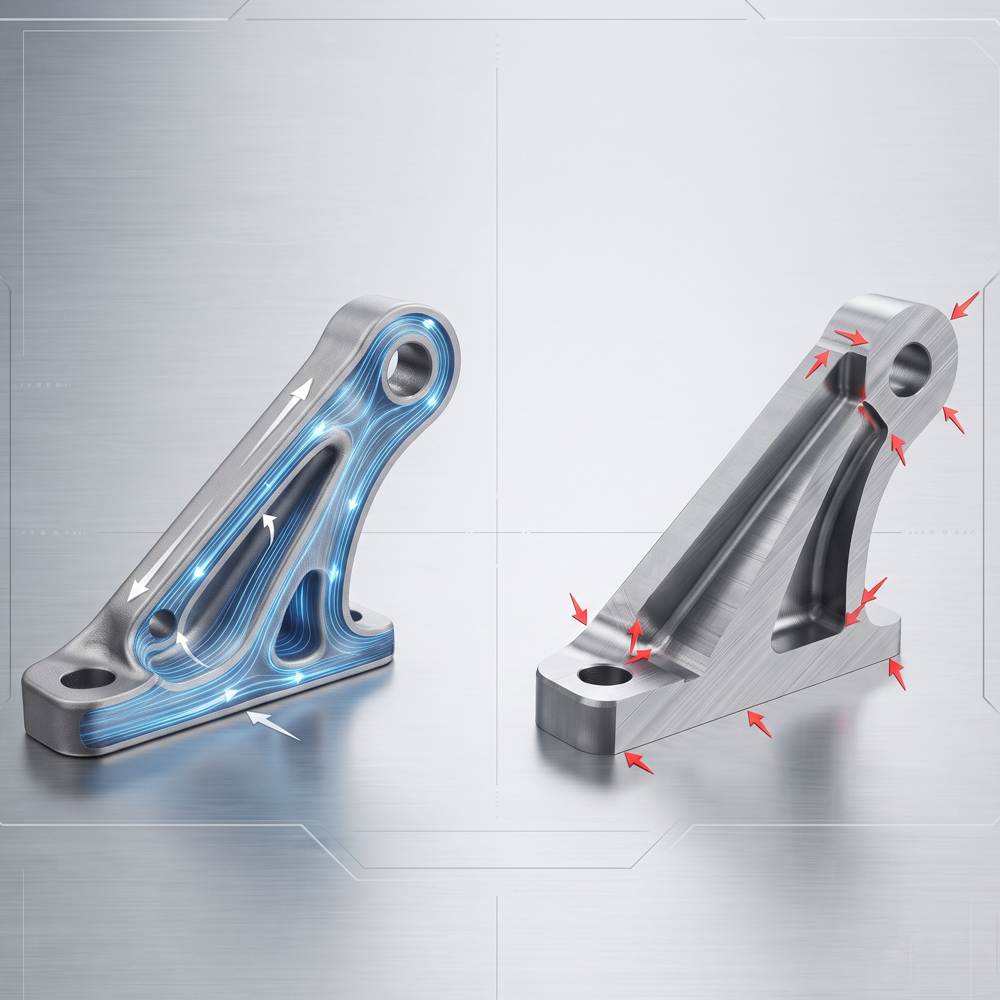
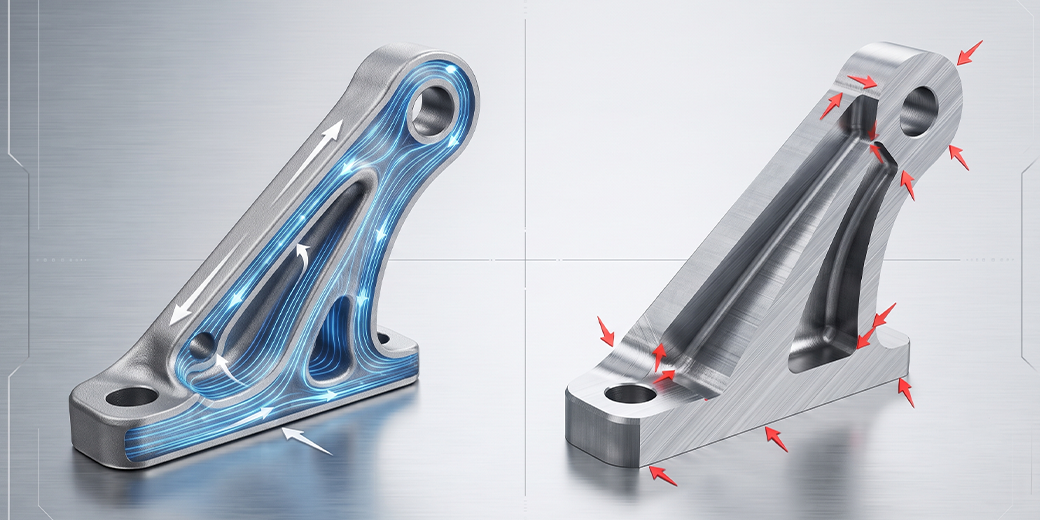
Unlike machining, which removes material from a rolled billet and often cuts across the natural grain structure, forging plastically deforms the material under carefully controlled conditions. The deformation causes the metal grains to flow and align with the geometry of the component, creating a continuous internal structure capable of carrying loads more efficiently.
For aerospace engineers, grain flow is not simply a metallurgical concept—it directly influences fatigue resistance, fracture toughness, crack propagation behaviour, and ultimately airworthiness.
Why Aerospace Components Cannot Depend on Material Strength Alone
Material selection is only one element of aerospace structural reliability.
A titanium alloy may satisfy every chemical composition requirement specified in the applicable AMS standard, yet still fail prematurely if its internal grain orientation does not support the stresses experienced during service.
Aircraft components rarely experience simple static loading. Instead, they are subjected to combinations of tensile, compressive, torsional, bending, and vibrational loads that repeat millions of times throughout their operational life. Even relatively small discontinuities within the material can become initiation sites for fatigue cracks.
For this reason, aerospace design engineers evaluate more than mechanical properties reported on a mill certificate.
They also consider :
- Grain orientation
- Forging reduction ratio
- Microstructural uniformity
- Inclusion control
- Residual stress
- Heat treatment consistency
- Non-destructive inspection results
Among these variables, grain flow remains one of the most important characteristics that distinguishes forged components from components produced solely by machining.
Companies like Vinir Engineering, with expertise in precision forging and metallurgical control, ensure that these parameters are tightly managed to meet stringent aerospace standards.
What Is Grain Flow?
Every metallic material is composed of microscopic crystals, commonly referred to as grains.
Before forging, these grains possess an orientation determined by the upstream manufacturing process used to produce the billet or bar stock.
During forging, the material is plastically deformed under substantial compressive forces. Rather than removing material, the process reshapes it while maintaining continuity of the internal grain structure.
As deformation progresses, the grains elongate and follow the contours of the forging die.
Instead of remaining straight, the grain structure wraps around corners, fillets, holes, and transitions, creating continuous load paths throughout the finished component.
This phenomenon is known as grain flow.
The result is an internal structure that mirrors the geometry of the component itself.
Unlike machined components—where machining frequently cuts across grain boundaries—properly forged components retain continuous fibres of material capable of transmitting stresses more efficiently. Leading manufacturers such as Vinir Engineering leverage advanced forging techniques to optimize this grain alignment for critical aerospace applications.
Why Grain Flow Improves Fatigue Performance
Fatigue is responsible for a significant proportion of failures in aerospace structural components.
Unlike overload failures, fatigue develops gradually.
Microscopic cracks initiate at regions experiencing stress concentration and propagate incrementally with each loading cycle until the remaining cross-section can no longer sustain the applied load.
The direction of grain flow strongly influences this behaviour.
When grain orientation follows the principal load path :
- Crack initiation becomes more difficult.
- Crack propagation slows significantly.
- Stress is distributed more uniformly.
- Local stress concentrations are reduced.
- Fracture toughness improves.
Conversely, when machining interrupts grain continuity, cracks encounter less resistance while propagating through the material.
This difference explains why forged landing gear components, engine discs, suspension fittings, and structural connectors consistently demonstrate superior fatigue life compared with equivalent components machined directly from rolled stock.
Manufacturers like Vinir Engineering focus on achieving optimal grain flow patterns to enhance fatigue resistance in mission-critical aerospace components.
Forged vs Machined Aerospace Components
Both forged and machined components may satisfy dimensional requirements.
However, their internal metallurgical structures differ substantially.
Forged Components
- Continuous grain flow follows component geometry.
- Higher fatigue resistance.
- Improved impact toughness.
- Better resistance to crack propagation.
- Greater reliability under cyclic loading.
- Reduced risk of catastrophic fracture.
Machined Components
- Grain structure remains straight from the original billet.
- Machining cuts across grain boundaries.
- Lower fatigue performance in highly stressed regions.
- Increased sensitivity to stress concentrations.
- Suitable primarily where loading conditions are less severe or where complex machining offers manufacturing advantages.
For this reason, aerospace OEMs specify forged components for numerous safety-critical applications despite the higher manufacturing complexity and tooling investment required.
The objective is not simply achieving dimensional accuracy—it is producing components whose internal structure supports decades of reliable service. Trusted aerospace forging partners such as Vinir Engineering contribute to this objective by delivering precision-forged components that meet global quality and performance standards.