


Closed die forging vs open die forging which process fits your critical component ?
If you’re sourcing forged components for Oil & Gas, Defence, Aerospace, Nuclear, Railways, or Energy, one question shows up early:
Should this part be made by closed die forging or open die forging?
Both processes create strong components — but they solve different problems.
This guide explains:
- What each process is best suited for
- How buyers decide between them
- How process choice affects strength, tolerance, lead time, and compliance
- How to write your RFQ so you don’t get quoted wrong
1) Quick definitions
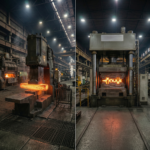
Closed Die Forging
Metal is shaped inside a cavity (die) that matches the required geometry.
Best for: repeatable shapes, controlled grain flow, high precision, tight tolerances.
Open Die Forging
Metal is shaped between flat or simple dies without a fully enclosed cavity.
Best for: large parts, low volume, flexible geometry, deep reductions, heavy-section components.
2) What buyers typically choose Closed Die Forging for
Closed die forging is usually the right fit when the part needs:
- Tight tolerances
- Near-net shapes
- Repeatable geometry
- Controlled grain flow around critical features
- Faster per-piece cycle once tooling exists
- Consistency for qualification and repeat audits
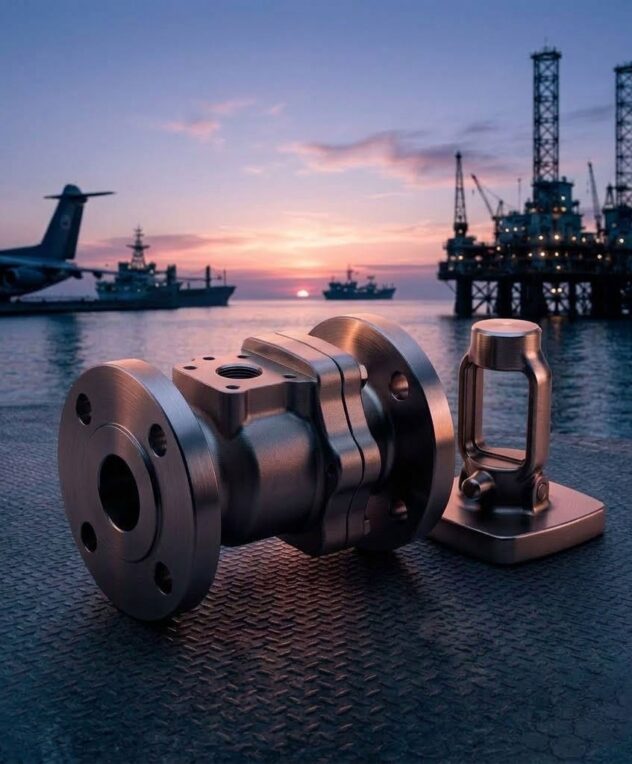
Typical closed die parts:
- Flanges with complex profiles
- High-load connectors
- Yokes, brackets, couplers
- Parts that require consistent geometry across batch
3) What buyers typically choose Open Die Forging for
Open die forging is usually the right fit when the part needs:
- Very large size or heavy section
- Low volume or one-off requirements
- Significant reduction ratios for metallurgical integrity
- Custom shapes where tooling cost doesn’t make sense
- Deep forging reductions for internal soundness
Typical open die parts:
- Shafts, stepped shafts
- Thick blocks and discs
- Rings and hollow cylinders
- Heavy forged preforms requiring machining
4) The real decision framework buyers use
Buyers don’t choose based on “process preference.”
They choose based on:
A) Geometry complexity
- More complex → closed die
- Large + simple → open die
B) Batch size / repeat demand
- Repeatable demand → closed die makes economic sense
- Low volume, variable parts → open die is often better
C) Strength and grain flow requirement
- Closed die gives better grain flow around contours
- Open die gives stronger overall integrity through reduction control
D) Delivery urgency
- If die exists already → closed die can be faster
- If die must be created → open die may be faster for first article
E) Total cost of ownership
- Closed die has tooling cost but lowers scrap and machining
- Open die may have more machining but avoids tooling cost
5) “Which one is stronger?”
Both can produce excellent strength.
But strength depends on:
- Reduction ratio
- Forging temperature control
- Heat treatment discipline
- Machining allowance
- Inspection depth
It’s not the process name – it’s the control system.
A well-controlled open die forging can outperform a poorly controlled closed die forging and vice versa.
6) What should be included in an RFQ so the supplier doesn’t quote wrong
Many sourcing teams send drawings and ask for a quote – but for critical components, that’s not enough.
- Service condition (pressure / fatigue / impact / temperature range)
- Material grade + spec (ASTM / EN / proprietary)
- Inspection requirements (UT, MPI, PT, RT, dimensional)
- Certification requirement (API / AS9100D / PED / IBR / ABS / IRIS)
- Traceability requirement (heat no, batch records, MTC, test reports)
- Annual volume estimate (even if small)
This helps the supplier decide the right route and quote accurately.
7) Closed Die vs Open Die:
| Factor | Closed Die Forging | Open Die Forging |
| Best for | Repeatable complex shapes | Large heavy parts, one-offs |
| Tooling | Required | Minimal |
| Cost structure | Higher upfront, lower per piece | Ower upfront, higher machining |
| Tolerance | Tighter | Depends on machining |
| Lead time | Fast after tooling exists | Fast for first articles |
| Typical industries | Aerospace, defence, oil & gas | Oil & gas, energy, heavy engineering |
| Strength drivers | Grain flow around geometry | Reduction control through thickness |
Which is better: closed die or open die forging?
Closed die forging is best for tight tolerances and repeatable complex shapes, while open die forging is best for heavy-section, low-volume, and large components where deep forging reductions and flexible geometry are required.


Leave a Reply