
Super Duplex UNS S32750 Forging Supplier for USA from India: ASTM A182 F53 Offshore & Subsea Components
Super duplex stainless steel occupies an important position between conventional stainless steels and much more expensive high-nickel corrosion-resistant alloys.
For offshore oil and gas equipment, that combination can be extremely valuable.
UNS S32750, commonly associated with ASTM A182 Grade F53 in forgings, combines a duplex ferritic-austenitic microstructure with approximately 25% chromium, 7% nickel, 4% molybdenum and about 0.3% nitrogen in typical compositions. Alleima identifies the grade as UNS S32750 / EN 1.4410 and specifically notes suitability for further production to ASTM A182 F53.
For American oil & gas and offshore OEMs evaluating a UNS S32750 forging supplier from India, the central question is not simply whether the supplier can buy F53 material.
The real qualification challenge is whether it can forge and heat treat the material while preserving the microstructure responsible for its corrosion resistance and mechanical strength.
What Makes UNS S32750 a Super Duplex Stainless Steel?
Duplex stainless steels derive their name from their two-phase microstructure.
Rather than being predominantly austenitic like common 300-series stainless steels, duplex grades contain significant proportions of both ferrite and austenite.
The two-phase structure provides a useful combination.
Austenite contributes toughness and corrosion resistance, while ferrite helps provide high strength and strong resistance to chloride stress-corrosion cracking.
Super duplex grades increase chromium, molybdenum and nitrogen compared with standard duplex grades such as 2205.
The result is significantly improved resistance to localised corrosion in chloride-rich environments.
Alleima describes S32750 as offering excellent resistance to chloride-induced stress-corrosion cracking, pitting and crevice corrosion, along with very high mechanical strength and high erosion-corrosion and corrosion-fatigue resistance.
PREN and Pitting Resistance
One commonly used indicator for chloride pitting resistance is the Pitting Resistance Equivalent Number, or PREN.
A conventional formula is:
PREN = %Cr + 3.3(%Mo) + 16(%N)
Using typical S32750 chemistry of roughly 25% chromium, 4% molybdenum and 0.27-0.30% nitrogen produces a PREN in the low-40s.
Outokumpu lists a PRE value of approximately 43 for its S32750 grade, compared with about 35 for 2205 and approximately 24 for 316L in the same comparison.
PREN should not be treated as a complete prediction of corrosion behaviour, but it helps explain why super duplex materials are selected for aggressive chloride service.
ASTM A182 F53
For forged components, ASTM A182 F53 is one of the key designations associated with UNS S32750.
ASTM A182 covers forged or rolled alloy and stainless steel pipe flanges, forged fittings and related parts for high-temperature service, and F53 is the super duplex grade designation associated with S32750.
The actual component specification can contain additional requirements beyond basic material grade.
US buyers may specify supplementary testing, corrosion tests, ferrite limits, NDT or customer-specific acceptance criteria.
This is why purchasing “F53” alone is not enough to define a complete manufacturing requirement.
Where F53 Forgings Are Used
S32750 forgings are relevant where chloride exposure and mechanical loading occur simultaneously.
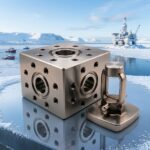
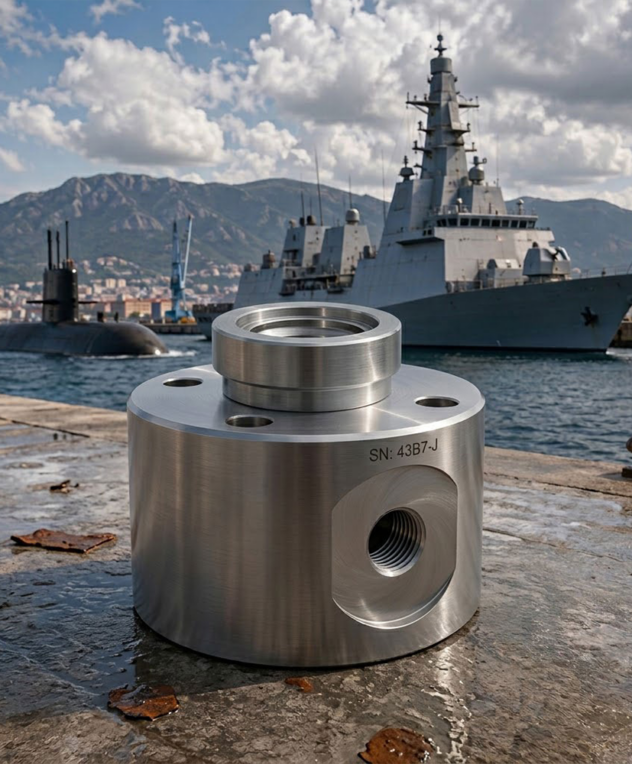
Typical offshore and oil & gas components can include forged flanges, valve bodies, bonnets, hubs, connectors, manifolds, pressure-containing blocks, pump components and subsea hardware.
Alleima specifically identifies oil and gas, seawater cooling, desalination, geothermal wells and refineries among typical applications for S32750.
For US Gulf of Mexico and other offshore programmes, this combination of high strength and seawater resistance can make F53 attractive for selected pressure and structural applications.
High Strength Can Reduce Section Requirements
One important feature of super duplex is its high yield strength relative to common austenitic stainless steels.
This can provide designers with opportunities to reduce wall thickness or component mass where the governing design code permits.
But buyers should avoid assuming that the material can simply replace 316L on a one-for-one basis with thinner geometry.
Stress limits, corrosion allowance, fabrication requirements, fatigue loading and design-code provisions all need to be considered.
Material substitution should therefore remain an engineering decision, not a procurement decision.
Forging Temperature Control
S32750 has a more sensitive thermal processing window than ordinary carbon or low-alloy steel.
If the material spends too much time in inappropriate intermediate temperature ranges, undesirable secondary phases can precipitate.
These phases can reduce corrosion resistance and toughness.
The forging manufacturer therefore needs to control billet heating, forging temperature, reheating and subsequent solution treatment.
The process is fundamentally metallurgical.
The objective is not merely to produce the correct shape but to arrive at the correct finished microstructure.
Solution Annealing and Rapid Cooling
After forging, super duplex components generally require an appropriate solution heat treatment followed by sufficiently rapid cooling.
The treatment helps dissolve detrimental precipitates and restore the desired phase distribution.
The exact temperatures and cooling requirements depend on the applicable material specification and section size.
Heavy forgings create a particular challenge because their centres cool more slowly than thin sections.
A furnace and quench system that successfully processes small F53 fittings may therefore not automatically be adequate for a large forged valve body or subsea hub.
Ferrite-Austenite Balance
Duplex performance depends on the relationship between ferrite and austenite.
A severely imbalanced microstructure can reduce toughness or corrosion performance.
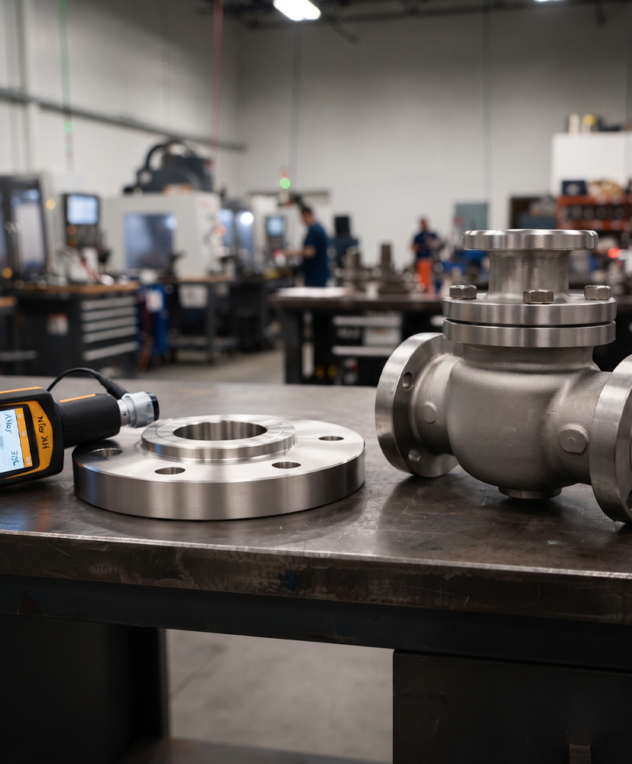
For critical applications, buyers may therefore request metallographic examination or ferrite measurement.
The key lesson is that chemical analysis alone cannot prove that a super duplex forging has been processed correctly.
The finished microstructure reflects the complete thermal history of the material.
Corrosion Testing
Depending on the purchase specification, corrosion qualification can include testing designed to identify susceptibility to intermetallic-phase precipitation or localised corrosion.
US buyers may specify tests based on recognised ASTM methods or project-specific acceptance criteria.
The forging supplier should therefore know the corrosion-test requirement before heat treatment and production planning begin.
Testing added after the component has already been forged may expose a problem that could have been prevented through correct process qualification.
NACE MR0175 / ISO 15156
For oil and gas production environments containing H2S, NACE MR0175 / ISO 15156 is a key materials framework.
Alleima lists S32750 products as compliant with NACE MR0175 / ISO 15156 for specified conditions and product forms.
However, it is important not to write “S32750 is NACE compliant” as an unconditional statement.
Applicability depends on material condition, environment and the restrictions in the relevant standard.
The buyer should define sour-service requirements explicitly.
S32750 Forgings at Vinir Engineering
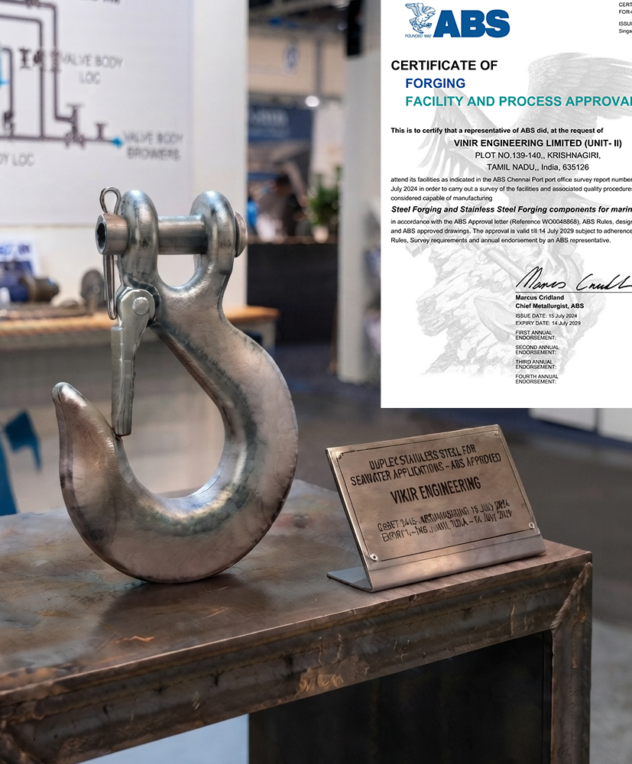
Vinir Engineering’s material portfolio includes duplex and super duplex stainless steels for oil & gas, marine and offshore applications.
Its integrated forging, heat treatment, machining and testing model is particularly relevant to super duplex components because process handoffs can introduce contamination, traceability gaps and thermal-control risks.
US buyers can provide the material specification, forging drawing, corrosion-testing requirements, NDT acceptance standard and finished machining scope for engineering review.