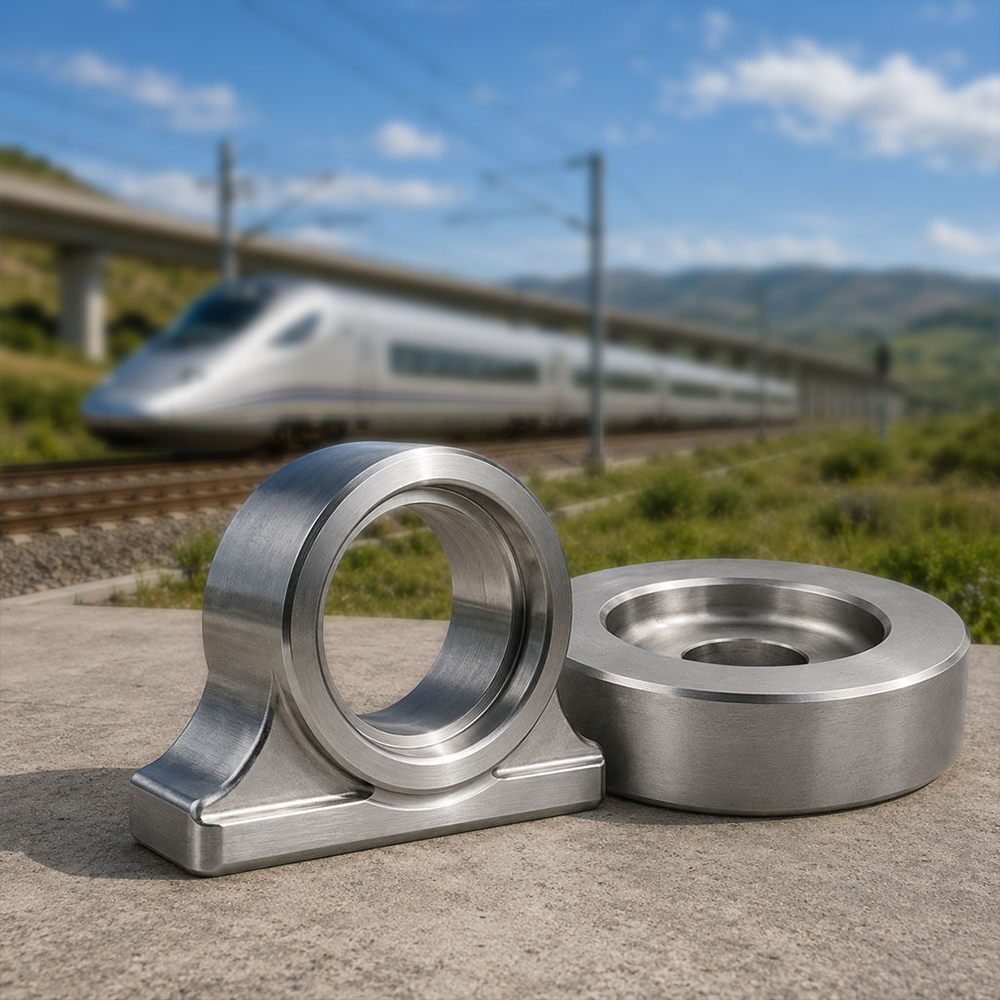
Spain operates Europe’s most extensive high-speed rail network – 3,800+ km of AVE (Alta Velocidad Española) track and has world-leading railway manufacturers in CAF (Construcciones y Auxiliar de Ferrocarriles, Beasain), Talgo (Madrid), and Alstom Spain (Santa Perpetua de Mogoda). Spain’s rail manufacturing sector exports rolling stock globally CAF and Talgo supply trains to over 30 countries. IRIS certified Indian forging manufacturers with EN 13261 EA4T axle steel capability are positioned to supply the Spanish railway forging market and, through Spanish OEM export programmes, the global rail market they serve.
OEM
Products
Key Forging
Market
CAF (Beasain, Basque Country)
AVE trains, metro, tram
EA4T high-speed axle, bogie frame
Spain, UK, Mexico, Australia
Talgo (Madrid)
Talgo 350, Avril, Vittal One
EA4T articulated axle, wheel set
Spain, USA, Germany, Saudi Arabia
Alstom Spain (Barcelona)
Avant, regional trains
EA4T passenger axle, motor axle
Spain and export
ADIF (Spanish rail operator)
Maintenance / renewal
EA4T and EA1N axle replacement
Spain domestic
CAF — headquartered in Beasain in Spain’s Basque Country is one of Europe’s largest railway manufacturers by revenue, with manufacturing facilities in Spain, UK (Newport, Wales), Mexico, and India (partnerships). CAF’s product range covers high-speed trains, regional trains, metros, trams, and freight wagons. CAF’s forging supply chain applies IRIS (ISO 22163) certification as the standard for axle and bogie component suppliers. CAF’s export success trains operating in Australia, the UK, New Zealand, Brazil, and the USA means that qualifying for CAF’s Spanish supply chain provides access to a global portfolio of railway programmes.
Talgo — the Madrid-based company known for its patented passive tilting articulated train technology produces trains operating on Spanish AVE networks, Germany (Hamburg-Berlin ICE service), and the USA (Amtrak, under the Talgo 250 designation). Talgo’s articulated design uses a unique axle configuration each axle is shared between two adjacent passenger cars rather than being attached to a single car bogie. This design creates specific axle forging requirements: Talgo axles are shorter than standard bogie axles and have different load distribution characteristics, but still require EN 13261 EA4T steel with 100% UT and magnetic particle inspection.
RENFE (Red Nacional de los Ferrocarriles Españoles) Spain’s national rail operator operates the AVE high-speed network and conventional regional services. RENFE’s fleet maintenance programme generates ongoing demand for EA4T axle replacement forgings as part of periodic axle reconditioning (wheelset replacement at 600,000 km service intervals for high-speed rolling stock). RENFE procures through Alstom, CAF, and Talgo as the rolling stock original manufacturers rather than directly from forging manufacturers.
Spain’s commitment to expanding its high-speed rail network with planned extensions to Extremadura, Galicia, and the Basque Y (connecting Bilbao, San Sebastián, and Vitoria to the French high-speed network) creates long-term sustained demand for EA4T axle forgings and bogie structural forgings through the CAF and Talgo supply chains.
EA4T axle forgings 150–400 kg, open die on 3,000T press.
100% UT with EA4T calibration standard.
Full MT of finished axle surface.
EN 13261 complete documentation package including heat treatment furnace chart.
Bogie structural forgings S355NL and 4340, 100–800 kg, closed and open die.
NABL Charpy at -20°C.
Ocean freight Chennai to Bilbao or Barcelona: 24–30 days.
Frequently Asked Questions
1.What is Talgo’s articulated train design and how does it create unique axle forging requirements?+–
Talgo’s patented design uses independently rotating wheels on axles shared between two adjacent cars — rather than the conventional two-axle bogie under each car end. Each Talgo axle is shorter than a standard bogie axle and the load distribution (each axle carries part of two adjacent cars) differs from conventional bogies. Talgo axles still use EA4T alloy steel per EN 13261, but the drawing geometry (shorter axle body, different journal diameter distribution) is Talgo-specific. Indian forging manufacturers seeking Talgo axle supply must obtain Talgo’s specific axle drawing — not an industry-standard EN 13261 drawing — before producing qualification forgings. Talgo has supplied trains to Amtrak (Amtrak Cascades service) and is bidding on US high-speed rail programmes, creating indirect access to the US rail market through Talgo qualification.
2.How does CAF’s Indian manufacturing partnership affect Indian forging manufacturer opportunities?+–
CAF has an established manufacturing partnership in India (through CAF India, associated with the Medha group) for metro and suburban train components supplied to Indian Railways and other Indian rail projects. This existing CAF-India manufacturing relationship creates institutional familiarity with Indian manufacturing capability within CAF’s supply chain organisation. Indian forging manufacturers approaching CAF for axle or bogie forging supply can reference CAF’s existing India manufacturing experience as evidence that CAF’s procurement organisation has direct knowledge of Indian manufacturing standards. This is an advantage not available to manufacturers approaching European railway OEMs without existing India operations.
3.What Spanish ADIF (rail infrastructure manager) standards supplement EN 13261 for Spanish high-speed axle supply?+–
ADIF (Administrador de Infraestructuras Ferroviarias) manages Spain’s rail infrastructure and, as part of the high-speed network maintenance framework, defines supplementary requirements for rolling stock components operated on Spanish high-speed lines. ADIF’s technical specifications for axles reference EN 13261 as the base standard and may add requirements for specific axle profile geometry compatible with Spanish track gauge (Spanish standard gauge is 1,435mm for AVE lines, same as European standard). ADIF supplementary requirements are communicated through the rolling stock manufacturer (CAF, Talgo, Alstom Spain) rather than directly to forging manufacturers — Indian suppliers receive these requirements as purchase order specifications from the OEM.
4.What is the cost advantage of Indian EA4T railway axle forgings versus Spanish or Polish domestic supply for CAF and Talgo?+–
EA4T railway axle forgings from India are typically 20–30% lower landed cost in Spain than equivalent domestic Spanish or Portuguese supply. Indian axle forgings compete effectively against Polish, Romanian, and Czech suppliers — the Indian cost advantage versus these Central European sources is 15–20% after ocean freight. The CAF and Talgo supply chains already source from Central European manufacturers for some axle categories — expanding to Indian supply diversifies the geographic source base while maintaining or improving cost competitiveness. Spanish OEM procurement teams who have not previously considered Indian axle forging supply typically respond positively once a capability and cost demonstration package is presented.
5.How do CAF’s global exports create opportunities for Indian forging manufacturers beyond the Spanish domestic market?+–
CAF exports trains to over 30 countries and manages production across 10+ manufacturing facilities globally. CAF’s supply chain for axle forgings serves all its global programmes — a supplier qualified for CAF’s Spanish axle procurement programme is typically eligible to supply CAF’s export programmes (UK metro for Transport for London, Australian suburban trains for Melbourne and Perth, Mexican metro for Mexico City). This global programme access multiplies the procurement volume accessible through a single CAF qualification by 3–5× compared to domestic Spanish rail market supply alone. For Indian forging manufacturers, this makes CAF qualification one of the most commercially valuable railway OEM qualifications in terms of total accessible market volume.