
AS9100D Aerospace Forging Supplier for German Aviation and Defence OEMs
Germany is Europe’s largest aerospace manufacturing economy home to Airbus Hamburg, MTU Aero Engines, Premium Aerotec, Liebherr Aerospace, and the Rolls-Royce Deutschland aeroengine facility. German aerospace OEMs and tier-1 suppliers consume substantial forged titanium, Inconel, and aluminium structural components annually. Indian AS9100D certified forging manufacturers with EASA Part 21G awareness, AMS specification compliance, and demonstrated aerospace production history are positioned to supply German aviation and defence programmes at 20–30% cost advantage over European domestic forging supply.
| OEM / Tier-1 | Programme | Key Forging | Material |
| Airbus Hamburg | A320neo, A321neo | Fuselage frames, floor fittings | 7075-T6, 2024-T4 |
| Premium Aerotec | A350 fuselage, A400M | Structural ribs, spar fittings | Ti-6Al-4V, 7050 |
| MTU Aero Engines | PW1100G, GE90 | Compressor discs, fan hubs | Inconel 718, Ti-6Al-4V |
| Rolls-Royce Deutschland | BR710, Trent XWB | Turbine structural rings | Inconel 625, 718 |
| Liebherr Aerospace | Landing gear systems | Gear beam, trunnion | Ti-6Al-4V, 300M |
| Rheinmetall Aviation | Military airframes | Structural bulkheads | Ti-6Al-4V, 4340 |
German aerospace procurement follows the EASA regulatory framework rather than the FAA framework governing US programmes. For forging suppliers, the practical implication is twofold: the quality system standard is AS9100D (universally applied across EASA and FAA jurisdictions), but the design approval and production organisation approval framework differs. German aerospace OEMs hold EASA Part 21G Production Organisation Approvals their forging suppliers must operate within quality systems that satisfy EASA oversight requirements, which in practice means full AS9100D compliance verified by an IAQG-recognised certification body.
MTU Aero Engines — headquartered in Munich and the world’s sixth-largest aeroengine manufacturer produces fan modules, low-pressure turbine modules, and high-pressure compressor modules for Pratt & Whitney, GE, and Rolls-Royce engines. The PW1100G Geared Turbofan (powering the A320neo) uses MTU-produced fan blades and low-pressure turbine components in Ti-6Al-4V and Inconel 718. MTU holds NADCAP accreditation for its own processes and requires NADCAP from its forging suppliers for rotating component supply.
Premium Aerotec the Airbus subsidiary responsible for large fuselage and structural component manufacturing uses 7075-T6 and 7050-T7452 aluminium structural forgings for A350 and A400M airframe components. Premium Aerotec’s supplier qualification process aligns with Airbus Group supplier quality standards (AIPI, AIPS specifications) that add to AS9100D.
Airbus Hamburg is the primary A320 family final assembly line in Germany. Wing components, door frames, and fuselage structural fittings are sourced from the Airbus supply chain Indian forging manufacturers who are qualified within the Airbus supply network (as tier-2 or tier-3 suppliers to Premium Aerotec, Spirit AeroSystems, or Stelia Aerospace) can supply Airbus Hamburg programmes without direct Airbus qualification.
Vinir Engineering’s Capability
- AS9100D full scope, Bureau Veritas, OASIS verifiable.
- 7075-T6/T73, 7050-T7452 aluminium forgings under AMS 2770 heat treatment.
- Ti-6Al-4V closed and open die with alpha case control.
- Inconel 718 double ageing in AMS 2750-calibrated furnaces.
- NABL-accredited testing to ASTM methods.
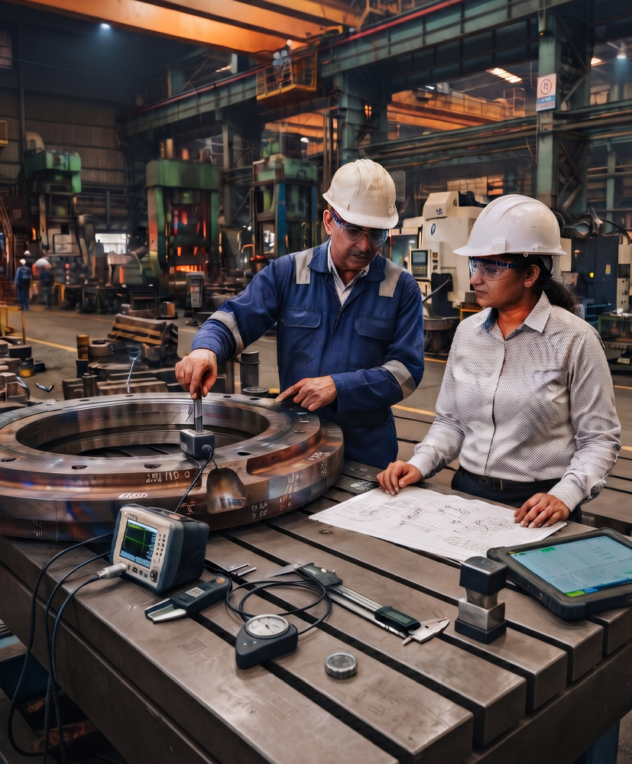
- CMM dimensional inspection with AS9102 FAIR capability.
- Ocean freight Chennai to Hamburg: 22–28 days.