
Aluminium Forgings for Aerospace in India: Structural Applications, Alloy Selection, and AS9100D Requirements
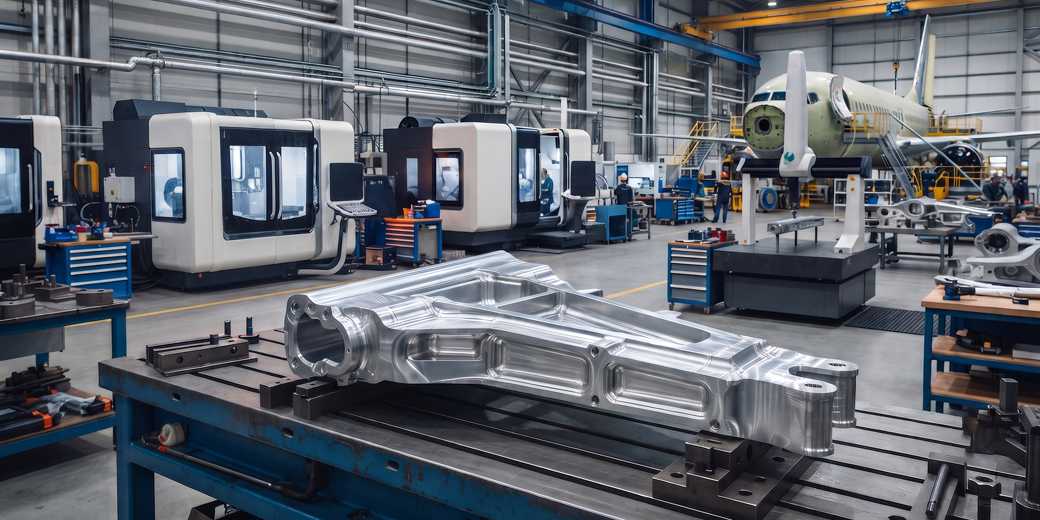
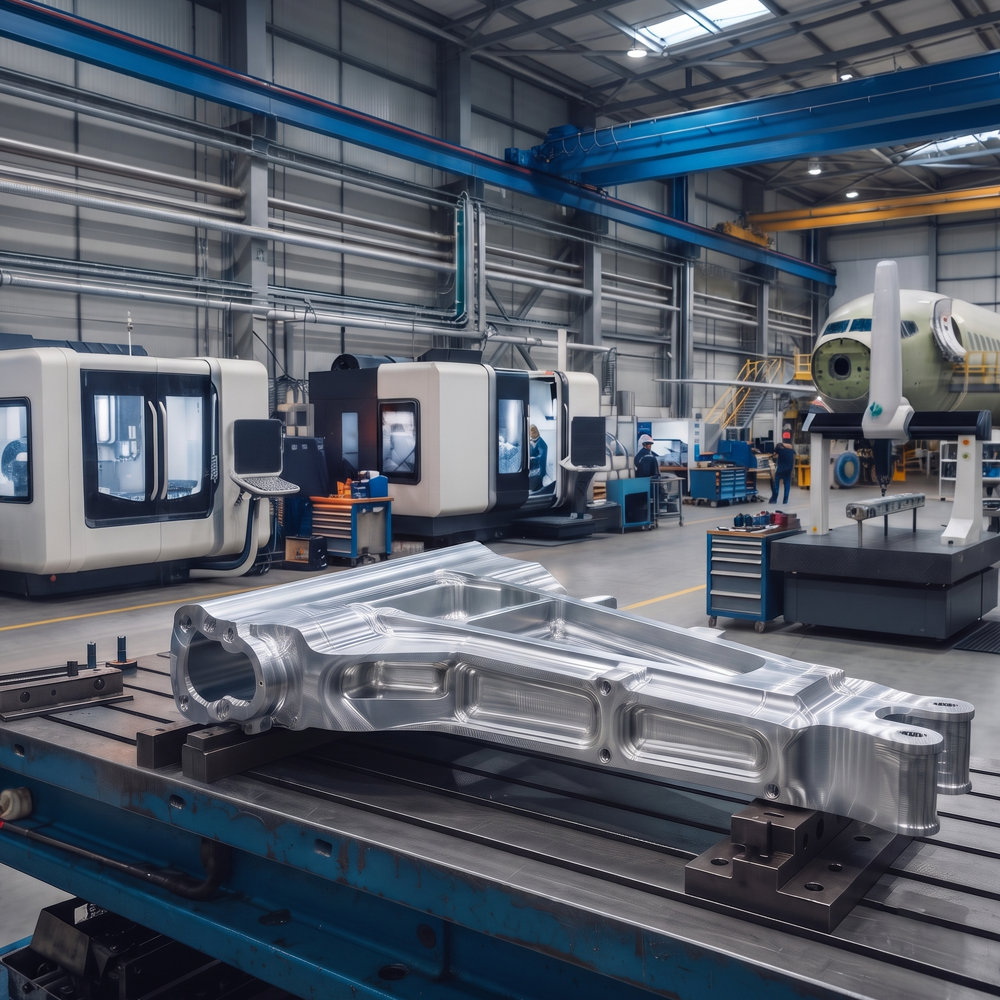
Aluminium aerospace forgings are forged components manufactured from high-strength aluminium alloys for use in aircraft structures, helicopter transmission housings, UAV airframes, and aerospace secondary structures where weight is the primary design driver and operating temperatures remain below 120°C. Aluminium forging occupies the third position in the aerospace materials hierarchy — below titanium for highest-strength structural applications and below Inconel for high-temperature applications — but accounts for a significant volume of total aerospace forging production because of its low density, good formability, and established supply chain.
Why Aluminium Is Used in Aerospace Structural Forgings
Aluminium’s case in aerospace is built on density — 2.70 g/cm³ versus 4.43 g/cm³ for titanium and 7.85 g/cm³ for steel. For equivalent volume, aluminium is 39% lighter than titanium and 66% lighter than steel. In an industry where every kilogram of structural weight reduces payload or increases fuel burn across a 30-year aircraft life, this density advantage is compelling for applications where titanium’s higher strength-per-unit-volume is not needed.
The trade-off is temperature. Aluminium alloys maintain adequate structural properties only to approximately 120°C (7075-T6) or 175°C (2024-T3) for sustained service. Above these temperatures, the precipitate hardening that gives high-strength aluminium alloys their properties begins to dissolve — a process called over-ageing. This temperature ceiling limits aluminium to the cool zones of the airframe: forward fuselage structures, wing ribs and spars, helicopter transmission housings, and secondary structural members away from the propulsion heat sources.
Within those zones, aluminium forgings provide :
- Lowest structural weight per unit cross-sectional area for moderate-strength requirements
- Good corrosion resistance (with appropriate anodising treatment) in atmospheric environments
- Excellent machinability — aluminium forgings machine faster and with lower tool wear than titanium or steel, reducing the total cost of the finished component
- Good electrical conductivity — relevant for bonded structure where structural ground paths are required
- Lower raw material cost than titanium or Inconel
Aluminium Alloy Grades Used in Aerospace Forgings
7075 — The Highest-Strength Standard Aerospace Aluminium
7075 is a zinc-magnesium-copper alloy — the strongest commercially available aluminium alloy in standard aerospace use. In the T6 temper (solution treated and peak-aged) it achieves :
- Ultimate tensile strength: 503–572 MPa
- Yield strength: 434–503 MPa
- Elongation: 8–11%
- Density: 2.81 g/cm³
The strength-to-density ratio of 7075-T6 (approximately 180–200 MPa / (g/cm³)) is competitive with alloy steels in the 800–900 MPa strength range at one-third the density. For load-bearing aerospace structural forgings where steel or titanium would be over-specified, 7075 provides the most efficient structural solution.
Applications in Indian aerospace :
- Wing spar and rib forgings on trainer and light combat aircraft
- Helicopter main rotor head forgings where titanium is over-specified on smaller platforms
- Fuselage frame station forgings on general aviation and UAV platforms
- Aileron and elevator hinge forgings — high load, moderate temperature
Applicable specification: AMS 4126 for die forgings, AMS 4144 for hand forgings (open die). Material from AMS 2770 heat treatment requirements.
Limitation: 7075 has relatively poor stress corrosion cracking (SCC) resistance in the T6 temper in the short transverse grain direction. For applications where through-thickness tensile stress is present in a corrosive environment — a concern for thick forgings — 7075-T73 (over-aged) provides better SCC resistance at a strength reduction of approximately 15%.
7050 — Damage Tolerant Alternative to 7075
7050 is a zinc-magnesium-copper alloy similar to 7075 but with higher zirconium content and modified zinc and copper levels. It achieves slightly lower peak strength than 7075 but significantly better fracture toughness and fatigue crack growth resistance — the damage tolerance properties that determine structural inspection intervals in fracture mechanics-based airframe design.
Applications:
- Thick-section wing structural forgings where short transverse stress corrosion is a concern
- Fuselage frames in the most fatigue-critical locations
- Pressure bulkhead forgings where damage tolerance is the design driver
Applicable specification: AMS 4342 for die forgings. Typically used in T7452 (solution treated, stress-relieved by stretching, over-aged) temper for the combination of strength, toughness, and SCC resistance.
2024 — The Standard for Fatigue-Critical Applications
2024 is a copper-based aluminium alloy — lower strength than 7075 but with better fatigue resistance and higher toughness. In the T3 or T4 temper (solution treated, naturally aged), 2024 is the standard material for aerospace fatigue-critical applications:
- Upper wing skin structures (compression-loaded, fatigue life critical)
- Fuselage skin in the upper-lobe (compression-loaded)
- Wing leading edge structural members
2024 is less commonly used in forging than in sheet applications, but forged 2024 components appear in:
- Wing attachment fittings where fatigue life is the critical design parameter
- Structural brackets in locations subject to high-cycle fatigue loading
- Helicopter airframe connecting fittings where fatigue rather than static strength is critical
Applicable specification: AMS 4112 for die forgings. T4 temper for maximum toughness, T6 or T8 for higher strength.
2219 — High-Temperature and Weldable
2219 is a copper-aluminium alloy with good strength retention at temperatures up to 175°C — higher than 7075 or 2024 — and excellent weldability. Specified for:
- Cryogenic tankage structural forgings (liquid oxygen/hydrogen tank fittings) — 2219 maintains excellent toughness at cryogenic temperatures
- Aeroengine nacelle structural forgings where moderate temperature exposure occurs
- Launch vehicle structural fittings where both weldability and temperature resistance are required
Aluminium Forging Processes for Aerospace
Closed Die Forging — The Standard Process
Closed die forging in aluminium produces near-net-shape structural forgings with grain flow oriented to the principal stress directions. The die design for aluminium aerospace forgings is critical — the geometry must allow complete die fill at relatively low forging temperatures (typically 350–480°C for 7075) without cold-working that exceeds the material’s deformation capability.
Flash design: Aluminium is more sensitive to flash thickness than steel. Too thick a flash and the die does not fill completely — inadequate metal pressure in the web sections of complex forgings. Too thin a flash and die wear is rapid. The flash land geometry is optimised for each forging during the die development phase.
Forging temperature: 7075 is typically forged between 370–440°C. Above 440°C, hot tearing at grain boundaries becomes a risk. Below 370°C, the material is too stiff and die fill is incomplete. Unlike titanium where the beta transus is a critical upper temperature limit, aluminium forging temperature is constrained by hot tearing (upper limit) and formability (lower limit).
Lubrication: Graphite-based lubricants in water or oil carrier are standard for aluminium die forging. Adequate lubrication reduces friction and the forging load required, improves surface quality, and extends die life. Inadequate lubrication on aluminium forging dies produces die soldering — aluminium adhering to the die surface — which requires die cleaning and can introduce surface defects on subsequent forgings.
Open Die Forging for Larger Aluminium Aerospace Forgings
For larger aluminium structural forgings — thick section bulkhead forgings, heavy structural members — open die forging on a hydraulic press provides the deformation required to refine grain structure and orient grain flow before the final closed die or machining operations.
Heavy aluminium forgings for aerospace require high reduction ratios to achieve the uniform, refined grain structure that the material specification requires. Pancake forging followed by repressing or multiple-direction pressing ensures adequate reduction through the critical cross-section.
Heat Treatment of Aluminium Aerospace Forgings
Solution Treatment
All high-strength aluminium alloys (7075, 7050, 2024) are solution treated before ageing. Solution treatment dissolves the strengthening precipitate phases into solid solution. For 7075, solution treatment is performed at 465–480°C for a time sufficient to achieve complete dissolution — typically 2–4 hours for forging cross-sections.
Critical requirement — quench delay: After removal from the solution treatment furnace, the forging must reach the quench medium within a defined maximum time — typically 5 seconds (thin sections) to 15 seconds (thick sections). Exceeding the quench delay allows reprecipitation to begin at grain boundaries, reducing both corrosion resistance (IGC susceptibility) and mechanical properties. For aerospace aluminium forgings, quench delay is a controlled and documented process parameter — not a guideline.
Quench medium: Cold water quench (room temperature) provides the fastest quench rate and highest subsequent strength. For thick sections and complex geometry, forced water quench or hot water quench (65°C) may be specified to reduce quench-induced residual stresses and distortion while maintaining adequate properties. The quench medium temperature must be monitored and documented for each lot.
Ageing
T6 temper (peak age): 7075 aged at 121°C for 24 hours achieves maximum strength. The precipitate phase (MgZn₂) develops to its peak size and distribution. T6 is specified where maximum strength is required and SCC in the short transverse direction is not a concern.
T73 temper (over-age): 7075 aged at 121°C then re-aged at 163°C achieves approximately 85% of T6 strength but dramatically better SCC resistance in the short transverse direction. For thick-section airframe forgings in locations where through-thickness tensile stress in a corrosive environment is possible, T73 is specified regardless of the strength reduction.
T7452 temper for 7050: Solution treat, cold water quench, controlled stretching to relieve residual stresses (the “52” designation indicates stretching), then over-age. The stretching step reduces residual stresses from quenching and improves fatigue life in residual stress-sensitive applications.
Natural ageing for 2024-T3/T4: 2024 achieves adequate properties through natural ageing at room temperature after solution treatment — no elevated temperature ageing is required. The T3 designation indicates solution treatment followed by cold working and natural ageing. Natural ageing is complete after approximately four days at room temperature and properties continue to improve slowly for several weeks.
Stress Relieving
For complex geometry aerospace aluminium forgings, quench-induced residual stresses can cause distortion during machining and reduce fatigue life. Stress relieving by controlled stretching (permanent elongation of 1–3%) after quench and before ageing redistributes and reduces residual stresses. This is the basis for the -51 (compression) and -52 (stretching) temper designations in aerospace aluminium specifications.
NDT for Aluminium Aerospace Forgings
Dye Penetrant Testing (PT)
PT is the primary surface inspection method for aluminium aerospace forgings — MT cannot be used because aluminium is non-ferromagnetic. Fluorescent penetrant inspection to AMS 2647 is the standard for aerospace aluminium — visible dye penetrant is typically not acceptable for aerospace structural components.
PT is performed after final machining on the finished surface. All surfaces accessible to inspection must be covered — a missed area is a finding in FAIR review. PT sensitivity for aluminium is high — tight forging laps, seams, and cold shuts are reliably detected.
Ultrasonic Testing
UT of aluminium aerospace forgings uses similar techniques to steel UT — contact and immersion scanning. Aluminium has lower acoustic impedance than steel, which affects probe selection and calibration. For thick-section aluminium forgings (above 50mm cross-section), UT is required to verify internal cleanliness and the absence of inclusions or porosity not eliminated by the forging process.
The applicable standard for aluminium forging UT is typically ASTM B594 or customer-specific criteria referenced in the quality plan.
Eddy Current Testing
Eddy current testing is used for some aluminium aerospace forging applications — particularly bore and hole inspection on disc and ring-type forgings where the probe can be inserted into the bore. Eddy current is sensitive to conductivity variations caused by micro-structural differences (age hardening gradient, porosity) as well as surface defects.
Specific Aerospace Applications: Indian Context
HAL Tejas — Secondary Structural Forgings
The Tejas LCA airframe uses titanium for primary structural members but aluminium for secondary structures, access panels, brackets, and fitting components where the structural load does not justify titanium’s cost premium. 7075-T6 and 7050-T7452 are the standard grades.
HAL ALH Dhruv and LCH — Transmission Housing Forgings
Helicopter transmission housings — the largest single aluminium forgings on most helicopter platforms — are produced by closed die forging in 7075 or 2024. The transmission housing carries the loads from the main rotor system and must be both light (to preserve rotor-to-engine power budget) and extremely stiff (to maintain gear mesh alignment under dynamic loading).
UAV and Light Aircraft Programmes
India’s expanding UAV production — Rustom series, Tejas variants, private sector UAV platforms — uses aluminium forgings extensively for airframe structural members, wing attachment fittings, and fuselage frame stations. Volume is generally low per platform but the number of distinct part numbers is high, making UAV aerospace forging a high-mix low-volume application.
International Offset — Airbus and Boeing Aluminium Forgings
Airbus and Boeing both use aluminium forgings extensively in their commercial aircraft — 7050-T7452 for thick wing structural components, 7075-T6 for smaller structural fittings, 2024-T3 for fatigue-critical applications. India’s offset obligations from Airbus A330 MRTA and other purchases include aluminium forging as a viable offset category. Indian suppliers qualifying for Airbus or Boeing aluminium forging supply must meet NADCAP requirements for heat treatment and the applicable AMS specifications for material and process.
Vinir Engineering’s Aluminium Aerospace Forging Capability
Vinir Engineering produces aerospace aluminium forgings in 7075, 7050, and 2024 alloy grades from AMS-certified billet. Closed die forging in the 5–500 kg range covers the primary size range for aerospace structural aluminium forgings. Heat treatment capability includes solution treatment with controlled quench delay monitoring, T6 and T73 ageing for 7075, and T7452 processing for 7050.
In-house FPI to AMS 2647 and UT inspection are performed by ASNT Level II certified operators. NABL-accredited in-house tensile, yield, elongation, hardness, and chemical analysis testing provides all required material certification data to ASTM test methods.
AS9100D certification covers aluminium forging within the full forge-to-finish scope. The combination of in-house heat treatment, NDT, machining, and testing means the complete aluminium aerospace forging workflow operates under one quality management system.
Frequently Asked Questions — Aluminium Aerospace Forgings India
What is the strongest aluminium alloy used in aerospace forgings?
7075-T6 is the highest-strength standard aerospace aluminium alloy — achieving ultimate tensile strength of 503–572 MPa depending on section size. 7050-T7452 achieves slightly lower peak strength (approximately 490–524 MPa) but significantly better fracture toughness and fatigue crack growth resistance. For applications where SCC resistance in the short transverse direction is required alongside maximum strength, 7075-T73 provides better corrosion resistance than T6 at a strength reduction of approximately 15%. The selection between these grades is driven by the specific combination of strength, toughness, fatigue, and corrosion resistance required for the application.
What is the quench delay requirement for aerospace aluminium heat treatment and why does it matter?
Quench delay is the maximum time allowed between removing a forging from the solution treatment furnace and immersing it in the quench medium. For most aerospace aluminium alloys, this is 5–15 seconds depending on section thickness. Exceeding the quench delay allows strengthening precipitates to begin forming at grain boundaries during the slow-cooling period — a process called quench sensitivity. Grain boundary precipitation reduces both intergranular corrosion resistance and short transverse mechanical properties. In aerospace aluminium heat treatment, quench delay is a controlled and documented process parameter with a specified maximum. Exceeding it is a non-conformance requiring investigation and engineering disposition.
Why is 7075 in T73 temper sometimes specified instead of T6 for aerospace forgings?
7075-T6 has relatively poor stress corrosion cracking resistance in the short transverse (through-thickness) grain direction. In locations where the forging experiences through-thickness tensile stresses — thick-section bulkheads, lug fittings in bearing locations — in the presence of any moisture or corrosive environment, SCC cracking can initiate and propagate in the T6 temper without visible prior warning. The T73 temper (deliberately over-aged) sacrifices approximately 15% of T6 peak strength but dramatically improves SCC resistance by changing the grain boundary precipitate morphology. For thick-section aerospace forgings in potentially corrosive environments, T73 is the conservative and often mandatory specification.
What is the difference between PT and FPI for aluminium aerospace forgings?
Both are penetrant inspection methods that detect surface-breaking defects. Visible dye penetrant (PT) uses a coloured dye and white developer — indications are visible under white light. Fluorescent penetrant inspection (FPI) uses a fluorescent dye and is inspected under UV light — indications glow brightly against a dark background. FPI provides significantly higher sensitivity than visible PT, particularly for tight, closed cracks with minimal opening. For aerospace aluminium structural forgings, FPI to AMS 2647 is the specified method — visible PT is typically not acceptable for primary structural aerospace applications.
Can Indian aluminium aerospace forging manufacturers supply to international OEMs under offset arrangements?
Yes, provided the supplier holds current AS9100D certification with scope covering aluminium forging and all associated special processes (heat treatment, NDT), NABL-accredited mechanical testing capability, and is willing to pursue NADCAP for heat treatment and NDT where required by the specific international OEM. Aluminium forging is a preferred offset category for Airbus and Boeing because Indian suppliers can genuinely add value — it is not a paper offset. The qualification process for international OEM aluminium forging supply typically takes 18–24 months from initial approach to first production order.