
Industrial forging processes explained: closed die, open die, ring rolling and selection criteria
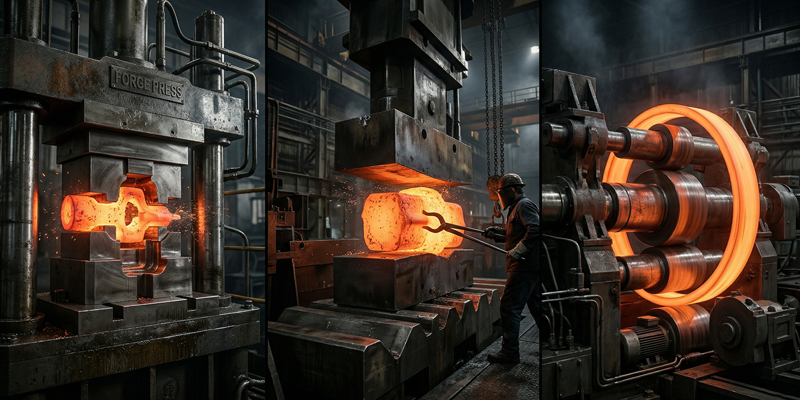
Introduction
Forging remains one of the most critical manufacturing processes for producing high-strength industrial components used in oil & gas, aerospace, defence, nuclear, marine, railway, and heavy equipment applications.
However, selecting the right forging process is not simply a matter of size or cost.
Closed die forging, open die forging, and ring rolling each produce distinct metallurgical characteristics, grain flow patterns, dimensional control levels, and structural reliability outcomes. For critical components, the wrong process selection can directly impact fatigue life, inspection acceptance, audit approval, and long-term performance.
This guide explains:
- How each forging process works
- Where each is used
- What metallurgical differences they create
- How OEMs evaluate process selection
- When one process is preferred over another
1. Closed Die Forging
Process Overview
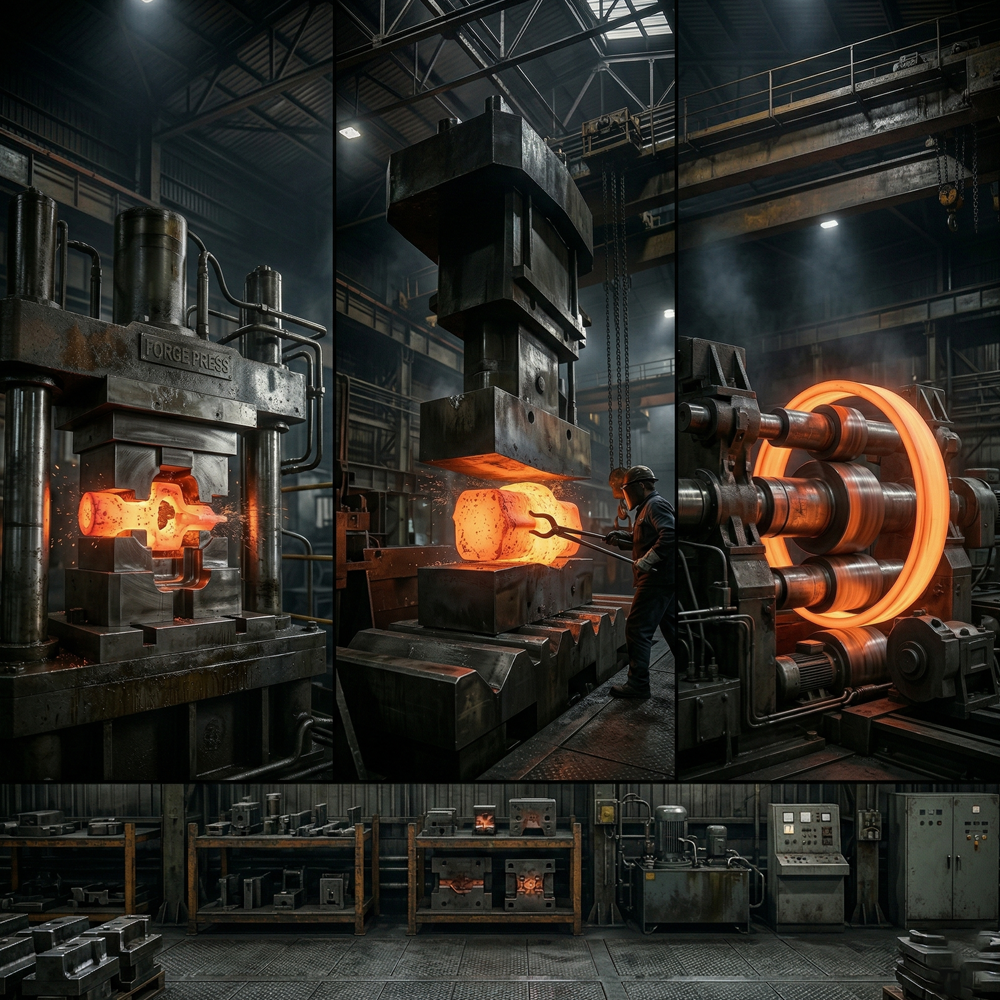
Closed die forging (also called impression die forging) involves placing heated material between precision-machined dies that contain a pre-formed cavity. As compressive force is applied, the material flows to fill the cavity, producing a near-net shape component.
The process may involve multiple stages:
- Preforming
- Blocking
- Finishing
- Trimming
Key Characteristics
- Controlled grain flow following part geometry
- Tight dimensional tolerances
- Repeatability in medium volumes
- Excellent mechanical strength
- Reduced machining allowance
Typical Applications
- Valve bodies
- Bonnet forgings
- Aerospace brackets
- Gear blanks
- Structural defence components
- Flanges and connectors
Advantages
- Superior fatigue resistance due to grain alignment
- Lower material waste than machining from billet
- Strong dimensional consistency
- Suitable for high-load components
Limitations
- High tooling cost
- Less economical for very low volume parts
- Size limitations compared to open die
2. Open Die Forging
Process Overview
Open die forging involves deforming heated metal between flat or contoured dies without fully enclosing the material. The operator manipulates the workpiece between compressions to achieve the desired shape.
Unlike closed die forging, the metal is not constrained by a cavity.
Key Characteristics
- High reduction ratios achievable
- Excellent internal soundness
- Suitable for very large components
- Flexible geometry control
Typical Applications
- Heavy shafts
- Rotors
- Large rings (pre-rolling stage)
- Pressure vessel components
- Nuclear-grade blocks
Advantages
- Suitable for very large sections
- Strong internal structural integrity
- Ideal for low-volume heavy components
- Flexible production
Limitations
- Wider dimensional tolerances
- More machining required
- Operator skill dependent
3. Ring Rolling
Process Overview
Ring rolling is a specialized forging process used to produce seamless rings. A pre-forged donut-shaped blank is placed between rollers, which progressively reduce wall thickness and increase diameter.
The process ensures continuous circumferential grain flow.
Key Characteristics
- Uniform grain flow around circumference
- Excellent fatigue strength
- Seamless structure
- Dimensional control for circular components
Typical Applications
- Bearing races
- Turbine rings
- Gear rings
- Flanges
- Aerospace engine rings
- Marine propulsion rings
Advantages
- Superior fatigue resistance
- Reduced weld risk
- Structural continuity
- Efficient material usage
Limitations
- Limited to ring geometries
- Requires preform forging
4. Metallurgical Differences Between Processes
Forging is not just shaping metal. It is engineering microstructure.
| Parameter | Closed Die | Open Die | Ring Rolling |
| Grain Flow Control | High (shape-oriented) | Moderate (directional) | Circumferential |
| Reduction Ratio | Moderate | High | Controlled radial |
| Dimensional Tolerance | Tight | Moderate | Controlled OD/ID |
| Suitable Volume | Medium | Low | Low–Medium |
| Typical Size Range | Small–Medium | Medium–Very Large | Circular only |
Grain orientation significantly impacts:
- Fatigue life
- Crack propagation resistance
- Pressure integrity
- Mechanical property consistency
5. Selection Criteria: How OEMs Decide
Process selection depends on:
1. Component Geometry
- Complex shapes → Closed die
- Large shafts → Open die
- Circular geometry → Ring rolling
2. Load Conditions
- Cyclic loading → Grain flow alignment critical
- Static load → Reduction ratio focus
3. Certification Requirements
- API → Pressure retaining integrity
- AS9100D → Process repeatability
- Nuclear → Documentation depth
4. Volume & Tooling Economics
- High tooling cost justified only if repeat production exists
5. Machining Requirements
- Near-net shape reduces cost
6. Why Process Selection Impacts Audit Outcomes
Auditors do not just verify certificates. They verify:
- Process control documentation
- Reduction ratio calculation
- Heat treatment traceability
- NDT methodology
- Die maintenance records
- Operator qualification
Improper process selection can lead to:
- Non-conformance reports (NCRs)
- Fatigue failures
- UT rejection
- Dimensional deviation
- Qualification delays
7. Integrated Forge-to-Finish Advantage
When forging and machining are integrated:
- Grain flow alignment can be preserved intentionally
- Machining allowances are optimized
- Traceability is continuous
- Dimensional corrections are faster
- Audit documentation is centralized
This becomes critical in high-mix, low-volume manufacturing environments serving non-automotive sectors.
8. Conclusion
Closed die forging, open die forging, and ring rolling are not interchangeable manufacturing options. Each process creates distinct structural characteristics that directly impact mechanical integrity, inspection acceptance, and long-term reliability.
For critical industrial components, process selection must align with:
- Application requirements
- Metallurgical demands
- Certification standards
- Lifecycle risk considerations
Understanding these differences is essential for OEMs sourcing from forging manufacturers serving oil & gas, aerospace, defence, nuclear, marine, and heavy equipment industries.
Choosing the Right Forging Process — With the Right Manufacturing Partner
Selecting between closed die forging, open die forging, and ring rolling is not only a technical decision — it is a long-term reliability decision.
At Vinir Engineering, process selection is aligned with:
- Component geometry and load paths
- Required reduction ratios
- Industry-specific compliance standards
- Fatigue and lifecycle performance requirements
As a non-automotive, high-mix, forge-to-finish manufacturer, Vinir supports OEMs across oil & gas, aerospace, defence, nuclear, marine, and heavy equipment sectors with process-driven engineering rather than volume-driven production.
If you are evaluating forging processes for a critical component, our engineering team can review drawings, load conditions, and certification requirements to recommend the most structurally appropriate manufacturing approach.
Discuss your forging process requirements with Vinir’s technical team.