
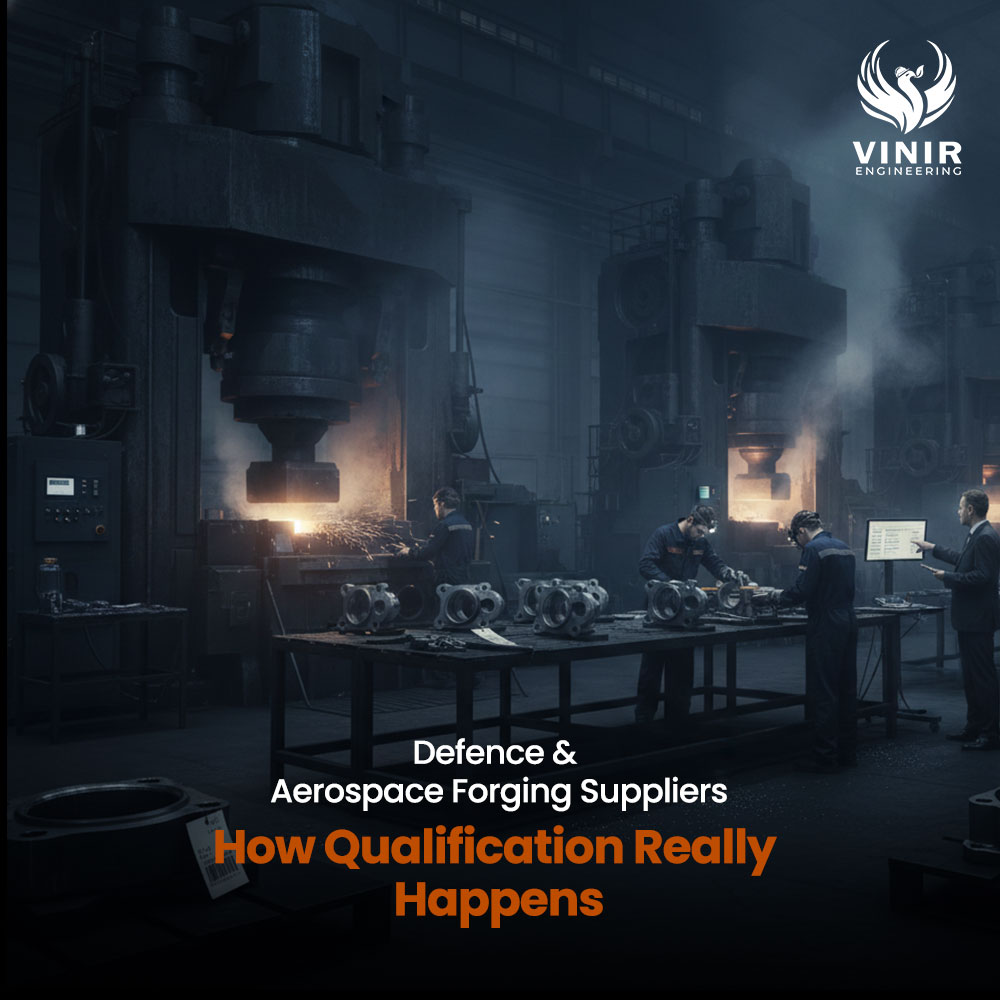
Defence & aerospace forging suppliers: how qualification really happens
Defence and aerospace supply chains are designed around risk elimination, not cost optimization.
Unlike commercial or automotive sourcing, buyers here assume:
- Programs will run for decades
- Volumes will fluctuate unpredictably
- Failures may have national, human, or strategic consequences
As a result, forging suppliers are qualified slowly, conservatively, and conditionally.
Step 1: Certifications Open the Door — They Don’t Secure Approval
Most defence and aerospace RFQs begin with a certification filter:
- AS9100D
- ISO 9001
- Customer or government approvals
- Special process accreditations (where applicable)
But certification only confirms that a system exists — not that it works under pressure.
Auditors immediately shift focus to execution depth, not paperwork presence.
Step 2: Engineering Ownership Is Evaluated Early
Buyers look for suppliers who own the forging process, not just operate equipment.
They assess:
- Die design responsibility and validation logic
- Defined deformation ratios and forging routes
- Control of grain flow orientation relative to load paths
- Evidence of process learning across part families
Suppliers who depend heavily on trial-and-error struggle to qualify.
Step 3: Material Pedigree Must Be Unbreakable
In defence and aerospace forging, material pedigree is sacred.
Qualification depends on:
- Heat-level traceability from raw stock to finished part
- Controlled segregation of material lots
- Verified linkage between MTCs, forging batches, machining lots, and inspection records
Any traceability gap is treated as a systemic risk, not a one-time error.
Step 4: Special Processes Are Audited Harder Than Forging
Heat treatment, NDT, and surface processes often receive more scrutiny than forging itself.
Auditors review:
- Process validation records
- Calibration and furnace uniformity
- Operator qualification and training
- Deviation handling and corrective actions
A supplier can lose qualification even if forging quality is excellent but special processes are weak.
Step 5: Low-Volume Stability Is a Hidden Requirement
Defence and aerospace programs rarely behave predictably.
Qualified suppliers must show:
- Ability to restart production after long gaps
- Preservation of process knowledge over time
- Stable quality in small, irregular batches
Facilities optimized only for high-volume flow often fail this test.
Step 6: Machining Integration Reduces Qualification Risk
Buyers increasingly prefer forge-to-finish suppliers because they reduce:
- Interface failures
- Documentation handoffs
- Accountability dilution
Integrated machining allows auditors to trace dimensional control, rework, and inspection decisions within a single quality system — lowering program risk.
Step 7: Audit Readiness Is Ongoing, Not Seasonal
Qualification does not end after approval.
Defence and aerospace suppliers face:
- Scheduled audits
- Unannounced audits
- Program-triggered reviews
Buyers quickly identify suppliers who prepare for audits versus those who operate audit-ready daily.
Common Reasons Suppliers Fail Qualification
Many capable forges are disqualified due to:
- Strong equipment, weak documentation discipline
- Inconsistent process execution across batches
- Inability to demonstrate repeatability
- Fragmented traceability between forging and machining
- Limited experience with customer or regulator audits
Failure is usually systemic, not technical.
How Vinir Aligns with Defence & Aerospace Qualification Models
Vinir operates with qualification-first thinking:
- Engineering-led forging routes
- Controlled material pedigree
- Integrated forge-to-finish execution
- Certification-aligned documentation workflows
- Continuous audit readiness
This approach allows Vinir to support defence and aerospace programs where qualification matters as much as capacity.
FAQ
How long does it take to qualify a forging supplier for aerospace?
Qualification can take several months to over a year, depending on audits, part criticality, and customer requirements.
Is AS9100 enough to supply aerospace forgings?
No. AS9100 is mandatory, but buyers also assess process maturity, traceability, and special process control.
Why are defence forging volumes so low?
Programs prioritize reliability and lifecycle control over scale, resulting in high-mix, low-volume production.
Can a supplier lose qualification?
Yes. Repeated NCRs, audit failures, or traceability gaps can result in suspension or removal.