
Wind Energy Forging Supplier for US Wind Farms: Tower Flanges and Bearing Rings
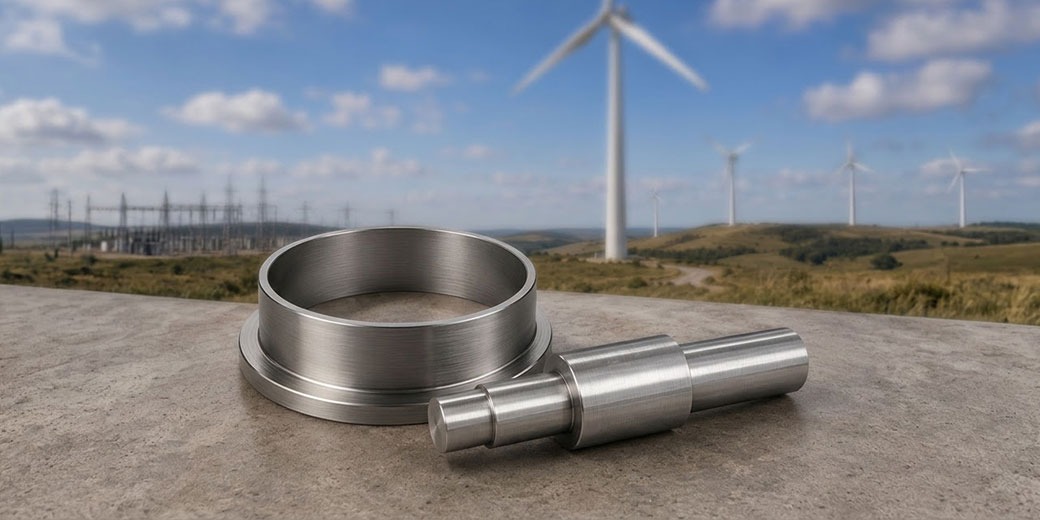
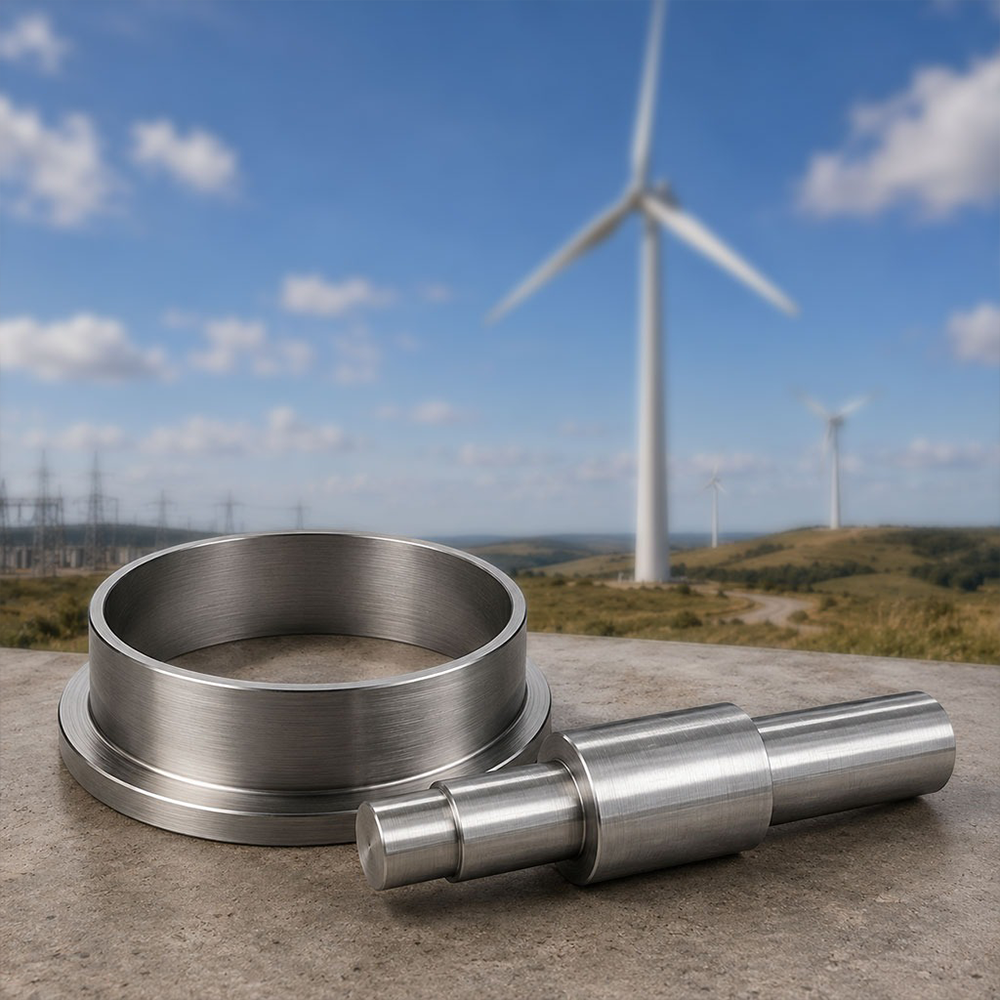
The United States wind energy sector is the second largest in the world — 150+ GW of installed capacity across 45 states, with the Biden-era permitting acceleration and the IRA (Inflation Reduction Act) production tax credits driving continued onshore expansion and an accelerating offshore wind programme. Tower flanges, main bearing rings, pitch and yaw bearing rings, and rotor hub structural forgings are the highest-volume forging categories in wind turbine manufacturing. Indian forging manufacturers with ring rolling capability, AS9100D certification, and established relationships with Vestas, Siemens Gamesa, GE Vernova, and Nordex supply chains are positioned to supply the US wind energy forging market at meaningful cost advantage.
At a Glance: Wind Energy Forging Requirements for US Programmes
| Component | Process | Material | Weight Range | Critical Requirement |
| Tower base flange | Ring rolling | S355NL / EN 10025-3 | 500–3,000 kg | Charpy at -20°C, flatness |
| Tower intermediate flanges | Ring rolling | S355NL | 300–1,500 kg | Same |
| Main bearing inner/outer rings | Ring rolling | 42CrMo4 / SAE 4140 | 500–5,000 kg | Hardness uniformity, UT |
| Pitch bearing rings | Ring rolling | 42CrMo4 | 200–1,500 kg | Same |
| Yaw bearing rings | Ring rolling | 42CrMo4 | 300–2,000 kg | Same |
| Rotor hub structural ring | Ring rolling / open die | S355NL or alloy steel | 1,000–8,000 kg | UT, magnetic particle |
| Nacelle bed plate structural | Open die | S355NL | 2,000–10,000 kg | Dimensional, UT |
The US Wind Energy Market: Scale and Forging Demand
Onshore Wind — The Established High-Volume Market
US onshore wind capacity additions have averaged 10–15 GW per year since 2020. Each onshore turbine in the 3–5 MW class the current standard for US land-based wind – requires approximately 8–12 ring-rolled forgings per turbine: 3–5 tower flanges, a main bearing inner and outer ring, and 2–4 pitch and yaw bearing rings.
At 3,000–4,000 new turbine installations per year, annual US onshore wind forging demand exceeds 30,000 individual ring-rolled forgings a sustained high-volume market.
Key turbine OEMs supplying the US onshore market:
- GE Vernova (Schenectady, NY): GE 3.x and 5.x MW platform. Historically the largest US market share for onshore wind
- Vestas (Aarhus, Denmark, US assembly in Pueblo CO): V150-4.5 MW and V162-6.2 MW for US onshore deployment
- Siemens Gamesa (Hamburg/Zamudio, nacelle assembly in Fort Madison IA): SG 5.0-145 and SG 6.6-170 for US onshore
- Nordex (Hamburg, nacelle assembly in US): N163/5.X platform
Offshore Wind -The Emerging High-Value Opportunity
US offshore wind is in early commercial development approximately 3 GW installed as of 2026 (Vineyard Wind, South Fork Wind, Revolution Wind) with 30+ GW in the pipeline across the Atlantic OCS, Gulf of Mexico, and Pacific coast. Offshore turbines are significantly larger than onshore – 12–15 MW machines using monopile, jacket, or floating foundations.
Offshore tower flange forgings are the highest unit value ring-rolled forgings in wind: A single tower flange for a 15 MW offshore turbine approximately Ø5,000mm outer diameter, 100mm wall thickness weighs 8,000–15,000 kg and has an individual value of $80,000–$200,000. Each offshore turbine uses 5–8 tower section flanges. At the scale of planned US offshore development (30+ GW requiring approximately 2,000–2,500 turbines), the cumulative tower flange forging demand is enormous.
Key US offshore wind developers and their turbine OEM selections:
- Vineyard Wind (Avangrid/Copenhagen Infrastructure Partners): Siemens Gamesa SG 14-236 DD (14 MW)
- Coastal Virginia Offshore Wind (Dominion Energy): Siemens Gamesa SG 14-236 DD
- New England Wind (Avangrid): Vestas V236-15 MW
- Empire Wind (Equinor/bp): Vestas V236-15 MW
Tower Flange Forgings: The Highest-Volume Wind Forging Category
What Tower Flanges Are and Why They Are Forged
Wind turbine towers the steel tubes that carry the nacelle and rotor at heights of 80–140 metres for onshore turbines are assembled from 3–5 steel tube sections. Each section interfaces with the adjacent section through a large-diameter flange ring that is bolted together. The tower base flange connects the tower to the foundation. The tower top flange connects to the yaw ring on the nacelle.
These flanges are ring-rolled rather than fabricated from plate for the same structural reason that applies to all flow around the ring that maximises resistance to the hoop stress from bolt preload and wind bending moments. A plate-cut ring has grain flow interrupted at the cut edges fatigue life under the cyclic wind loading is inferior to a ring-rolled equivalent.
Material- EN 10025-3 S355NL
S355NL is the standard material for wind tower flange forgings. The “N” denotes normalised condition, “L” denotes guaranteed low-temperature Charpy impact specifically at -20°C. Wind turbines in northern US states (Minnesota, the Dakotas, Montana) experience ambient temperatures below -20°C during winter operation the tower flange must maintain adequate toughness at these temperatures to prevent brittle fracture under the combined bolt preload and wind bending loads.
S355NL Charpy requirement: Minimum 27 J average at -20°C per EN 10025-3. This is verified on specimens from the same heat and heat treatment condition as the production flange. US wind turbine OEMs specify this requirement explicitly in their flange procurement specifications lots without -20°C Charpy results are rejected.
Why this matters for Indian suppliers: Standard structural steel NABL testing in India covers Charpy at ambient temperature. S355NL wind flange supply requires NABL-accredited Charpy testing at -20°C. Indian suppliers must confirm their NABL scope explicitly covers -20°C impact testing before quoting S355NL wind flange programmes.
Dimensional Requirements for Tower Flanges
Tower flange geometry is defined by the turbine OEM’s tower interface drawing. The critical dimensions:
Face flatness: The mating faces of adjacent tower section flanges must be flat within defined tolerances typically 1–2mm total across the full flange face diameter. Face flatness directly determines whether the bolted joint achieves uniform preload distribution around the circumference. A distorted flange face creates areas of low bolt load the fatigue failure initiation point under cyclic wind loading.
Perpendicularity of bore to face: The bore must be perpendicular to the face within tight tolerances eccentricity creates bending moments at the flange connection.
Bolt hole position: Bolt holes are drilled after ring rolling and initial machining. Bolt hole position relative to the bore centreline must be within the OEM’s positional tolerance misaligned bolt holes create asymmetric load distribution.
Outer diameter and inner diameter: Machined to OEM drawing dimensions. Ring rolling achieves the approximate shape final OD and bore dimensions are machined to tolerance.
Bearing Ring Forgings: The Most Technically Demanding Wind Forging Category
Main Bearing Rings
The main bearing the large-diameter rolling element bearing that connects the rotor hub to the nacelle main shaft carries the full rotor weight plus the aerodynamic thrust and bending moments from the rotor. In a direct drive turbine (Siemens Gamesa DD series, GE Haliade-X), the main bearing also carries the full generator rotor weight. A 5 MW direct drive main bearing inner or outer ring may weigh 3,000–8,000 kg.
Material: 42CrMo4 (SAE 4140) alloy steel, quenched and tempered. The through-hardened condition provides the combination of high surface hardness (after induction hardening of the raceway) and adequate core toughness. The through-hardened core toughness is the critical property a main bearing ring that fractures through the body (not just surface wear) creates an immediate turbine failure.
Heat treatment: Through-hardening (quench and temper) of the full ring to 28–34 HRC achieves the core properties. The raceway surface is subsequently induction-hardened to 58–62 HRC by the bearing manufacturer this is not performed at the forging stage. The forging manufacturer’s responsibility ends at through-hardened ring delivery with dimensional and material certification.
Hardness uniformity requirement: The through-hardened hardness must be uniform around the ring circumference and through the section. Hardness variation above 3 HRC between measurement points indicates uneven quench cooling a potential fatigue life reduction. Indian suppliers must demonstrate hardness uniformity by testing at multiple circumferential positions per ring.
UT requirements: 100% volumetric UT of all main bearing ring forgings before delivery. The acceptance criteria for bearing ring forgings are more stringent than general structural forgings the Hertzian contact stress in a main bearing raceway makes even small subsurface inclusions potential fatigue initiation sites.
Pitch and Yaw Bearing Rings
Pitch bearing rings — the large diameter bearings that allow each rotor blade to rotate around its long axis for pitch control are smaller than main bearings but more numerous. A three-blade turbine has three pitch bearings, each with an inner and outer ring. A 5 MW turbine pitch bearing ring weighs 200–800 kg per piece six rings per turbine.
Yaw bearing rings — the bearing that allows the nacelle to rotate on top of the tower to track wind direction is a single large-diameter bearing with one inner and one outer ring. For a 5 MW turbine, the yaw bearing ring weighs 500–2,000 kg per piece.
All bearing rings are produced in 42CrMo4 quenched and tempered, with the same hardness uniformity and UT requirements as main bearing rings, but at smaller diameter and weight.
The IRA and US Domestic Content Requirements
How the Inflation Reduction Act Affects Wind Forging Supply
The Inflation Reduction Act (2022) introduced domestic content bonus credits for wind energy projects additional production tax credit (PTC) or investment tax credit (ITC) for projects using US-manufactured components. The domestic content requirement for wind turbine components to qualify for the bonus credit:
- Steel and iron components: 100% US-manufactured
- Manufactured products (includes turbine components like nacelles, blades, towers): increasing percentage of total cost from 40% (2023) to 55% (2027+)
What this means for Indian forging supply: Tower flanges and bearing rings that are incorporated in US-assembled turbine towers and nacelles may or may not qualify as “US-manufactured” under IRA domestic content rules depending on where final machining and assembly occur. The IRA rules are complex and have been subject to Treasury Department guidance that US wind developers and turbine OEMs navigate with their legal and tax teams.
The practical current situation: Most major US wind turbine OEMs – GE Vernova, Vestas US, Siemens Gamesa US – have evaluated the IRA domestic content requirements and are pursuing US manufacturing of some components while continuing to source others internationally. Tower flanges and bearing rings are categories where the OEMs are evaluating the economics of US domestic forging versus continued import.
For Indian forging manufacturers, the IRA creates uncertainty but does not eliminate the market. Projects that do not claim domestic content bonus credits and many do not, because the economics favour the higher base credit over the domestic content bonus continue to source tower flanges and bearing rings internationally. And for the offshore wind market which is less affected by IRA domestic content rules in the near term Indian forging supply remains fully competitive.
GE Vernova Forging Supply Chain
GE Vernova’s wind turbine division producing the GE 3.x and 5.x MW onshore platform and the Haliade-X 12–14 MW offshore platform has one of the largest and most structured wind forging supply chains of any turbine OEM.
GE Vernova’s tower flange sourcing: GE Vernova qualifies tower flange suppliers through a structured supplier quality process requiring AS9100D (or equivalent quality system), dimensional capability demonstration, -20°C Charpy testing, and a qualification ring test programme. GE Vernova’s supply chain team has engaged Indian ring rolling manufacturers as potential sources for US market supply.
Haliade-X offshore tower flanges: The Haliade-X 12 MW (used at Vineyard Wind) uses tower flanges of approximately Ø5,500–6,000mm outer diameter at the upper limit of Indian ring rolling mill capability. Suppliers for Haliade-X tower flanges are among the most technically capable ring rolling manufacturers globally.
Vestas Wind Forging Supply Chain
Vestas the world’s largest wind turbine manufacturer has a global supply chain for tower flanges and bearing rings that includes suppliers from Europe, Asia, and increasingly India.
Vestas supplier qualification for tower flanges: Vestas applies a supplier quality audit (SQA) process requiring ISO 9001 or AS9100D, demonstration of ring rolling capability at the required diameter range, and a qualification flange programme with dimensional and material verification. Vestas US – which assembles V150 and V162 turbines for US onshore wind sources tower flanges through Vestas’ global supply chain.
Vestas bearing ring supply: Vestas uses bearing ring forgings sourced through its approved bearing ring suppliers typically the major European bearing manufacturers (SKF, Schaeffler, Thyssenkrupp Rothe Erde) who procure ring-rolled forgings from Indian and other international forge shops for their own bearing ring production programmes.
Qualification Process for US Wind Energy Forging Supply
What Wind OEMs Require
US wind energy forging qualification is less complex than aerospace or nuclear qualification but more demanding than standard industrial supply. Key requirements:
Quality system: ISO 9001 minimum, AS9100D preferred for US wind OEM supply. Wind turbine components are not aerospace but the consequence of a tower flange fatigue failure at 100-metre height is a total turbine loss and potential safety incident. OEMs treat structural forgings accordingly.
Ring rolling capability demonstration: The OEM’s engineering team or supply chain quality team visits the Indian ring rolling facility. They observe a ring rolling operation, review dimensional measurement capability (laser measurement of ring OD and face flatness is preferred), and confirm the mill’s diameter range covers the required programme.
Qualification ring programme: Produce 2–3 qualification rings in S355NL or 42CrMo4 at the required diameter and weight. Full material testing chemistry, tensile, Charpy at -20°C, hardness plus dimensional verification of all drawing dimensions.
NABL accreditation with -20°C Charpy: Confirmed at pre-qualification not discovered after the qualification rings are produced.
TPI: Bureau Veritas or DNV witness inspection of heat treatment and mechanical testing for production lots. Wind OEMs typically require TPI on every production lot not just on qualification forgings.
Lead time commitment: Wind project schedules are driven by installation vessel availability and grid connection windows. Tower flange and bearing ring delivery dates are on the critical path. Indian suppliers must commit to realistic lead times and demonstrate schedule reliability across the qualification programme before OEMs commit production volumes.
Vinir Engineering’s Wind Energy Forging Capability
Vinir Engineering’s ring rolling and forging capability for US wind energy programmes:
Ring rolling to Ø4,500mm: Wagner and Banning radial-axial ring rolling mill. Covers onshore wind tower flange diameters (Ø1,500–4,000mm for 3–5 MW turbines) and offshore turbine flanges up to Ø4,500mm. Main bearing, pitch bearing, and yaw bearing ring forgings across the full size range for 3–15 MW turbines.
S355NL tower flange production: EN 10025-3 S355NL in normalised condition. NABL-accredited Charpy impact testing at -20°C. Face flatness measurement by machining and verification. TPI by Bureau Veritas or DNV for OEM-specified inspection.
42CrMo4 bearing ring production: Quench and temper to 28–34 HRC. Hardness uniformity verification at multiple circumferential positions per ring. 100% UT before delivery. Induction hardening not performed bearing rings supplied in through-hardened condition for subsequent raceway hardening by the bearing manufacturer.
AS9100D: Full scope including ring rolling, heat treatment, NDT, and machining across all four manufacturing units.
Lead time: S355NL tower flanges 8–12 weeks to US port. 42CrMo4 bearing rings 10–14 weeks to US port. Both include ocean freight from Chennai to US East or Gulf Coast.
For US wind energy procurement teams and turbine OEM supply chain managers evaluating Indian ring rolling sources, Vinir provides a capability package within 5 working days.