
Forging Supplier for Global Valve Manufacturers: API 6D and API 600 Applications
Industrial valves — the flow control devices in oil and gas pipelines, petrochemical process systems, power generation, and water treatment are among the largest consumers of forged steel components in the industrial sector. API 6D (pipeline valves), API 600 (bolted bonnet steel gate valves), and ASME B16.34 govern the most widely used valve categories globally. Global valve manufacturers Emerson (Fisher), Flowserve (Durco, Kammer), IMI (CCI), Cameron (SLB), and Velan procure forged valve bodies, bonnets, and pressure housings from qualified API 20B certified forging manufacturers worldwide.
| Valve Type / Standard | Material | Size Range | Key OEM |
| Gate valve body — API 600 | A182 F316L, A105 equiv | 2″ – 24″ (DN50–DN600) | Emerson, Flowserve, IMI, Velan |
| Ball valve body — API 6D | 4130, A182 F316L, duplex 2205 | 2″ – 56″ (DN50–DN1400) | Cameron, Emerson, Neles (Metso) |
| Check valve body — API 6D | 4130, A182 F304L | 4″ – 48″ (DN100–DN1200) | Flowserve, Valvtechnologies |
| Control valve body — ASME B16.34 | 4130, Inconel 625, duplex 2507 | 1″ – 16″ (DN25–DN400) | Emerson Fisher, Samson, Metso |
| Subsea gate valve body — API 17D | Super duplex 2507, Inconel 625 | 2″ – 16″ (DN50–DN400) | TechnipFMC, Aker, OneSubsea |
Global valve manufacturers source forged valve bodies the primary pressure-containing component of a valve from qualified forging manufacturers under API 20B or equivalent quality programmes. The valve body forging is the highest-value single forging in any valve assembly, typically representing 40–60% of the total valve manufacturing cost. For a large-bore (DN600) carbon steel API 6D ball valve body, the rough-forged body weighs 500–1,500 kg and has a forging cost of $5,000–25,000.
Valve body forging geometry requires closed die forging for smaller sizes (DN50–DN200) and open die plus machining for larger sizes (DN300 and above). The internal flow path geometry cannot be forged directly the valve body is forged to approximately net external shape, then the internal flow path is machined. For high-pressure valves (Class 2500, 420 bar working pressure), the valve body wall thickness is substantial the forging must achieve mechanical properties throughout the thick section, requiring adequate section thickness reduction during forging.
For oil and gas pipeline service, API 6D governs ball valves, gate valves, plug valves, and check valves used in pipeline service. API 6D valves in sour gas service require valve body forgings compliant with NACE MR0175 maximum hardness 22 HRC for carbon and low alloy steel (4130M). For subsea valves, API 17D applies governing subsea tree gate valves. API 17D valve body forgings require API 20B PSL 3 or PSL 4.
The global valve market valued at approximately $80 billion annually is served by a mix of large multinational valve manufacturers and regional specialists. Indian valve manufacturers are already significant global valve suppliers L&T Valves and BHEL produce API 6D and API 600 valves for oil and gas globally. Indian forging manufacturers supplying valve body forgings access both the global valve OEM market and the domestic Indian valve manufacturing market.
Vinir Engineering — Capability for this Market
- API 20B PSL 1–3.
- Valve body forgings: 4130 and 4130M alloy steel (NACE MR0175 sour service), A182 F316L austenitic stainless, A182 F51 duplex 2205, A182 F53 super duplex 2507, Inconel 625.
- Closed die valve body forgings 1–500 kg (DN50–DN250).
- Open die valve body rough forgings 500–5,000 kg (DN300–DN600+).
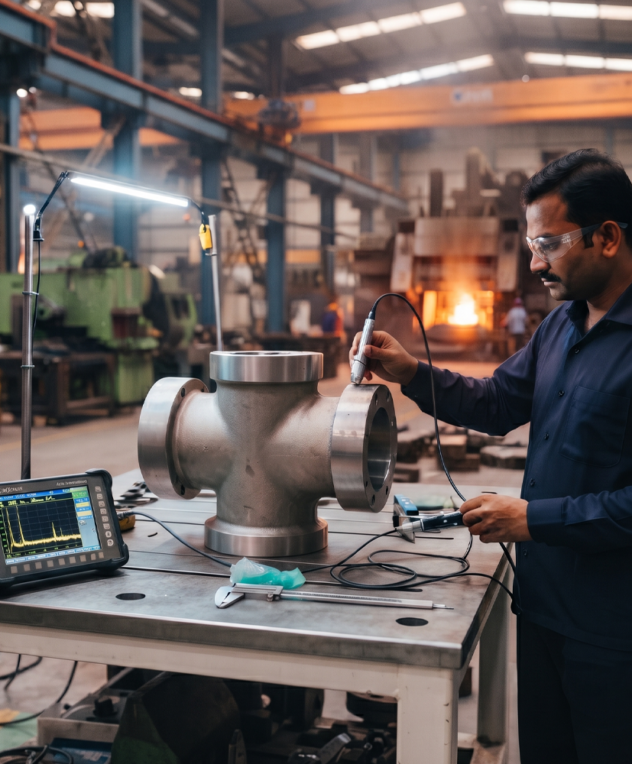
- 100% UT per ASTM A388.
- PMI on all CRA forgings.
- NACE MR0175 hardness verification.
- API 6D and API 600 material certification format.
- TPI by Bureau Veritas, Intertek, and SGS.