
Radial Forging Tolerances and Surface Finish: How Near-Net Forging Can Reduce Machining

One of radial forging’s most commercially interesting characteristics is that it sits between rough heavy forging and precision finished machining.
It can produce geometry substantially closer to the finished component than a simple oversized billet, yet it remains a forging process and should not be expected to replace precision machining for highly toleranced interfaces.
Understanding this distinction is essential for procurement teams evaluating total component cost.
What Does “Near-Net Shape” Actually Mean?
Near-net shape does not mean finished shape.
It means that the forging is deliberately designed so that the material envelope follows the final geometry closely enough to reduce downstream material removal.
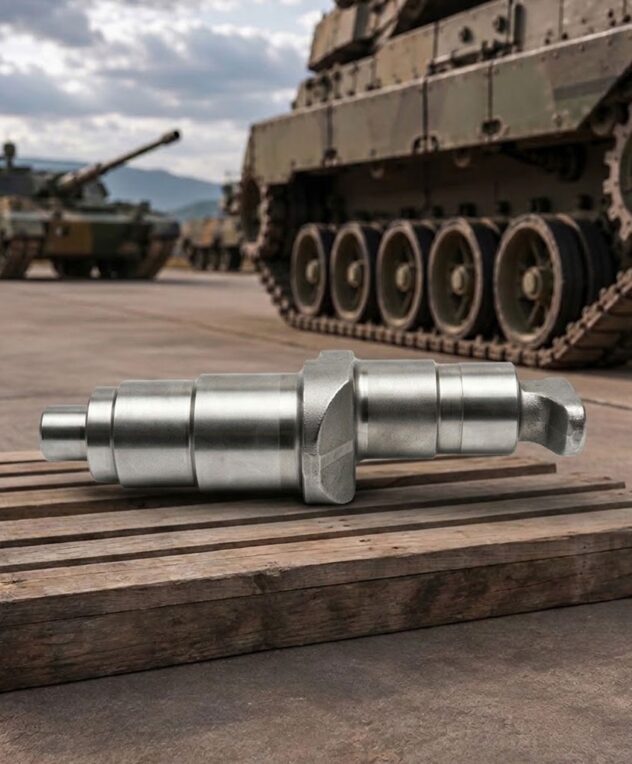
For a stepped shaft, this may mean forging three distinct diameter regions instead of buying a constant-diameter bar at the largest dimension.
The machine shop then removes a controlled amount of stock from each region rather than turning away an enormous quantity of excess material.
Radial Forging Can Be Surprisingly Precise
Radial forging was developed specifically to provide controlled manufacture of rods, tubes and profiled axial components.
A classic technical study described the process as capable of precision forging rods and tubes and reported material utilisation above 95% in favourable applications.
Later process-modelling research also notes advantages including good surface finish, tight geometric tolerance, high production rates and significant material savings.
These statements should be understood in context: actual tolerance depends on machine size, material, temperature, component geometry and whether the process is hot or cold.
Why Hot Forgings Still Need Allowance
Hot material expands.
When the forging cools, dimensions change.
Scale can form on steel surfaces, and long components can distort during cooling or subsequent heat treatment.
A designer therefore cannot simply specify finished-machine dimensions as the hot-forging target.
The manufacturing engineer adds enough allowance to ensure every final surface remains clean-up capable after forging and heat treatment.
Surface Finish and Die Contact
Radial forging repeatedly exposes the surface to die contact.
Compared with rough conventional breakdown forging, the high frequency and controlled nature of this contact can produce relatively consistent external geometry.
However, hot scale, die wear, lubrication and material behaviour still affect surface condition.
Final bearing surfaces, seal diameters and aerospace interfaces remain machining or grinding operations.
The Cost Relationship Between Forging and Machining
The economic optimisation is not “minimise forging cost.”
It is “minimise total finished-component cost.”
A cheaper cylindrical forging may be far more expensive overall if the machine shop must remove hundreds of kilograms of material.
A slightly more sophisticated radial-forged stepped preform can reduce machining time and raw-material input enough to produce a lower total cost.
Example Cost Logic
| Route | Raw material | Forging complexity | Machining stock | Typical commercial effect |
| Machine from bar | Highest | None/minimal | Very high | Simple sourcing, high material waste |
| Simple open-die blank | High | Low | High | Good low-volume flexibility |
| Stepped radial preform | Lower | Moderate | Lower | Potentially lower total finished cost |
| Precision closed die | Low | Higher tooling | Low | Attractive at suitable volume/geometry |
Straightness and Concentricity
Long components add another challenge.
A diameter can be correct locally while the shaft itself is not straight enough for economical machining.
Radial forging process design therefore needs to control not only diameter but axial behaviour.
Heat treatment can subsequently introduce distortion, so straightness must be managed throughout the entire manufacturing route.
Interesting Fact: Radial Forging Was Designed for Automation
Published work on GFM radial forging describes four dies operating around the workpiece, with manipulators providing axial feed and rotation and enabling a highly automated process.
That automation is one reason radial forging can produce strong repeatability across long sections.
It also distinguishes the process from the image many buyers have of heavy forging as almost entirely operator-controlled manipulation.