
Radial Forging for Aerospace Shafts: Grain Flow, Fatigue Performance and AS9100D Supply Requirements
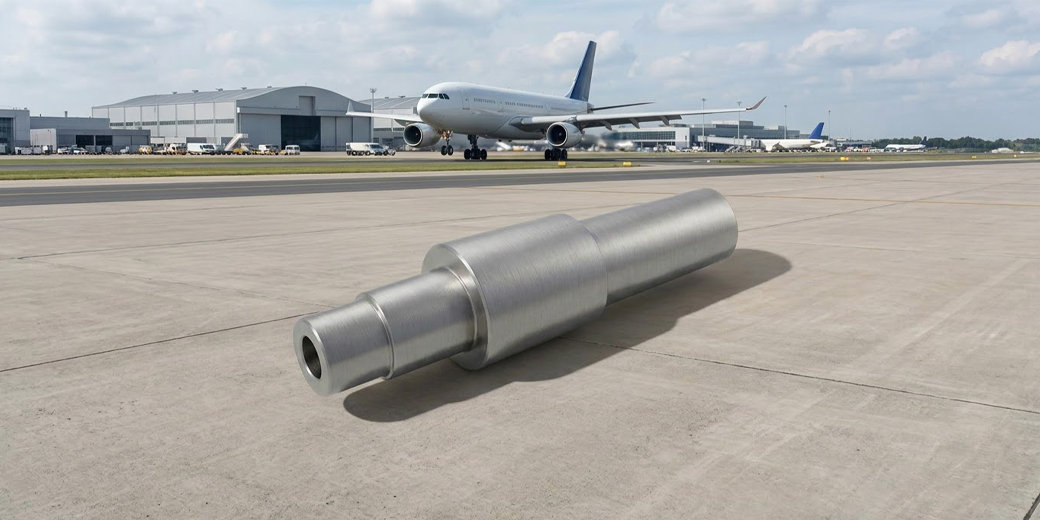
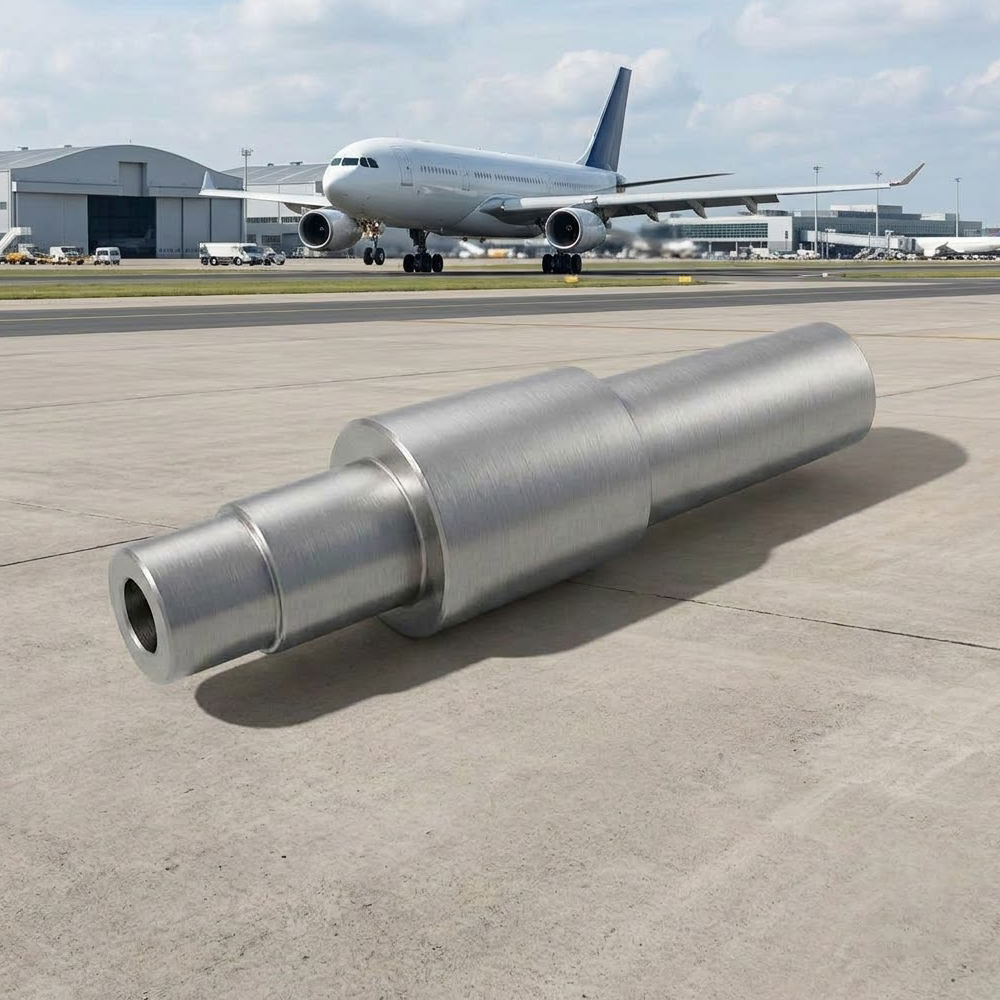
Aerospace shafts operate in environments where weight must be minimised, rotational accuracy must be maintained and fatigue failure may be unacceptable. They can transmit torque, connect rotating assemblies, support engine or transmission systems and operate under combinations of bending, torsion, vibration and temperature.
The finished component may appear geometrically simple, but the manufacturing problem is not.
A precision-machined shaft can satisfy every dimensional requirement and still possess an unfavourable metallurgical history if its starting material, deformation, heat treatment or inspection were inadequately controlled.
This is why forging remains relevant even in an era of extremely capable CNC machining.
Why Aerospace Engineers Care About the Material Before the Machine Shop
Machining defines geometry by removing material.
Forging changes geometry by plastically moving material.
That distinction is fundamental.
When a shaft is machined from oversized stock, the original grain-flow pattern remains largely inherited from the stock manufacturing route. Forging intentionally introduces additional thermomechanical working and can develop longitudinal material flow along the shaft.
Shimadzu’s examination of a radial-forged hollow motor shaft describes this directional microstructure as fiber flow and notes that forging generates directional material structure associated with improved mechanical properties along the flow direction.
For aerospace applications, that structural history can matter in fatigue-sensitive regions.
Fatigue Is Usually More Complicated Than a Tensile-Test Number
Aerospace shafts may operate for enormous numbers of cycles without ever approaching ultimate tensile strength during normal use.
The main concern can instead be fatigue.
Fatigue cracks frequently begin at locations where local stress is amplified: shoulders, grooves, splines, fillets, threads, surface defects or material discontinuities.
The implication is important.
Selecting a steel with a very high tensile-strength certificate does not automatically produce a long-fatigue-life shaft. Forging, heat treatment, surface finish, geometry and inspection must function as one system.
How Radial Forging Develops a Shaft Preform
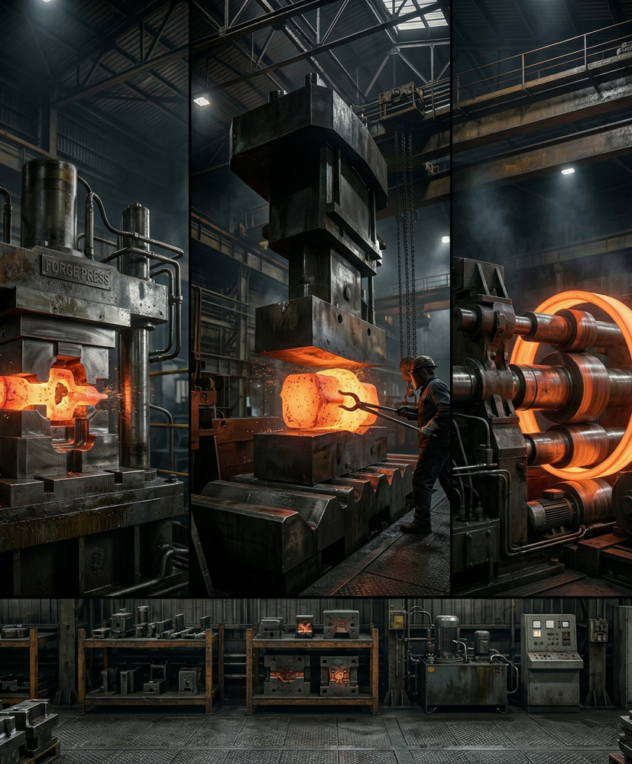
In radial forging, multiple dies repeatedly compress the workpiece while it rotates and moves axially.
This allows different diameters to be created along its length.
Academic descriptions of radial forging consistently identify shafts, stepped shafts, axles and tubes among its principal applications, and research has shown that machine variables such as die geometry, reduction and axial feed influence strain distribution through the workpiece.
That is why a radial-forged shaft should not be thought of as merely a bar that has been made smaller.
The objective is controlled deformation throughout the intended section.
What Changes From Industrial to Aerospace Supply?
The fundamental forging physics do not change because a shaft is destined for an aircraft.
The quality architecture does.
Aerospace programmes may require approved raw material, controlled drawing revisions, specific manufacturing plans, defined special processes, detailed NDT procedures, first-article inspection and long-term traceability.
AS9100D establishes the broader quality-management framework, while customer specifications and AMS standards define additional technical requirements.
Heat treatment commonly introduces another layer of control through AMS2750 pyrometry requirements. SAE’s current AMS2750H revision defines controls covering sensors, instrumentation, thermal-processing equipment, system accuracy and furnace temperature uniformity.
Industrial vs Aerospace Shaft Supply
| Area | General industrial shaft | Critical aerospace shaft |
| Material purchase | Commercial material specification may be sufficient | Approved source and exact AMS/customer specification may apply |
| Process changes | Often managed internally | Configuration/customer approval may be required |
| Heat treatment | Property-focused | Property + approved special-process controls |
| NDT | Project dependent | Frequently tightly specified and documented |
| Inspection | Final dimensions | Full drawing characteristic verification may apply |
| Traceability | Batch/heat level | Can extend to individual serialized components |
| Documentation | MTC + inspection | FAIR, process records, NDT, HT and complete traceability package |
Material Choice: Steel, Titanium or Nickel Alloy?
No single material defines an aerospace shaft.
High-strength steels can provide exceptional load capacity and wear resistance. Titanium offers high specific strength where mass reduction is valuable. Nickel alloys become relevant where the component needs to retain mechanical capability at elevated temperatures.
The manufacturing route must therefore change with the alloy.
A radial forging programme suitable for a low-alloy steel cannot simply be copied onto titanium or Inconel by changing furnace temperature.
Each alloy has a different flow-stress response, microstructural sensitivity and heat-treatment requirement.
Why Near-Net Forging Matters More as Alloy Cost Rises
Aerospace material is expensive not only because of alloy chemistry but because of melt practice, testing, certification and traceability.
If a finished shaft weighs 100 kg but requires a 250 kg starting bar because one local section has a large diameter, the buyer effectively purchases 150 kg of certified premium material only to remove much of it during machining.
A stepped radial-forged preform can reduce that buy-to-finish ratio.
Research into radial forging has historically reported material utilisation above 95% for certain precision-forged rod and tube applications, though actual aerospace utilisation depends entirely on geometry and machining allowance.
The important commercial idea is not the headline percentage but the ability to move metal before paying to machine it away.
Inspectability Is Part of Manufacturability
A shaft must not only be forgeable; it must also be inspectable.
Large grains can make ultrasonic examination more difficult. Complex diameter transitions can limit probe access. Rough surfaces can reduce inspection sensitivity.
Manufacturing engineering should therefore consider where and when NDT will occur.
Sometimes preliminary machining is useful before UT because it provides a more consistent surface. Other examinations may be performed after final heat treatment.
A supplier that plans forging and NDT independently can create avoidable inspection problems.