
Custom Forging Supplier for USA from India: Forge-to-Finish Components for Critical Industries
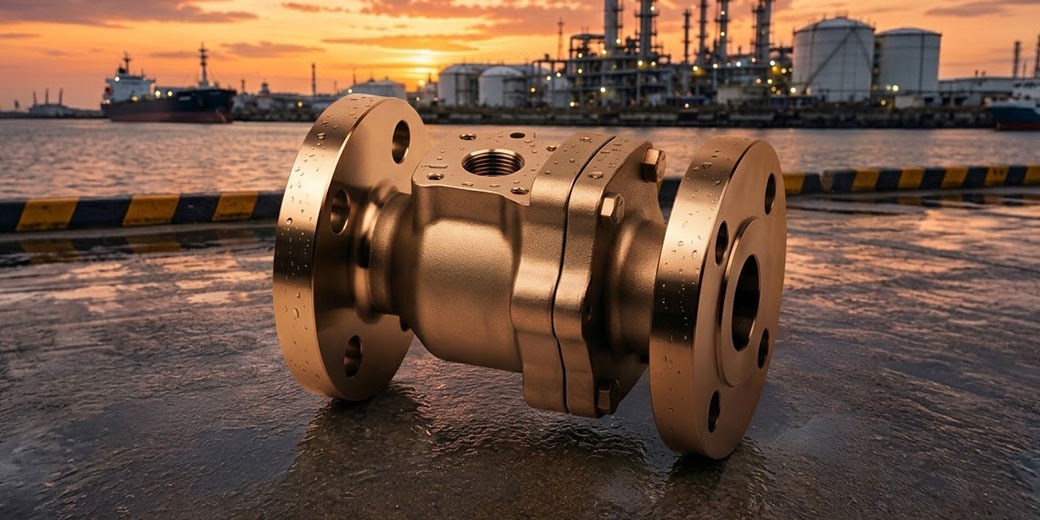
The phrase “custom forging supplier” covers a much wider requirement than producing a hot-shaped piece of metal. US OEMs increasingly expect a supplier to interpret drawings, select a viable forging route, control material and heat treatment, perform inspection, manage machining allowances, deliver final dimensions and provide a complete documentation package.
That expectation is especially strong in critical industries because every additional handoff creates another interface: material moves to a heat treater, then to an NDT house, then to a machine shop, with separate schedules and separate quality records. A forge-to-finish supplier reduces those interfaces by managing the manufacturing chain as one controlled system.
For India-to-USA sourcing, the model can be commercially powerful. Lower-volume custom components often carry high development cost in the United States, while long-distance outsourcing becomes risky if the buyer must coordinate four or five independent Indian vendors. The ideal sourcing model combines India’s manufacturing economics with single-source technical ownership.
What “Custom Forging” Should Mean in a US RFQ
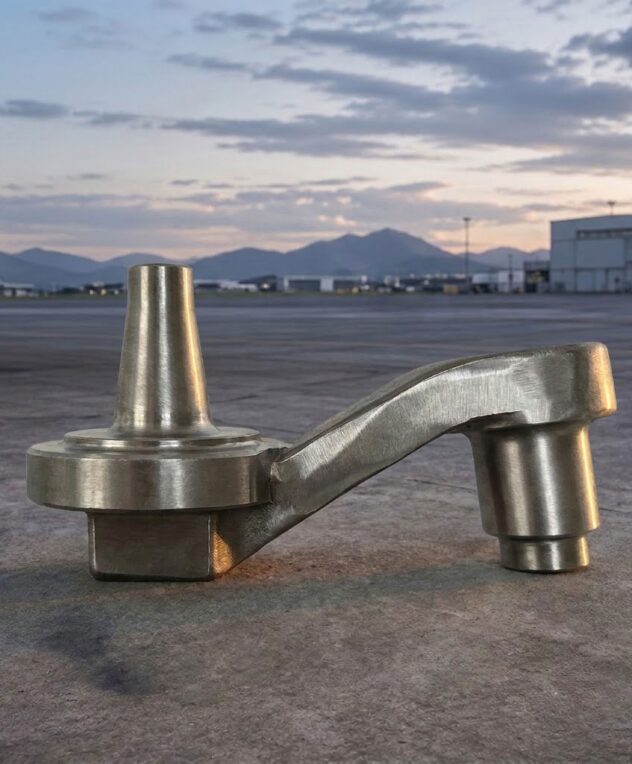
A true custom forging program starts with the finished component requirement, not with a catalog forging. The supplier should review geometry, material, service conditions, quantity, critical features and required standards before proposing open die, closed die, ring rolling, radial forging or a hybrid route.
The same finished shape can often be produced through different routes, but the trade-offs are different. Closed die may minimize machining for a repeatable geometry; open die may be more economical for a large low-volume part; ring rolling may be ideal for annular geometry; radial forging may suit shafts and tubular forms. A supplier that offers only one process may unconsciously force every RFQ into that process.
The Forge-to-Finish Model
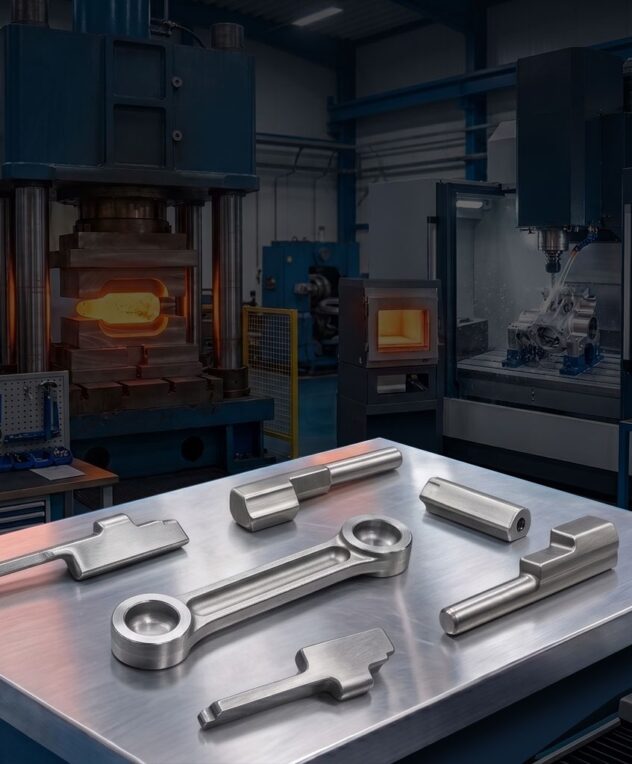
Forge-to-finish means that the manufacturing responsibility extends from process planning through a machined and inspected component. The exact boundary varies by contract, but an integrated route typically includes incoming material verification, cutting, heating, forging, heat treatment, rough machining, NDT, final machining, dimensional inspection, marking, preservation and documentation.
The commercial advantage is not merely convenience. When the same organization owns the process chain, manufacturing decisions can be optimized globally. A forging engineer can add stock only where machining needs it. Heat-treatment distortion can be considered before fixture design. NDT surfaces can be built into the machining sequence. A dimensional issue can be traced back to the forging or thermal step instead of becoming a vendor dispute.
Materials for Critical Custom Forgings
US custom-forging demand spans carbon steels, low-alloy steels, stainless steels, duplex and super duplex, nickel alloys such as Inconel, titanium and aluminium. Material choice is driven by corrosion, strength, toughness, temperature, fatigue, weight and code requirements rather than by forging convenience.
The supplier must protect material identity through the entire route. Heat number transfer, positive material identification where required, segregation, traceable test coupons and controlled re-marking become particularly important when multiple alloys are processed in the same facility.
For high-value alloys, yield management also matters. The chosen forging route should minimize discard and machining waste without compromising grain flow or inspection accessibility. That balance can materially change total landed cost.
Engineering Review Before Quotation
The best custom-forging RFQs are collaborative. Before quoting, the supplier should flag features that drive unnecessary cost or manufacturing risk: extremely tight tolerances on as-forged surfaces, insufficient machining stock, abrupt section changes, inaccessible NDT zones, unrealistic corner radii, or material conditions that conflict with the requested mechanical properties.
A design-for-forging review does not mean changing the buyer’s functional requirement. It means translating the finished design into a manufacturable envelope and identifying where the drawing, specification and inspection plan need clarification before production starts.
Quality Documentation US Buyers Typically Expect
The documentation package varies by industry, but a custom forging order may include the material test report, heat-treatment record, mechanical test results, NDT reports, dimensional inspection, calibration references, process traveler, nonconformance dispositions and certificate of conformity. Aerospace and nuclear programs may add far more prescriptive records.
The documentation structure should be agreed at purchase order stage. A component can meet every physical requirement yet remain commercially unacceptable if the heat-treatment chart, inspector qualification or traceability record required by the PO is missing.
Total Landed Cost: Look Beyond Piece Price
For a US buyer, the economic comparison should include tooling and development, raw material yield, machining hours, inspection, documentation, packaging, freight, customs handling, inventory buffer and the internal cost of supplier coordination. A low forging price can become expensive if it creates excess machining stock or requires multiple offshore subcontractors.
Conversely, a more integrated India source can justify longer physical transit because process steps are consolidated and the buyer receives a more complete component. The relevant metric is total landed, usable component cost – not the ex-works price of the forging.
Where Custom Forging from India Makes the Most Sense
- High-mix programs with many part numbers and modest annual quantities
- Legacy or replacement components where original supply has become expensive
- Critical components that benefit from integrated forging and machining
- Materials with high buy-to-fly or buy-to-finish cost
- Programs requiring engineering collaboration rather than catalog parts
- Supplier-transition projects where the buyer wants a second qualified source
These conditions align closely with Vinir’s stated manufacturing model: high mix
What US Buyers Should Verify Before Approving a Supplier
| Buyer Question | What to Verify | Why It Matters |
Can the supplier choose among processes? | Open die, closed die, ring rolling, radial forging and machining options. | Prevents a process-limited supplier from forcing an inefficient route. |
Is material traceability continuous? | Heat identity, transfer method, MTR linkage and segregation controls. | Critical for alloy verification and audit readiness. |
| Who owns process integration? | One accountable manufacturing plan across forging, heat treatment, NDT and machining. | Reduces interface risk and schedule disputes. |
| Can engineering challenge the RFQ constructively? | DFM feedback, machining allowance review and inspection accessibility. | Early engineering changes cost far less than late rework. |
| What is included in landed scope? | Tooling, testing, machining, packing, documentation and shipping terms. | Allows a true apples-to-apples supplier comparison. |
Frequently Asked Questions
1.What is a custom forging supplier?
2.What does forge-to-finish mean?
3.Which forging process is best for a custom component?
4.How can a US buyer compare Indian custom forging suppliers?
5.Can one supplier handle both forging and machining?
6.What should be included in a custom forging RFQ?
Why Vinir Engineering Fits This Requirement
Vinir is positioned around the custom-forging problem itself: multiple forging processes, a 5 kg to 15,000 kg stated weight range, low batch quantities, and integration of forging, heat treatment and machining across dedicated manufacturing units. That combination is more relevant to a US critical-component buyer than a single headline capacity number.